Home Blog Page 780

B-36 Peacemaker: The Cold War’s Giant Bomber

0
Image Source: Bing Image. License: All Creative Commons

The Convair B-36 Peacemaker has been regarded as one of the most amazing and awe-inspiring works of art in the whole history of the world, maybe even one of the most gigantic ones, a monument to the desperation, brilliance, and strategic need of the Cold War era’s very first days. The saga of this juggernaut is traced back to WW2, when US military planners feared that Hitler’s army might take over the UK, thereby isolating the US from the nearby bases for strategic bombing. To solve the problem of hitting targets on the other side of the oceans from their own land, the U.S. Army Air Forces had to set out an extremely difficult and almost unachievable list of requirements: a range of 10,000 miles, a maximum altitude of 40,000 feet, and the ability to carry huge bombs all over the earth.

Image Source: Bing Image. License: All Creative Commons

Consolidated Vultee, which was later renamed Convair, won the contract in late 1941, outcompeting Boeing. Construction of the B-36 was not simple. The original specifications pushed the technology available at the time to its limits, necessitating numerous redesigns. Its 230-foot wingspan, a record-high behemoth still standing today on any combat aircraft, is the broadest ever. The wings were so wide that engineers created crawlspaces inside them so that the crew could maintain the engines while in flight—a feature that still fascinates airplane enthusiasts.

Image Source: Bing Image. License: All Creative Commons

The motor of the Peacemaker was really amazing. At first, the company had chosen six radial engine Pratt & Whitney R-4360 Wasp Major in a “pusher” way, as the propellers were at the rear. After that, the machines with four General Electric J47 jet engines hung under the wings were talked about with the help of the phrase “six turning, four burning” got a new meaning, as six propellers were turning and four jets were burning.

Image Source: Bing Image. License: All Creative Commons

The combination allowed the B-36 to cruise around 200 miles per hour and reach speeds over 400 miles per hour at altitude—slow for a jet, but impressive for an aircraft of such size. The B-36J could fly nearly 40,000 feet with a maximum takeoff weight of 410,000 pounds, figures that sound impressive even today.

Image Source: Bing Image. License: All Creative Commons

The B-36 entered service with the newly established Strategic Air Command in 1948 when tensions against the Soviet Union were escalating. The main use of the B-36 was nuclear deterrence. With a load of up to 86,000 pounds of bombs—four times the B-29’s—the Peacemaker could ship America’s biggest thermonuclear and atomic bombs to remote places without interruption.

Image Source: Bing Image. License: All Creative Commons

Versions were equipped for reconnaissance, while others, like the NB-36H, even tested out nuclear-powered flight concepts. Its range and length made it nearly impossible to penetrate for early air defenses, at least during the first few years of the aircraft’s operation.

Image Source: Bing Image. License: All Creative Commons

Life on board was tough. Crews of 15 to 22 men spent dozens of hours in the air, often over two days at a time, in sometimes unpressurized cockpits far above the surface. The engines were finicky, maintenance was complex, and the plane had to be constantly monitored. Early variants could be outfitted with as many as sixteen remotely operated 20mm cannons for defense, although these were reduced later to save weight and improve performance now that jet-fighter opponents were becoming a greater threat.

Image Source: Bing Image. License: All Creative Commons

Despite having formidable capabilities, the B-36 never went to war. Its purpose was deterrence—a visible, physical demonstration of American power. The aircraft was mocked as the “Billion Dollar Boondoggle,” and some questioned whether money would have been better spent on newer bombers or Navy ships.

Image Source: Bing Image. License: All Creative Commons

But for more than a decade, the Peacemaker was the staple of the U.S. nuclear arsenal, filling the gap between the World War II piston-engine bombers and the jet-powered B-52 Stratofortress that would ultimately supplant it. As jet technology advanced, the B-36’s slow speed and maintenance demands highlighted the limits of its design.

Image Source: Bing Image. License: All Creative Commons

Production was halted in 1954, with a total of 384 aircraft being completed. In 1958, upon the arrival of the B-52, the fleet was retired. The last B-36 flight was on April 30, 1959, from Davis-Monthan Air Force Base to the National Museum of the United States Air Force, where it still is—a living memory of the people who flew and maintained the aircraft.

Image Source: Bing Image. License: All Creative Commons

The heritage of the B-36 is massive. It deeply challenged the limits of aerospace engineering, had a strong impact on the design of bombers of the following decades, and was a great contributor to the nuclear strategy of the Cold War. Its enormous size, ten engines, and peculiar shape made it one of the most recognizable aerial vehicles—an embodiment of American might, a depiction of both the people’s fear and their reassurance, during its time. At present, there are only a handful of B-36s left in museums, quiet doves of peace, but at the same time, ghosts of war, flying nearly a football field length, was the delicate balance of power that dominated the earth.

The Reality of Russian Tank Losses in Modern Wars

0
Image Source: Bing Image. License: All Creative Commons

The bears of Russian tanks were, for a long time, the image of a brutally strong force in the battles—universally, these myths of tanks made of iron and steel going wild through the European forests and Middle East mountains were typical stories you could come across in any pub. Nevertheless, in the latest wars, especially in Ukraine and Syria, these very vehicles— notably the T-72 with all its various modifications—have become a distinctly different character: they are visually the most wrecked postmodern tank series globally.

Image Source: Bing Image. License: All Creative Commons

Conceived for Offense, Not Stamina

The T-72 was fundamentally designed based on Soviet concepts and ideas during the Cold War period. Unlike the majority of the West’s main battle tanks, the T-72 was not that versatile or flexible. It was the tank that was supposed to be in the first line of a breakthrough offensive operation, tearing apart enemy trenches and making a way for the rest of the troops.

Image Source: Bing Image. License: All Creative Commons

To reduce the cost and increase the speed of production, the tank used an autoloader, which made it possible to have a smaller crew of three people, and the tank’s elegant design kept it at a low level on the battlefield. A retired T-72 commander once summarized it as: “versatile, fast, easy to use, and an inexpensive killing machine.” This philosophy was still alive in the later Russian tanks, which kept borrowing a lot from the basic design of the T-72. However, while getting periodic updates of armor and firepower, the fundamental design was never really changed in such a way as to be able to keep up with the new combat requirements.

Image Source: Bing Image. License: All Creative Commons

Harsh Lessons in Ukraine, Syria, and Iraq

The past ten years have been harsh for the T-72 family. Ukraine alone has lost close to 2,000 T-72s, T-80s, and T-90s in more than a year of combat, frequently against Ukrainian troops running older T-64s supported by Western anti-tank missiles. Images and footage of Russian tanks charred beyond recognition have become so ubiquitous that they’re all but a dark standard of the conflict.

Image Source: Bing Image. License: All Creative Commons

Syria shares the same tale. The Syrian Arab Army lost nearly 1,000 T-72s in under a decade, and most of them were destroyed by barely armed insurgents. American, Iraqi, and Saudi Abrams tanks in similar situations suffered greatly fewer losses throughout an extended timespan. Even Russian accounts concur on the magnitude of these defeats.

Image Source: Bing Image. License: All Creative Commons

A Design That Punishes Its Crews

One of the largest design failures in Russian tanks is the storage of ammunition. In the T-72 and its variants, the shells are stored in a carousel loader under the turret, directly beneath the crew. If an opposing round penetrates the armor, the ammunition will explode on the spot, frequently sending the turret flying into the air in a now-notorious “jack-in-the-box” movement.

Image Source: Bing Image. License: All Creative Commons

Western tanks, such as the Abrams or Leopard, in contrast, keep their ammunition within armor compartments with blow-out panels, so if the ammo cooks off, the explosion vents away from the crew. That detail has saved thousands of Western tankers—and killed many Russian crews.

Image Source: Bing Image. License: All Creative Commons

Training, Leadership, and the Human Element

Hardware is only half the battle. The skill and discipline of the crew can make or break a tank’s effectiveness. In Iraq, poorly trained crews in T-72s were no match for Western forces. In Ukraine and Syria, similar issues have surfaced: inexperienced crews, poor coordination, and panic under fire.

Image Source: Bing Image. License: All Creative Commons

One of the most popular viral clips came from Ukraine and depicted a highly skilled Bradley Fighting Vehicle crew taking out Russia’s best-of-the-line T-90M with a round into the weakly armored rear. The Russian crew didn’t even fight hard, leaving their tank to be finished off by a drone. Military analysts maintain that a lot of Russia’s most skilled tank crews were lost in early fighting, replaced by inexperienced troops inadequately trained for high-intensity battles.

Image Source: Bing Image. License: All Creative Commons

Western Armor Compared

Western tanks such as the Leopard and Abrams typically weigh more, are more expensive, and have much better optics, armor, and survivability. Even the Bradley—technically an infantry fighting vehicle, not a tank—is a repeat destroyer of Russian armor when operated by experienced crews with modern ammunition and fire control systems.

Image Source: Bing Image. License: All Creative Commons

The Bigger Lesson

The limitation of Russian tank armies is not only due to their outdated designs. It’s about the combination of intrinsic vulnerabilities, inadequately trained crews, and a modern battlefield that is full of drones, guided missiles, and precision munitions.

Image Source: Bing Image. License: All Creative Commons

The T-72 was designed for a type of warfare that does not now exist. In modern conflict, numbers are not enough to secure victory. Survivability, flexibility, and the ability of the crew count much more, and the experience of Russian armor in Syria and Ukraine confirms it.

More related images you may be interested in:

Image Source: Bing Image. License: All Creative Commons

A-12 Avenger II: The Navy’s Failed Stealth Project

0
Image Source: Bing Image. License: All Creative Commons

The A-12 Avenger II was meant to be the Navy’s next generation—an undercover, carrier-borne bomber that would bypass sophisticated enemy safeguards and deliver impact far inside enemy land. By the end of the 1980s, the Navy’s trusty A-6 Intruder was starting to age noticeably, and the intensifying threats of the Cold War era necessitated a plane that could handle a radar-guided missile and an integrated air defense system-dominated world.

Image Source: Bing Image. License: All Creative Commons

That challenge spawned the Advanced Tactical Aircraft (ATA) program. The mission: create a next-generation carrier-capable stealth attack aircraft.

Image Source: Bing Image. License: All Creative Commons

The Air Force had already amazed the world with the F-117 Nighthawk, and the Navy desired its ace of stealth. In 1988, McDonnell Douglas and General Dynamics were given the contract, and the A-12 Avenger II idea took to the skies, at least on paper.

Image Source: Bing Image. License: All Creative Commons

The shape stood out as sharp and daring: a triangle-like wing they called “Flying Dorito.” It held weapons inside to stay off radar, was made with new, strong materials, and had paint that hid it from radar. Inside were two crew members, a top new flight tech, ground-reading radar, and war electronics gear. It could fight far out, over 900 sea miles away, much more than what came before it.

Image Source: Bing Image. License: All Creative Commons

But translating that promise into a functional aircraft turned out to be much more difficult than anticipated. Combining stealth needs with the special stresses of carrier takeoffs and landings turned into a serious engineering problem. The weight of the plane ballooned beyond early estimates, threatening to make it unsafe for carrier use. Experimental materials and production methods added more delays and technical nuisances.

Image Source: Bing Image. License: All Creative Commons

The secrecy of the program did not aid it. As a secret “black” project, it was exempt from usual oversight, so Congress and the Pentagon were not fully aware of the extent of the problems. The contractors, wanting to maintain confidence at high levels, minimized problems. Navy officials, not wanting to risk killing the program, did the same.

Image Source: Bing Image. License: All Creative Commons

Its costs skyrocketed. The initial $4.8 billion development cost ballooned to close to $11 billion with an eye-popping estimated cost of more than $165 million per plane. In early 1991, the A-12 was behind schedule by 18 months, billions of dollars over budget, and still not flight-ready.

Image Source: Bing Image. License: All Creative Commons

Secretary of Defense Dick Cheney eventually canceled it in January of that year, bringing to an end what proved to be the largest Pentagon contract cancellation in history. The sole A-12 ever to exist was a full-scale mockup.

Image Source: Bing Image. License: All Creative Commons

The end was a mess. For more than 20 years, a big fight went on in court between the state and the builders until it finished in 2014.

Image Source: Bing Image. License: All Creative Commons

The Navy, now without the A-6, had to use the F/A-18 Hornet and later the Super Hornet to do the job. It took a while, but the stealth F-35C finally showed up on ship decks. Yet, it was not the bomber A-12 was meant to be.

Image Source: Bing Image. License: All Creative Commons

Now, the A-12 Avenger II stands as a big warning in U.S. military flight tales. It showed the risks of pushing too far with new tech, handling hard tasks incorrectly, and hiding too much.

Image Source: Bing Image. License: All Creative Commons

The “Flying Dorito” never flew, but its tale helped change how the Pentagon watches big weapon plans, making rules tighter and aims more real before they bet big on a new top plane.

More related images you may be interested in:

Image Source: Bing Image. License: All Creative Commons

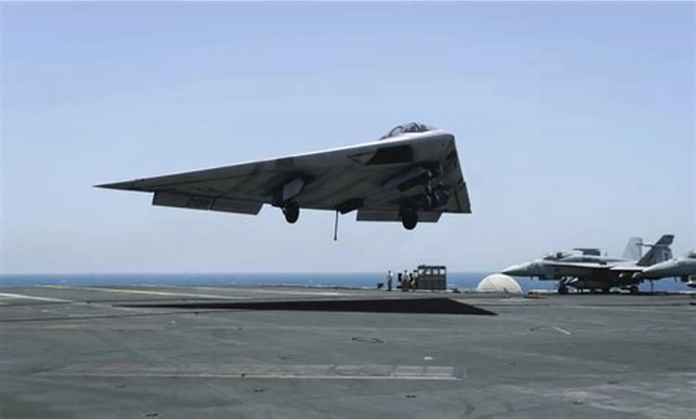
How the X-45A Pioneered Autonomous Military Flight

0
Image Source: Bing Image. License: All Creative Commons

In the 1st century of the 21st century, the expansive Mojave Desert in California, with its vast blue sky, was the next big step in the history of aviation. Visually, it was something that no one had seen before, and it was a look into the future when aerial fights would be done without human pilots, but in the air, it was a very dry and standard, jet-powered, long, and fast flight. This was the Boeing X-45A, a drone, a velvet and futuristic concept of a cutting-edge unmanned aerial vehicle that would change the very image of the air force in the 21st century.

Image Source: Bing Image. License: All Creative Commons

Pioneers Behind the Program

Boeing’s research division, Phantom Works—famous for its willingness to take a chance—teamed up with DARPA and the U.S. Air Force to tackle a daunting challenge: knocking out enemy air defenses without risking pilots’ lives. It was a lofty mission, and the X-45A was their solution.

Image Source: Bing Image. License: All Creative Commons

Form Meets Function

The X-45A was not built for looks—it was constructed to hunt. Its bulbous fuselage, spindly landing gear, and 26-foot wingspan created a slightly bug-like shape. Behind that visage was a single-minded mission: to prove that an unmanned aircraft could conduct combat missions, specifically the Suppression of Enemy Air Defenses (SEAD).

Image Source: Bing Image. License: All Creative Commons

The initial of the two prototypes, Elsie May by nickname, flew in 2002 from Edwards Air Force Base. Under the call sign Stingray One, it reached 7,500 feet and 225 mph on its first flight.

Image Source: Bing Image. License: All Creative Commons

When the drone took off from the runway, the cry of the flight director—”She’s off!”—emotionally conveyed the sense of being there when history happened. Soon after, the X-45A was the first autonomous UAV to deliver ordnance on a target.

Image Source: Bing Image. License: All Creative Commons

Milestones in the Mojave

Two X-45As were constructed by Boeing as reduced-scale proof-of-concept planes. The inaugural test flight arrived on May 22, 2002, in a 14-minute oval-track mission at 195 knots. The second entered the program in November. The X-45A had reached a significant milestone by April 2004: hitting a ground target with a 250-pound inert precision-guided bomb.

Image Source: Bing Image. License: All Creative Commons

The event was four months later, when the program demonstrated multi-drone coordination, which had two X-45As controlled by a single ground operator. On their 50th mission in February 2005, the pair took this another step further by autonomously deciding which aircraft was best positioned to engage a simulated target, allocating resources, and reacting to new threats in real time. This was not some preprogrammed flight-it was adaptive, coordinated decision-making without constant human input.

Image Source: Bing Image. License: All Creative Commons

Why UCAVs Matter

The X-45A was part of the larger Unmanned Combat Air Vehicle (UCAV) idea: cheap, deadly, and handy machines to hit early and frequently in a war. These vehicles could engage many targets on one mission, fight in tandem with manned aircraft, and deploy from regular air bases. The “pilotless” configuration eliminated weight, saved money, and avoided the long time needed to train flesh-and-blood aviators.

Image Source: Bing Image. License: All Creative Commons

With improvements in precision-guided weapons, even a small UCAV such as the X-45A might destroy hardened targets that previously necessitated heavy bombers. In a universe where budgets and operational risk are continuously balanced, this was a tantalizing capability.

Image Source: Bing Image. License: All Creative Commons

A Success That Never Deployed

Even with its stellar track record, the X-45A never saw operational deployment—a familiar destiny for testbeds. The shift from technology demonstrator to deployed system tends to get mired in what has been termed the “valley of death,” in which funding and strategic interest fluctuate before production can start.

Image Source: Bing Image. License: All Creative Commons

Now, DARPA is trying to narrow that gap with programs such as the “X Prime” program, which seeks to get promising prototypes out of the lab and into real-world applications sooner and narrow the gap between experimentation and deployment.

Image Source: Bing Image. License: All Creative Commons

Roots and Legacy

The DNA of the X-45A lies in previous Boeing experiments, such as the YF-118G Bird of Prey, where low-cost stealth and manufacturing methods were experimented with. Insights from those initiatives directly influenced the design and building of the X-45A.

Image Source: Bing Image. License: All Creative Commons

Both X-45A prototypes are now housed in museums, reminders of a time when unmanned air combat made a huge leap forward. But their impact goes far beyond placating static displays. Contemporary UAVs and UCAVs still borrow from the autonomy, survivability, and mission flexibility first demonstrated in Mojave skies.

Image Source: Bing Image. License: All Creative Commons

The X-45A’s story is more than a chapter in aviation history—it’s a blueprint for the future. In an age where speed, precision, and risk reduction drive innovation, its lessons remain highly relevant. The program proved one thing beyond doubt: the era of the autonomous combat aircraft isn’t coming—it’s already here.

The B-58 Hustler’s Supersonic Rise and Sudden Fall

0
Image Source: Bing Image. License: All Creative Commons

One of the most daring aircraft from the Cold War era could be the Convair B-58 Hustler—a superfast bomber that managed to outrun, outfly, and outsmart almost all the enemy’s countermeasures. However, in many respects, the tale of the Hustler is also a failure of expectations and a learning experience about the consequences of excessive haste.

Image Source: Bing Image. License: All Creative Commons

The B-58 history dates back to the late 1940s, when the U.S. Air Force, buoyed by the success it had enjoyed in WWII, initiated what had been dubbed the Generalized Bomber Study (GEBO II). The plan was to construct a bomber that would outfly and outclimb any of the Soviet Union’s current fighters or missiles.

Image Source: Bing Image. License: All Creative Commons

It was, however, at the time more theory than practice, and even before it took to the skies, the potential price tag was already making eyebrows rise. Nevertheless, the Air Force pushed ahead, requesting proposals from the likes of America’s premier aerospace concerns. Convair, in 1952, won the deal with a streamlined, delta-wing plane that drew heavily upon post-war research, some of which had been “borrowed” from German research.

Image Source: Bing Image. License: All Creative Commons

The B-58 was built to impress from day one. With aggressively angled delta wings, a thin, extended fuselage, and four GE J79 engines hung beneath the wings, the aircraft resembled something out of a science fiction film. Those J79 engines were revolutionary, meant to produce power specifically at sustained supersonic velocities. Its airframe was equally sophisticated, constructed of honeycomb sandwich panels to accommodate the hot flight at Mach 2.

Image Source: Bing Image. License: All Creative Commons

Perhaps the Hustler’s most distinctive feature was the huge external pod carried under the fuselage. This pod contained additional fuel as well as a nuclear bomb, because the aircraft’s narrow body left little room for anything within. Later models even featured external hardpoints to hold more than one nuclear weapon.

Image Source: Bing Image. License: All Creative Commons

The inside was no less unusual. Rather than sitting together, the three-man crew—pilot, navigator/bombardier, and defensive systems operator—sat in a line, each with his own covered cockpit. Communication was so difficult that some crews allegedly used a string-and-pulley system to pass notes. Instead of standard ejection seats, each crewman had his escape capsule. These capsules were also tested on animals—chimpanzees and bears—to see if they were capable of withstanding ejection at supersonic speeds and even serving as flotation devices in case of necessity.

Image Source: Bing Image. License: All Creative Commons

The B-58 lived up to its performance promises as well. It set nineteen world speed and altitude records, such as a coast-to-coast run over the United States in less than five hours, and a Mach 2 dash from Tokyo to London. These accomplishments won the plane a variety of aviation awards and established it as the fastest bomber of its era. According to one aerospace historian, the J79 engine itself was a wonder, cutting-edge technology that broke records and set the standard for jet propulsion to come.

Image Source: Bing Image. License: All Creative Commons

While being a state-of-the-art design, the B-58 was a disaster made of metal, both in terms of providing and financially. Exorbitantly expensive to make and maintain, the B-58 was, compared to the B-47 and B-52, the cost of one flight-hour per hour reached the sky. The aircraft, unfortunately, also ranked low on the safety scale: over a quarter of all the B-58s were wrecked in accidents, and 36 personnel were killed in crashes due to structural and system failure. One researcher emphasized that out of the 116 planes that were built, 26 were destroyed—numbers that speak for themselves and are quite depressing, not only for an aircraft but also for those armed with nuclear weapons.

Image Source: Bing Image. License: All Creative Commons


Afterward, the situation was changed entirely and was non-negotiable: the Soviet Union’s introduction of the S-75 (SA-2 Guideline) surface-to-air missile system. The incident when the missile brought down the high-altitude U-2 spy plane, which was flying at 70,000 feet, was a turning point that basically put an end to the idea that speed and altitude could save bombers from being shot down.

Image Source: Bing Image. License: All Creative Commons

The Air Force then tried a different approach, moving the Hustler to low-altitude missions where the radar could not pick it up, but the plane was not designed for that type of flying. It battled the wind, and its range was cut significantly, which meant it had to be refueled more often. Thus, the performance that had been honored before the Hustler’s arrival now had severe limitations.

Image Source: Bing Image. License: All Creative Commons

By 1970, only ten years after entering service, the B-58 was withdrawn from service. It never delivered a single combat flight. Its responsibilities were transferred to the FB-111A, a more flexible aircraft more attuned to the changing exigencies of nuclear war. Now, there remain just eight B-58s on display in museums throughout the U.S., reminders of an era when speed and height were the measures of victory. As one aviation authority described it, the B-58’s achievements—particularly in shattering speed and altitude records—are still worth noting, even though the service life of the plane was short.

Image Source: Bing Image. License: All Creative Commons

The B-58’s legacy is a bittersweet one. It demonstrated what was technologically possible, but also the danger of rushing ahead without complete consideration for practical requirements and overall strategy. While its flight was brief, the Hustler left a lasting mark. It demonstrated the power of ambition to drive innovation, but also the speed with which that innovation can be overthrown as the strategic environment changes. Ultimately, the B-58 is both an icon of Cold War audacity and a reminder that even the greatest machines can be made obsolete nearly overnight.

The Littoral Combat Ship: The Navy’s Costly Mistake

0
Image Source: Bing Image. License: All Creative Commons

The Littoral Combat Ship, abbreviated as LCS, was initially promoted as the next generation naval combat vehicle – a smart, versatile, modular ship capable of performing any task from clearing mines to fighting submarines, and at a cost that was only a fraction of that of traditional ships. However, after 20 years, the LCS story has become a warning message: a project that had great ideas on paper but turned out to be costly and, most importantly, empty-handed for the Navy in terms of accomplishing tasks.

Image Source: Bing Image. License: All Creative Commons


The US Navy started the LCS program in the early 2000s, at a time when the Navy fleet was shrinking, and the retirement of numerous Cold War-era ships was imminent. The concept was straightforward: design a small, multi-mission combatant that could be quickly and cheaply made, take over the low-end missions while the larger ships concentrate on the high-end wars. Defense officials were aiming for a target price of roughly $400 million per ship—about one-third of an Arleigh Burke-class destroyer.

Image Source: Bing Image. License: All Creative Commons

The unique feature of the LCS was its modularity. In addition, the ships were designed with a minimum number of crew members, which is less than half of the standard frigate; thus, the vessels relied on automation and the use of unmanned vehicles. As then-deputy defense secretary Bob Work stated, the concept was daring and unproven, a complete departure from the usual naval ship design.

Image Source: Bing Image. License: All Creative Commons

But the desire to push forward outpaced available resources. The Navy steamed ahead with the LCS to production before there was a complete plan, bypassing many of the customary testing and evaluation phases. The first LCS went into service in 2008, years sooner than the typical Pentagon acquisition schedule. Bryan Clark of the Hudson Institute says the Navy’s urgency to innovate left few with the stomach to say “no” to added requirements as the program grew more complex.

Image Source: Bing Image. License: All Creative Commons

Issues soon arose. The mission packages, long espoused as the LCS’s signature strength, were complicated to implement and frequently behind schedule. The anti-submarine package encountered sonar deployment problems, minesweeping systems fell behind schedule, and hull designs experienced transmission problems and cracking under high speeds—a critical issue for vessels designed to be fast-moving. Efforts to cycle specialized crews between ships also didn’t pan out, detracting from operational effectiveness.

Image Source: Bing Image. License: All Creative Commons

The costs escalated way over what was originally projected. Although the Navy was aiming to stay within the $250 million limit for each of the ships, the actual cost went beyond $500 million for each vessel, and that with no account taken for the expensive mission packages. The administration that was backing the idea of these ships financially went along with the plan to buy in bulk both the Freedom and Independence classes. But because of the following troubles, such as technical issues, maintenance difficulties, and performance problems, the program would eventually face very bad consequences. By the time it came to 2016, there was only one solution left, which was a complete inspection due to the continuous failures of the engines; however, the program’s fame was already affected.

Image Source: Bing Image. License: All Creative Commons

During that time, the strategic landscape was shifting. The LCS was designed for near-shore “brown water” operations, but China’s expanding anti-access, area denial capabilities made those missions more and more perilous. Several LCSs were retired after fewer than five years—far less than their planned 25-year life.

Image Source: Bing Image. License: All Creative Commons

Experts calculated that the premature retirement accounted for about $7 billion in lost service time, not counting billions more in operating expenses that the Navy saved by retiring the ships.

Image Source: Bing Image. License: All Creative Commons

For others, the choice to cut losses was painful but necessary. Former naval officer Bryan McGrath said maintaining the ships in commission would have been more expensive and less effective, especially in a possible high-end war. The American Enterprise Institute’s Mackenzie Eaglen noted the high yearly operating expenses—about $70 million per vessel—as another basis for why early retirement was financially astute.

Image Source: Bing Image. License: All Creative Commons

However, the program was not a complete failure. The minesweeping package did finally achieve operational status, and in doing so performed a world-first by employing unmanned vehicles to sweep out minefields.

Image Source: Bing Image. License: All Creative Commons

In the end, the LCS saga is a lesson that naval innovation is an exercise in balance, between striving for what is best and staying grounded in reality. Without hard testing, precise requirements, and an open mind to change in the face of changing threats, even the best ideas can become costly lessons. As one congressional staffer explained it, the Navy might have caught on to the LCS’s faults too late, but learning from them will be essential for what comes next for the fleet.

F-117 Nighthawk: The Stealth Jet That Won’t Retire

0
Image Source: Bing Image. License: All Creative Commons

It might be that the F-117 Nighthawk is one of the most intriguing and weirdest machines in the world. Although “The Stealth Fighter” was the one to take the place of the US Air Force in 2008, the F-117 is still flying to keep it alive way beyond the 2030s. Its peculiar and mysterious past has led it to be the icon of the highest technology, yet the question of its existence on the path not only depends on recognition of the past but also on the capability and versatility.

Image Source: Bing Image. License: All Creative Commons

The story of the Nighthawk goes back to the time after the Vietnam War, when the U.S. was looking for ways to beat the enemy air defenses that were getting more and more sophisticated. In extreme secrecy, Lockheed’s Skunk Works created the plane using standard parts—T-38A Talon engines and a flight control system from the F-16—as the basis for a new stealth concept.

Image Source: Bing Image. License: All Creative Commons

Its flat, angular design was designed to scatter radar waves. Combined with special radar-absorbing coatings applied to the plane, its radar cross-section was said to be the size of a marble. It first took to the skies in 1977 and entered service in 1983, though not before the public would catch a glimpse of it five years later.

Image Source: Bing Image. License: All Creative Commons

When it eventually did see action, the F-117 lived up to its legend. In missions that ranged from Panama to the Gulf War, it proved that it could strike heavily defended targets with unparalleled accuracy. During Desert Storm, the planes escorted only a small percentage of all missions but destroyed a large share of primary targets, without losing a single aircraft or even taking combat damage. Nighthawk’s ability to penetrate air defenses and strike specific targets was a milestone in the way wars could be fought: fewer aircraft, greater accuracy, and much less exposure for pilots.

Image Source: Bing Image. License: All Creative Commons

But with the advent of military aviation, the limitations of the F-117 grew more and more impossible to ignore. It was not particularly fast, nimble, or multirole-capable, and newer aircraft like the F-22 and F-35 were both longer-range and more flexible at performing stealth missions. Still, the Air Force found new uses for the Nighthawk. Instead of retiring it completely, the service reoriented it into missions where it could still excel.

Image Source: Bing Image. License: All Creative Commons

Nowadays, the F-117 is mainly used as aggressor planes, simulating against stealthy adversaries to conduct training exercises. It has radar and infrared signatures that are effective in simulating how detection systems and fighter pilots respond to low-observable targets. It’s also an effective test platform for new stealth coatings, avionics, and mission systems, which helps in research for the next generation of aircraft. With relatively quick modifications—termed T-2 changes—the aircraft may be converted to accommodate test missions, offering engineers and tacticians a flexible, cost-effective platform.

Image Source: Bing Image. License: All Creative Commons

Also pragmatically, it’s a good idea to keep the Nighthawks in the air. Using these retired fighters for training protects the Air Force from risking expensive and short-handed F-22s or F-35s in high-stress practice. It also keeps current generations of experience flying and maintaining first-generation stealth technology—experience that still has use as newer designs emerge.

Image Source: Bing Image. License: All Creative Commons

The majority of the remaining F-117s are stationed at the out-of-the-way Tonopah Test Range in Nevada, a location famously linked to secret projects. The Air Force has progressively disassembled the fleet over the years, gifting some of the aircraft to museums and scrapping a few annually. Nevertheless, some remain flight-capable under firm maintenance contracts. Existing plans maintain a component of the fleet operational through at least 2034, with no intention of returning them to combat service.

Image Source: Bing Image. License: All Creative Commons

The F-117 has been able to benefit from some new developments during its long service life, and one of them is that it can now work with the KC-46 Pegasus air refueling tanker. This allows the F-117 to carry out extended, more intricate flights for both training and experimentation. The KC-46 crew has also been working on their own upgrades that will enhance the plane’s sight and refueling functions, thus making it easier for them to serve a wider range of aircraft, including old models like the Nighthawk.

Image Source: Bing Image. License: All Creative Commons

The concept of the F-117 being kept in the air is not just about commemorating the past times, but it is also about satisfying current requirements. As programs such as Next Generation Air Dominance are only at their initial stages, the need for stealthy targets that are realistic and reliable testbeds has become quite high. The steady characteristics of the Nighthawk and its adaptability have made it a trustworthy resource in sensor verification, tactics advancement, and testing of materials in an AANCOIS-controlled environment.

Image Source: Bing Image. License: All Creative Commons

Finally, the F-117’s legacy is guaranteed. It was the first operational stealth fighter in the world, the pioneer that changed the character of war. Now, it lives not as a front-line combat plane, but as a bridge between yesterday’s innovation and tomorrow’s advancements—proof that in flight, yesterday’s game-changer can still influence tomorrow’s victory.

Ulyanovsk Supercarrier and the Fall of Soviet Naval Power

0
Image Source: Bing Image. License: All Creative Commons

For a very long period of time, carrier ships were the dream of sea powers, the naval vessels that could fly and thus spread their power all over the globe. The idea of constructing the next supercarrier was so absorbing for Russia that this imaginary project was not only followed with excitement, but also with pride and the desire to overtake the big maritime rivals. It was transformed from a dream into a late 1980s reality with the Ulyanovsk, which would have elevated the Moscow navy to a blue-water navy. However, the ship was one of the Navy’s most historic “what-ifs” scenarios, rather than being actually converted into the latter.

Image Source: Bing Image. License: All Creative Commons

The Ulyanovsk began construction in 1988 at the Mykolaiv shipyard, Ulyanovsk—official designation Project 1143.7—intended to be the first Soviet carrier on par with the American behemoths of the day. Whereas the Admiral Kuznetsov employed a ski-jump to take off, Ulyanovsk employed steam catapults, which could safely carry heavily loaded aircraft.

Image Source: Bing Image. License: All Creative Commons

Almost 80,000 tons long and 324 meters, she would have been as big as the largest carriers in the world. Her nuclear power plant, with four reactors driving four turbines, produced a speed of 30 knots and a range limited only by the crew’s endurance.

Image Source: Bing Image. License: All Creative Commons

The flight deck of the ship would be able to accommodate up to 70 aircraft: Su-33 fighter, Yak-44 early warning aircraft, and Ka-27 helicopters. The ship would also have substantial missile equipment consisting of P-700 Granit missiles, S-300 anti-aircraft systems, and some close-in weapon systems.

Image Source: Bing Image. License: All Creative Commons

The term was straightforward. Ulyanovsk was more than a warship—it was a statement that the Soviet Navy could now challenge the carrier strike force of its adversaries. To Moscow, it was a badge of political presence and one of military necessities.

Image Source: Bing Image. License: All Creative Commons

Fate, however, had other plans. The Soviet Union disintegrated at the time the carrier was breaking through. By the beginning of 1992, only a quarter of the ship had been constructed, and Moscow and Kyiv’s new governments had little money—or inclination—to finish it.

Image Source: Bing Image. License: All Creative Commons

The expenses had increased far beyond early estimates to the billions. Economic survival now being the priority, the incomplete hull was ordered to be broken down into scrap metal. Soviet supercarrier dream expired on February 4, 1992, on the cutting room floor of a shipyard.

Image Source: Bing Image. License: All Creative Commons

Waves of Ulyanovsk’s collapse still echo. Russia’s only carrier, the Admiral Kuznetsov, is now infamous for breaking down. Refurbishment fires, catastrophic crane collapse, and routine engine breakdowns have dogged the ship. Even when sailing, Kuznetsov has a tug escort attending it—insurance against early failure in the middle of the ocean. For most sailors, to work on the ship is now gallows humor, more ordeal than privilege.

Image Source: Bing Image. License: All Creative Commons

But the idea of the Russian supercarrier persists. Designs for new classes, from the nuclear-powered Shtorm to concept designs connected with the navy’s modernization program, surface sporadically. But they remain on paper, hobbled by budget limitations and shifting strategic priorities. Ulyanovsk is a metaphor—and not a metaphor of what was built, but of what was lost.

Image Source: Bing Image. License: All Creative Commons

The major lesson is at that location. In any case, the power of the Kremlin to sail its flotilla worldwide, without a contemporary carrier, is limited. Maybe the dream of being global would talk, but the Motherland is an ocean-going country hampered by geography, budgets, and technology.

Image Source: Bing Image. License: All Creative Commons

The Ulyanovsk disaster is giving the planet a lesson in history: these failures could actually terminate the pursuit of going beyond the stars. The offshore journey has turned into a distress of broken desires and the unforeseen problems of keeping naval force for the Motherland.

10 Little-Known WWII Aircraft That Revolutionized Flight

0
Image Source: Bing Image. License: All Creative Commons

World War II was a period when the technological revolution in the area of aviation practically jumped several floors up. As every air force was trying to outdo the others, the engineers came up with some of the most unimaginable, peculiar, and even the strangest aircraft that ever existed. To mention just a few, besides the rocket-powered interceptors that were only rarely put into operation for so-called crazy test flying wings, these were very bold aircraft that not only challenged the limits of the possible but also sometimes the limits of insanity. These are the ten most amazing and bizarre aircraft from that era, and what makes each one so different is not only the fabric that they were made of, but also their very own story of invention and genius.

Image Source: Bing Image. License: All Creative Commons

10. Martin PBM-5A Mariner

The PBM-5A Mariner was one of America’s most powerful patrol bombers, even beating the legendary PBY Catalina at several tasks. Designed by the Glenn L. Martin Company, it boasted a gull wing that left its engines above the spray of salt, and retractable wing floats to cut drag. Its bomb bay lay hidden in the fuselage, so it could fly more quickly when weighed down with bombs. Subsequent versions were even equipped with jet-assisted take-off rockets for short, high-angle climbs—ideal for rescue missions in choppy seas. Staffed by nine and equipped with several .50-caliber cannons, the Mariner paid its dues in the Battle of the Atlantic by sinking ten German submarines. Of the over a thousand that were built, just one survives today.

Image Source: Bing Image. License: All Creative Commons

9. Curtiss XP-55 Ascender

The XP-55 Ascender resembled something out of a science fiction strip—its engine was mounted behind the pilot, it featured a canard wing at the front, and dual vertical tails mounted at the end of its wings. The unorthodox “pusher” design was supposed to provide improved visibility and concentrate firepower in the nose. Unfortunately, it had unpredictable stalls and never produced the desired performance. Three were constructed, and two were destroyed in crashes. The one that remains is a testament to how far engineers would push things to experiment.

Image Source: Bing Image. License: All Creative Commons

8. Vought V-173 “Flying Pancake”

The bizarrely endearing V-173 became known by its nickname due to its body being round and flat and its massive propellers—over sixteen feet in diameter each. Conceived by Charles Zimmerman, the plane was able to lift off over an extremely short distance, and with a powerful headwind, it could nearly fly vertically. Its peculiar shape created lift over its entire surface, which provided helicopter-like maneuverability in flight. Although testing was successful, the Navy’s interest was already turned toward more speed-oriented jet aircraft, and the Flying Pancake never entered production.

Image Source: Bing Image. License: All Creative Commons

7. Focke-Wulf 190D “Long Nose”

Designated as the “Langnasen” to German airmen, the Focke-Wulf 190D was an interception-capable high-altitude fighter equipped with a liquid-cooled Jumo 213 engine. Its top speed was raised to approximately 440 mph with this improvement and enabled it to engage Allied bombers at altitude. Equipped with 20mm and 13mm cannons, it was a formidable foe, but wartime production interruptions meant that it was never produced in the quantities that could have made the difference. Now, only a few remain on display in museums. 

Image Source: Bing Image. License: All Creative Commons

6. Nakajima Ki-43 Hayabusa (“Oscar”)

The Ki-43 Hayabusa, or “Peregrine Falcon,” was a long-legged and quick-flying fighter that surprised Allied pilots at the beginning of the war. Highly agile, it was one of Japan’s most ubiquitous fighters, with over 5,900 produced. Early models had no armor or self-sealing fuel tanks, but subsequent improvements corrected those limitations without destroying the plane’s legendary agility. There is only one complete example of the type preserved.

Image Source: Bing Image. License: All Creative Commons

5. Mitsubishi A6M7 Reisen (Zero)

The Mitsubishi Zero was legendary enough for its speed and maneuverability, but the A6M7 model added even more capabilities. It was built for dive-bombing from smaller carriers with strengthened wings and bomb racks instead of a centerline fuel tank. This model was one of the last Zeros to fly, as the war went against the Japanese. Although more than ten thousand Zeros were produced in total, relatively few intact aircraft remain in original condition today.

Image Source: Bing Image. License: All Creative Commons

4. Horten Ho 229

The Ho 229 was in a class by itself—a streamlined jet-propelled flying wing decades ahead of its time. Its unconventional shape cut both drag and radar signature, and its twin jet motors promised up to 600 mph speeds. The aircraft took to the air in prototype in 1944, but the war’s end came before it could go into production. Still, it was one of the most sophisticated ideas to come out of the war.

Image Source: Bing Image. License: All Creative Commons

3. Messerschmitt Me 262

The Me 262 was the first operational jet fighter in the world, and when it emerged, it startled Allied pilots. It had a top speed of around 540 mph and nose-mounted heavy cannons, and could tear through bomber formations before the bombers had time to respond. Reliability and fuel shortages held it back from altering the war, but its design left a gigantic mark on postwar aircraft development.

Image Source: Bing Image. License: All Creative Commons

2. Heinkel He 178 and He 280

The Heinkel He 178 is the first jet plane to have ever flown, which it did in 1939. Following on from this achievement, Heinkel produced the He 280, the first purpose-built turbojet fighter. With a top speed of in excess of 550 mph, the He 280 was a leading contender, but rival designs—such as the Me 262—got to production first. Nevertheless, these initial jets represented the beginning of a new age for flight.

Image Source: Bing Image. License: All Creative Commons

1. Mitsubishi J8M1 Shusui / Ki-200

The number one position is held by the Mitsubishi J8M1 Shusui, a rocket-powered interceptor designed with Germany’s Me 163 Komet as its model. Developed to combat bombers at high altitudes, it was able to ascend to breathtaking heights in just minutes and achieve scorching speeds—but for only five minutes, as the fuel would then be depleted. Technical information from Germany came in pieces, so Japanese engineers had to improvise much of the development. Unfortunately, the prototype crashed during its initial test flight, and it killed the test pilot. The war broke out before the aircraft were further developed.

Image Source: Bing Image. License: All Creative Commons

These planes are a testament to the daring experiments and risky leaps in technology that characterized WWII aviation. Some of them were breakthroughs, some failures, but all left their unique imprint on the history of aviation.

F-15EX Eagle II and the Future of Air Superiority

0
Image Source: Bing Image. License: All Creative Commons

The F-15EX Eagle II is not merely an enhanced, history fighter jet that is no longer relevant – rather, it is a deliberate step by the U.S. Air Force to keep its range and deadliness against the changing threats and lower budgets. By fusing the standard parts of the first F-15 with state-of-the-art technology, the Eagle II maintains a powerful comeback to a demanding battlefield without starting over from scratch.

Image Source: Bing Image. License: All Creative Commons

From Cold War Warrior to 21st-Century Workhorse

The F-15 Eagle, an aircraft that was originally conceptualized during the Cold War period, was a groundbreaking plane that could dominate the air with its unheard-of speed, nimbleness, and power. Over time, it gained the versatility to perform different roles, and the F-15E Strike Eagle model complemented the picture with the exact strike capability. Its flexibility helped it to become the plane that not only the U.S. had the most, but also the greatest number of air force friends in the world had the most wanted aircraft.

Image Source: Bing Image. License: All Creative Commons

The F-15EX Eagle II harnesses that tried-and-tested airframe and reimagines it for today’s combat environments. It may look familiar on the outside, but with the upgrades behind the facade, it’s an entirely new creature.

Image Source: Bing Image. License: All Creative Commons

Next-Gen Tech Under the Hood

What distinguishes the F-15EX as properly modern is its onboard technology. It features cutting-edge avionics, improved radar, and BAE’s EPAWSS (Eagle Passive/Active Warning and Survivability System)—a next-generation electronic warfare suite that provides the aircraft with real-time threat detection, jamming, and self-defense capabilities. EPAWSS is not only a defense system; it’s based on a digital foundation that facilitates constant software updates and modular upgrades. That allows the F-15EX to adapt rapidly to future threats without an extensive overhaul.

Image Source: Bing Image. License: All Creative Commons

Firepower and Range: The Ultimate Missile Truck

Where the F-15EX truly excels is in its ordnance capacity. It can handle as much as 30,000 pounds of ordnance, consisting of 16 air-to-air missiles, more than any other fighter in service today. It’s the ultimate “missile truck,” capable of remaining at a standoff distance while raining down a deluge of long-range missiles.

Image Source: Bing Image. License: All Creative Commons

Its payload range is already massive, but can be stretched with conformal and external tanks. And while stealth jets count on hidden weapon bays to remain radar-invisible, the F-15EX doesn’t hide its weapons, embracing them. From the AIM-120D through the forthcoming AIM-260 to standoff strike weapons such as JASSM-ER, the aircraft can carry almost any U.S. munition.

Image Source: Bing Image. License: All Creative Commons

Team Player: Teaming with Stealth Jets

The Eagle II wasn’t designed to fly solo—it’s supposed to fly in support of fifth-gen fighters like the F-22 and F-35. Here, the F-15EX stays in the rear while stealthier aircraft penetrate hostile airspace, collect targeting information, and feed it back. And then the F-15EX brings the hammer down, firing massive missile barrages without exposing itself. This makes the jet particularly worthwhile in large theaters such as the Indo-Pacific, with its long distances and logistics involved. Its recent deployment to Kadena Air Base in Japan suggests the Air Force’s intentions to make use of the F-15EX’s range and payload in that area.

Image Source: Bing Image. License: All Creative Commons

Closer to home, the F-15EX is also replacing older F-15C models in Air National Guard squadrons, where its reliability, ease of maintenance, and infrastructure compatibility make it a smooth transition.

Image Source: Bing Image. License: All Creative Commons

Price Tag and Production Perspective

The F-15EX is not inexpensive. Its unit price has gone up from $80.5 million to as much as $97 million in later lots, barely higher than the F-35A’s $82.5 million flyaway cost. Raw cost comparisons can be deceptive, though. The Eagle II gains from being compatible with current infrastructure and parts it carries over from earlier F-15s, which reduces the cost of entry and upkeep in the long term.

Image Source: Bing Image. License: All Creative Commons

It’s also a strategic commodity for the defense industrial base. Maintaining the F-15 line open prevents the U.S. from having to depend solely on a single fighter platform and provides procurement flexibility—a welcome commodity in an uncertain or production-delays environment.

Image Source: Bing Image. License: All Creative Commons

Built to Last—and Adapt

Looking down the road, the F-15EX will have service into the 2050s. It’s not attempting to be a stealth plane, nor is it attempting to replace one. Rather, it closes a gap, providing unmatched firepower, range, and upgrade capacity that fifth-gen fighters simply cannot at scale.

Image Source: Bing Image. License: All Creative Commons

Whether on homeland defense missions, patrolling disputed areas with allies, or augmenting strike packages in support of stealth fighters, the F-15EX demonstrates there’s still space in the air for intelligent, effective upgrades of tried platforms. The F-15EX is a modern answer to a complex problem—how to stay ready for high-end warfare without betting everything on one expensive, stealthy solution. It’s fast, it’s flexible, and it’s here to bridge the gap between legacy systems and the future of air combat.