Home Blog

Donkey Kong Country Returns HD Signals Retro Studios’ Big Return

0

In less than a minute, Nintendo’s iconic trio will be back doing what they do best—hauling objects and hurling barrels with gusto. Fans couldn’t be more excited. With Donkey Kong Country Returns HD arriving on the Nintendo Switch, players are getting another opportunity to revisit one of the standout platformers of its era. But this release isn’t just a visual upgrade—it’s also a reminder of how Retro Studios helped breathe new life into the franchise and leave a lasting mark on Nintendo’s legacy.

Image Source: Bing Image. License: All Creative Commons

Before taking on Donkey Kong, Retro Studios had already made a name for itself with the Metroid Prime series, known for its immersive and atmospheric design. That’s why the announcement that the studio would handle a Donkey Kong revival caught many off guard. According to longtime Nintendo producer Kensuke Tanabe, the project came together somewhat unexpectedly. After internal changes at Retro left the team searching for a new direction, Shigeru Miyamoto proposed revisiting Donkey Kong. Tanabe believed Retro was the perfect fit—and that decision ultimately led to the creation of Donkey Kong Country Returns, a game that honored its roots while pushing forward in new ways.

From the start, expectations were high. Developers like Kynan Pearson, Mike Wikan, and Tom Ivey later shared how staffing shifts within the studio created both challenges and opportunities. Many of the newer team members had grown up with the original Donkey Kong Country games, and that passion shaped their approach. Working closely with Nintendo’s Kyoto-based developers also helped guide the project. What initially seemed like an unusual pairing quickly turned into a strong collaboration that eased doubts about whether Retro could handle such a different kind of game.

When Donkey Kong Country Returns debuted at E3 2010, it made an immediate impact. It captured the tight platforming and inventive level design fans loved, while introducing a brighter visual style and fresh mechanics. Both critics and players responded enthusiastically, and the game’s success quickly validated Retro’s approach. As Tanabe later pointed out, the team succeeded because they truly understood what made the series special in the first place.

Now, Donkey Kong Country Returns HD is set to bring that experience to a new audience. Launching on January 16, 2025, the remaster includes all 80 levels from the original Wii version, along with additional content from the 3DS release. Whether you’re tackling tricky mine cart stages alone or teaming up with a friend in local co-op, this version aims to preserve the original’s charm while updating its visuals and performance for modern players.

Of course, a Donkey Kong game wouldn’t be complete without memorable enemies. In Returns, players faced the hypnotic Tiki Tak Tribe, while Tropical Freeze later expanded the series’ roster with the Snowmads, led by the bombastic Lord Fredrik. Their icy, Viking-inspired invasion added a new flavor to the game’s world. While Fredrik drew some comparisons to classic villains like King K. Rool, his presence still helped shake things up, bringing new environments and mechanics into the mix—even if longtime fans had mixed feelings about him.

Looking back, it’s clear that Retro Studios struck a careful balance between honoring tradition and trying new ideas. They weren’t afraid to experiment, whether through gameplay changes or new antagonists, but they always stayed grounded in what made the series work. That mix of respect and creativity allowed Donkey Kong Country to evolve without losing its identity.

At its core, the franchise’s revival is built on a deep appreciation for its past combined with a willingness to move forward. Retro didn’t just bring back a classic—they reinvigorated it. With Donkey Kong Country Returns HD about to hit the Switch, both longtime fans and newcomers can experience the series’ signature blend of challenge, charm, and imagination. Whether you’re revisiting familiar jungles or stepping into Kong Country for the first time, the adventure feels as lively as ever.

Black Ops 6 Review: The Truth Behind the Buzz

Every year, the launch of a new Call of Duty title sparks a familiar wave of hype—and Black Ops 6 was no exception. Set in the early 1990s, just after the fall of the Berlin Wall, Treyarch promised a fresh, time-shifting experience. Add to that its record-breaking day-one Game Pass release, and expectations were sky-high. Now that it’s finally in players’ hands, the big question is whether Black Ops 6 truly pushes the series forward—or simply reworks the same formula yet again.

Image Source: Bing Image. License: All Creative Commons

Multiplayer is where the game takes its biggest swings. Treyarch leans back into its signature tactical style but introduces a bold twist with omni-movement. Players can sprint in any direction, adjust their body mid-air, and pull off movements that feel straight out of an action movie. It’s fast, fluid, and surprisingly intuitive. After a few matches, traditional movement systems can feel sluggish by comparison. That said, the system sometimes goes overboard—gunfights can turn chaotic, with players diving through windows, spinning mid-air, and firing in all directions. It’s undeniably fun, but it can make encounters feel less strategic and more unpredictable.

Map design is a mixed experience. The return of the classic three-lane structure helps maintain flow and keeps matches from becoming too camp-heavy. Some maps stand out, like Lowtown, with its bright coastal setting and layered verticality that adds depth to engagements. Others, however, miss the mark. Babylon, for instance, suffers from overly long sightlines and cluttered spawn areas, echoing frustrations players had with Modern Warfare (2019). These issues become even more noticeable when paired with inconsistent netcode or questionable spawn logic.

Customization remains a double-edged sword. The Gunsmith system offers extensive control over weapon builds, which is great in theory—but in practice, it often leads to dominant meta loadouts appearing match after match. The slightly longer time-to-kill adds a bit more breathing room compared to recent entries, but quick reflexes still reign supreme. The addition of a third perk slot and the return of Wild Cards open up creative loadout options, like running dual primary weapons or stacking attachments. While there’s plenty to unlock, the real concern is whether the game can maintain proper balance over time—a challenge the series has struggled with before.

Zombies mode takes a more traditional approach this time around. The experimental DMZ-style format has been scrapped in favor of classic round-based gameplay. At launch, players get two maps: Liberty Falls and Terminus. Liberty Falls offers a large, atmospheric setting—a nighttime town in West Virginia—but its openness can make survival feel a bit too forgiving. Terminus, set on a creepy island facility, leans more into the tight, tense gameplay longtime fans love. Both maps include story elements and cinematic touches, though they don’t quite reach the iconic status of earlier Treyarch Zombies experiences.

From a technical standpoint, Black Ops 6 impresses. The visuals are sharp, the performance is smooth, and accessibility options are plentiful. Crossplay works seamlessly, and overall polish is strong. Still, familiar issues linger beneath the surface. Netcode inconsistencies, a clunky user interface, and persistent cheating problems continue to frustrate players. While the updated launcher is a step in the right direction, it doesn’t fully hide the aging structure of the franchise.

Player reception has been somewhat lukewarm. On Steam, the game saw an initial surge to around 300,000 concurrent players, only to drop to roughly 100,000 not long after—a steeper decline than Modern Warfare 3 experienced. This has led some fans to question the series’ direction. There’s growing speculation about whether Activision and Treyarch might rethink the annual release cycle or lean more heavily into Warzone if interest continues to dip.

At its core, Black Ops 6 delivers one of the strongest multiplayer experiences the series has seen in years—arguably its best since before Modern Warfare (2019). It nails the fundamentals, introduces exciting mechanics, and looks great doing it. However, it also carries many of the same long-standing issues that have held the franchise back. With player engagement already slipping, the real question isn’t just whether Black Ops 6 succeeds—but whether it signals evolution for Call of Duty, or the beginning of the end for its traditional formula.

Spiritborn Could Be Diablo IV’s Most Fascinating Class Addition Yet

0

The Return of the Spiritborn in Diablo 4

Diablo IV has never shied away from experimenting, and with the upcoming Vessel of Hatred expansion, Blizzard Entertainment is introducing one of its most original class concepts yet: the Spiritborn. Rather than reworking familiar archetypes like Rogues, Barbarians, or Druids, this new class takes a different path entirely. It’s deeply rooted in the game’s lore, offers a distinct playstyle, and feels designed for players looking for something fresh and more unconventional.

Image Source: Bing Image. License: All Creative Commons

Early speculation ran all over the place—some players expected a Monk-Druid hybrid, while others hoped for something closer to a Paladin or Shaman-style class. But the Spiritborn has proven to be something entirely its own. Rather than borrowing heavily from past archetypes, it carves out a distinct identity—and it’s shaping up to be one of the most original additions the franchise has seen in years.

Lore and Setting: Nahantu and the Spirit Realm

The Spiritborn derives its power from a corner of Diablo history that’s been teased for years but has never been explored fully. Originating from the jungle land of Nahantu—the same land where Mephisto’s soulstone was previously unearthed—the Spiritborn have been hidden for centuries, cut off from the ceaseless conflict between Heaven and Hell.

But their secret days are behind them. With Neyrelle coming back to Nahantu with Mephisto’s soulstone, the Spiritborn are brought into the fray of conflict. Being added to the main story feels organic and well-deserved, not a tacked-on addition for gameplay diversity. They are part of Sanctuary, and their presence enriches both the world and the narrative.

A New Kind of Hero: Spiritborn’s Unique Identity

Don’t expect the Spiritborn to be played as a re-skinned Monk or Druid. Yes, there are acknowledgments of those classes—martial arts, elemental powers, animal motifs—but Spiritborn is essentially a different class. This is a spiritual warrior, tapping into primal energies and creating a connection with four animal gods that influence their combat style.

What sets this class apart is its fluid identity. You’re not locked into a single path or playstyle. Instead, you’re encouraged to explore and combine the powers of four distinct spirits—each representing a different combat philosophy.

The Four Animal Spirits: Jaguar, Eagle, Gorilla, Centipede

At the heart of the Spiritborn’s design are its four guiding animal spirits, each unlocking a unique flavor of gameplay:

  • Jaguar: Quick, aggressive, and deadly. Jaguar provides quick multi-hit melee combos with frequent fire lashings—perfect for cleaning up clusters up close.
  • Eagle: The speedy ranged striker. Eagle abilities concentrate on evasion, lightning attack, and accuracy. High-risk, high-reward play for those who enjoy keeping on their toes.
  • Gorilla: The bruiser. Gorilla skills deal heavy, slow-hitting attacks and massive defense improvements, enabling you to absorb damage and beat up enemies with brute power.
  • Centipede: The poison master and crowd controller. Centipede wields decay and renewal with area-of-effect abilities that drain and overwhelm opponents over time.

What makes the system even more exciting is that you don’t need to commit to a single spirit. The Spiritborn skill tree allows hybrid builds, so you can combine, for example, Eagle’s speed with Gorilla’s raw strength, or Jaguar’s fiery ferocity with Centipede’s venom.

Deep Customization Through Skills and Synergy

Buildcrafting is a major standout of Spiritborn gameplay. Each skill set has options from all four spirits, encouraging players to experiment with atypical pairings. Some abilities have synergy among two or more spirits, unveiling imaginative opportunities to stack effects and enhance performance.

Take the Eagle skill Vortex, for instance—it pulls enemies into a cyclone. Now combine it with Jaguar’s ultimate, The Hunter, and you’ve got a setup where grouped enemies can be annihilated in a single, explosive combo. These kinds of interactions reward theorycrafting and strategic thinking.

Introducing the Spirit Hall and Gear Interactions

Aside from the active skills, Spiritborn introduces a passive system known as the Spirit Hall. This enables players to enhance all abilities associated with a given spirit or even transform skills from a certain type to be included as another. It’s a very useful system for cleaning up builds and maximizing synergy.

And then there’s equipment. Spiritborn legend items don’t just add power—they redefine how abilities work. Imagine an amulet that makes Jaguar’s Counterattack bounce projectiles back, which then interacts with Eagle’s Razor Wings to double retaliatory damage. Equipment becomes a part of your strategy, providing more depth and replayability.

Why Spiritborn Stands Out

Blizzard may have played it safe with this expansion—added a traditional class archetype, adjusted the formula, and called it done. They did that instead. Spiritborn isn’t merely a new class—Spiritborn is a statement: Diablo 4 is changing.

By combining spiritual themes, dynamic skill combinations, and strong narrative integration, Spiritborn feels like a fresh chapter in the Diablo saga. It encourages players to break away from routine builds, think outside the box, and embrace a class that’s as wild and unpredictable as Nahantu itself.

If you’re ready to explore uncharted territory in Sanctuary—and play a class unlike anything you’ve seen before—Spiritborn is your gateway.

Gears of War Reloaded: A New Benchmark in Cross-Platform Action

Back in 2006, the idea of Gears of War landing on a PlayStation console would’ve sounded ridiculous. It was the Xbox shooter—gritty, aggressive, and deeply tied to Microsoft’s identity. Fast forward to today, and that reality has completely shifted. Gears of War: Reloaded isn’t just available on Xbox Series X|S and PC—it’s also making its way to PlayStation 5 and Steam, complete with full cross-play and cross-progression. The old boundaries between platforms are fading, and honestly, it makes the whole thing more exciting.

Image Source: Bing Image. License: All Creative Commons

This remaster goes far beyond a simple visual upgrade. The Coalition didn’t just polish the surface and call it a day. While the game still runs on a heavily reworked Unreal Engine 3, it now blends in a range of modern enhancements. Native 4K resolution, a smooth 60 FPS campaign, and 120 FPS multiplayer push the experience well beyond its original limits. Lighting has been improved, textures are sharper, and shadows feel more dynamic, giving the world of Sera a much-needed refresh. On top of that, advanced upscaling technologies like FSR, DLSS, and PSSR help maintain crisp visuals across platforms.

Players on PS5 Pro, in particular, are in for a standout experience. PSSR upscaling delivers image quality that comes impressively close to true 4K, while the DualSense controller adds a tactile layer to combat. Every burst from the Lancer, each reload, and even chainsaw executions carry a satisfying sense of weight thanks to the controller’s haptic feedback and adaptive triggers.

Beyond visuals and performance, gameplay has also been fine-tuned. Movement feels more responsive overall, making combat smoother than before. The iconic roadie run is still here—fast, grounded, and as intense as ever—but transitions into cover feel quicker and more fluid. Load times have also been dramatically reduced, keeping the action moving without interruption.

One of the biggest changes is cross-play. Players across Xbox, PlayStation, and PC can now jump into matches together, while cross-progression ensures your progress follows you no matter where you play. For a franchise that once defined console exclusivity, this is a major shift. As a nice bonus, anyone who owned the digital Ultimate Edition before May 2025 will receive Reloaded as a free upgrade.

The campaign remains as engaging as ever. Marcus, Dom, Cole, and Baird still trade banter while tearing through Locust forces in a series of explosive encounters. The addition of the Brumak chapter from the Ultimate Edition, along with all previously released DLC, rounds out the experience. While the storytelling hasn’t been modernized in a significant way, the pacing, tone, and atmosphere still hold up remarkably well. On PS5, the DualSense further enhances immersion by letting players feel the distinct power of each weapon, adding a physical dimension that Xbox hardware doesn’t quite replicate.

Multiplayer also makes a return, featuring classic maps, modes, and eight-player Versus matches. It leans heavily into nostalgia, with tight arenas and a focus on close-quarters combat—especially shotgun duels. That said, some players might miss features introduced in later entries, like Horde mode. PvP can also feel a bit awkward at times, as mechanics designed for AI encounters don’t always translate perfectly to competitive play. Still, for longtime fans, this is classic Gears through and through.

More than anything, Gears of War: Reloaded reflects a broader shift in the gaming industry. Once a flagship Xbox exclusive, it now stands as an example of how platform lines are becoming less rigid. Microsoft’s evolving approach is opening the door for more players to experience iconic franchises, breaking down barriers that once defined the console space.

Whether you’re returning to Sera after years away or stepping into the fight for the first time, Gears of War: Reloaded manages to honor its roots while embracing what comes next. One thing hasn’t changed, though—the roar of the chainsaw is just as loud, no matter which platform you’re playing on.

How Battlefield 6 Redefines the Modern Shooter Experience

0

Much of the discussion around this release still ties back to the troubled launch of Battlefield 2042, which left fans wary, but with Battlefield 6 now here, there’s a clear sense of excitement as players finally get their hands on something new. Early impressions were shaped by the game’s hour-long reveal, which started as a slow buildup before diving into sweeping war scenes that moved from the crowded streets of Manhattan to the vast deserts of the Sahara. The showcase leaned heavily into spectacle, with tanks tearing across dunes, jets rushing into active combat zones, and large-scale destruction taking center stage—most notably a dramatic sequence where the Brooklyn Bridge collapses amid the chaos—creating a cinematic experience clearly designed to pull players in and highlight the game’s ambitious scale.

Image Source: Bing Image. License: All Creative Commons

A High-Stakes Campaign: Pax Armata vs. NATO

Battlefield 6 is not just about blowing things up and killing people—although those are at the forefront. The single-player campaign is back, with a story that’s greater, brasher, and more politically complex than ever. It takes place in 2027, and NATO is in turmoil as multiple European allies defect, leaving America and a few scattered allies to take on Pax Armata, a well-armed private military company.

Pax Armata, literally “armed peace,” makes simultaneous attacks on major NATO installations from Gibraltar and Georgia to Belgium and even New York. The story also suggests the possible presence of turncoats like France, introducing tension and intrigue. Although creators claim it’s all just fictional fun, fans can’t help comparing it to actual geopolitics and feel the stakes are thrillingly high.

Gameplay Enhancements: Classes, Annihilation, and Strategic Combat

Teamplay is at the center of Battlefield 6. The returning classes are Assault, Support, Engineer, and Recon, each with its own abilities and gadgets. Loadouts are customizable, yet class roles remain essential—engineers keep things running, medics keep the squads alive, and recon players scout for the battlefield.

The new Kinesthetic Combat System adds realism to the game, providing more refined weapon recoil, movement, and range. You can mount weapons, lean around walls, and observe your cover deteriorate from enemy fire. Battlefield 6 brings destruction into a tactical scenario, so hiding behind a wall is never entirely safe.

Multiplayer and the Portal-Building Game-Changer

Multiplayer is where Battlefield 6 truly excels. Timeless modes like Conquest and Breakthrough are returned with additional high-speed options like Escalation. Maps travel the world, from fan-favorite locales to new spots like Cairo and Brooklyn.

The Portal Builder is a highlight feature, enabling players to set up custom matches with bespoke rules, mutators, and even NPC behavior. Featuring the Godot engine, it provides virtually endless creative possibilities for gamers who wish to create their own Battlefield experience.

Development: EA’s Largest-Ever Battlefield Team

Battlefield 6 has been designed by the franchise’s biggest development team to date, with four studios working together globally. After the disappointments of 2042, EA opened up playtesting through Battlefield Labs, getting more than 600,000 North American and European players involved in refining everything from movement to weapon balance.

CEO Andrew Wilson termed Battlefield 6 a “pivotal step” in EA’s blockbuster vision for gaming, with a target to hit 100 million unique players—a number that competes with Call of Duty: Warzone’s high point.

Battlefield vs. Call of Duty: The Rivalry Continues

Battlefield and Call of Duty have always co-existed as competitors. Battlefield focuses on big war, vehicles, and destructible environments, whereas Call of Duty is all about fast, arcade-style action. Vince Zampella, Call of Duty co-creator and current leader of Battlefield, mentions that the two franchises complement one another, each providing an experience the other does not.

Battlefield 6 is not looking to overthrow Call of Duty—it’s forging its own niche. EA is pinning hopes on a free-to-play battle royale component for increasing user activity, and if that fusion of enormous battles and strategic destruction meets the target, Battlefield 6 may solidify its position as the definitive large-scale shooter.

Launch Details and Community Buzz

Due out sometime during EA’s fiscal year 2026 (March 31, 2026), Battlefield 6 weighs in at a reasonably compact 76 GB and plays effortlessly at 60fps, although occasional crashes and glitches have been experienced, especially during multiplayer mode. Windows 11 is the preferred OS, and the Javelin anti-cheat needs Safe Boot.

Fans are already abuzz. Discord servers are filled with tips, leaks, and chatter, with content creators gearing up to share gameplay and custom matches. The multiplayer livestream and previews are keenly awaited, and the fans are looking forward to diving into this new chapter of Battlefield.

With an epic style to match the big screen, smooth action, and an ambitious online mode, Battlefield 6 seems like a great comeback for the series. If you are a fan of the series for a long time or just wondering what the franchise has to offer now, this is definitely a shooter to watch.

The Cultural Power of Street Fighter: A Legacy That Still Packs a Punch

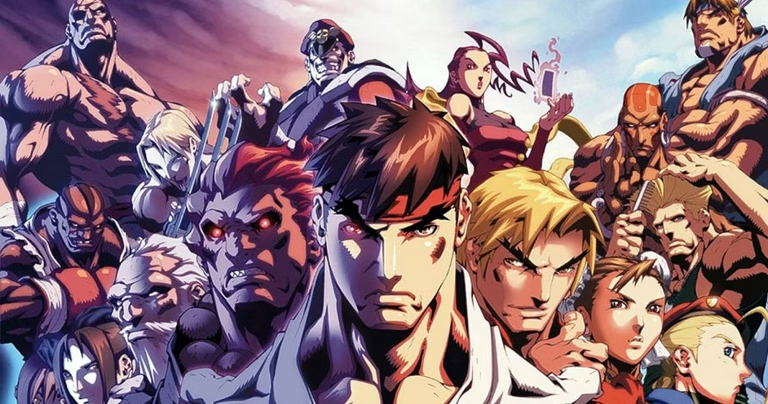
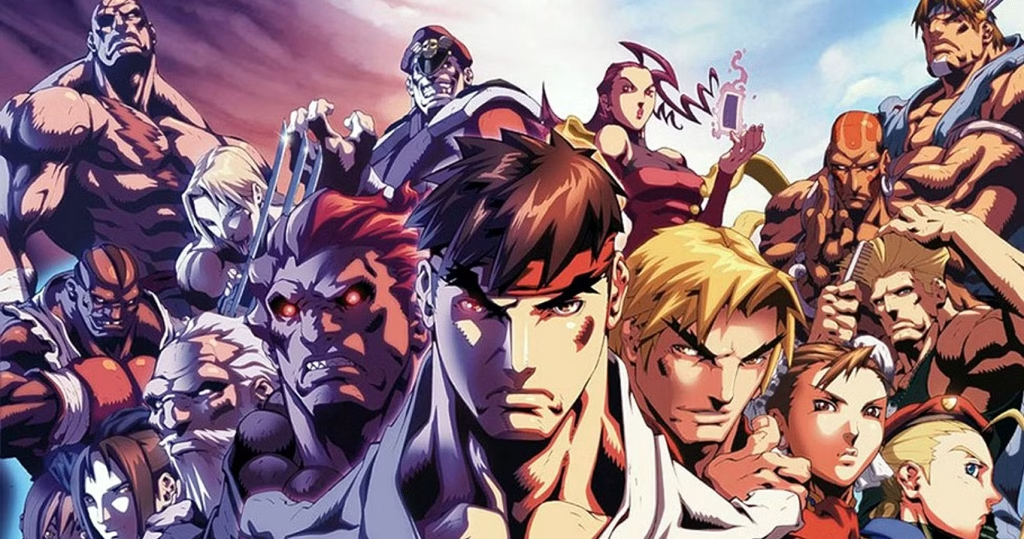
If you’ve ever hovered over an arcade cabinet, argued about who the strongest fighter is, or felt the thrill of landing a perfectly timed Hadouken, then you already understand—Street Fighter is more than just a video game. It’s a cultural force. When it first appeared in 1987, the idea was straightforward: step into the role of Ryu, take on challengers like Sagat, and prove your skill. What began as a simple fighting tournament quickly grew into something much bigger, with layered stories, rivalries, and a global stage.

Image Source: Bing Image. License: All Creative Commons

The journey from a single arcade machine to worldwide recognition didn’t happen overnight. While the original laid the groundwork, it was Street Fighter II that truly changed everything. Arcades became battlegrounds where players spent hours mastering combos, studying movesets, and finding their main fighter among an expanding roster.

That roster played a huge role in the series’ staying power. Characters like Ken Masters, Chun-Li, M. Bison, and Guile weren’t just fun to play—they had motivations and personalities that stuck with fans. Ryu’s constant drive to improve, Chun-Li’s pursuit of justice, and Guile’s personal vendetta gave the series emotional weight. It wasn’t long before these characters expanded beyond games, appearing in shows, films, and merchandise, helping cement the franchise’s place in pop culture by the ‘90s.

Even after decades, the series hasn’t lost its momentum. It continues to evolve in ways that keep fans engaged. Platforms like VeVe let players interact with their favorite fighters in augmented reality, while online communities keep competition alive through shared strategies and rivalries. The newest installment, Street Fighter 6, shows how willing the series is to experiment. Alongside new mechanics and characters, it introduces crossover fighters like Mai Shiranui and Terry Bogard from Fatal Fury—a surprising move that still feels natural within the game’s world.

That willingness to innovate is clearly working. Within just six months of release, Street Fighter 6 moved close to 2.5 million copies worldwide, becoming a standout success for Capcom during that time.

The franchise’s reach goes beyond gaming, too. A new live-action film set in 1993 is on the way, aiming to bring the iconic fighters to life on the big screen while staying faithful to their original look and feel. Early footage revealed at a major gaming event gave fans a glimpse of familiar faces like Ryu, Ken, Chun-Li, Guile, and the imposing M. Bison.

What makes Street Fighter endure isn’t just nostalgia—it’s its ability to adapt while staying true to what makes it fun. Whether you’re battling online, collecting digital versions of your favorite fighters, or waiting for the next big release, one thing hasn’t changed: the series still knows how to keep the fight alive.

Fortnite Lore Explained: Where the Story Falls Apart

0

Beyond being a battle royale powerhouse and a favorite among streamers, Fortnite is also trying to tell an ongoing story. But if you’ve ever tried to follow what’s actually happening on the island, you’re probably in the minority. Over time, the game’s narrative has split its audience in two—those who are invested in the lore, and those who are completely lost. What started as an intriguing mystery has slowly turned into something harder to follow, shifting from grand, myth-like ideas to explanations that can feel scattered or even a bit frustrating.

Image Source: Bing Image. License: All Creative Commons

Back in 2019, though, things felt different. The end of Chapter 1 wasn’t just another in-game moment—it was a massive cultural event. The meteor crash, the island’s collapse, and that eerie blackout drew attention from far beyond the usual gaming crowd. Watching it unfold live gave players a sense of being part of something bigger, and it seemed like Epic Games was building a universe with real continuity and purpose.

As time went on, that sense of direction started to fade. The storyline has never been perfectly consistent, but in recent chapters, the lack of a clear path has become more noticeable. Some seasons put the narrative front and center, like Chapter 3, Season 2 with its strong resistance theme. Others barely acknowledge it at all, leaving players wondering what’s even going on. The tone can swing wildly too—one moment you’re dealing with a reality-consuming threat, and the next you’re dropped into a laid-back, party-themed season. For players who care about the lore, that kind of inconsistency can be hard to ignore.

Things got even messier when key parts of the story started showing up outside the game. Comic series like Zero Point and Zero War, created in collaboration with Marvel and DC, revealed major details about the world—things that weren’t fully explained in-game. The problem is, not everyone had access to those comics. Many players were left piecing things together through YouTube videos or secondhand summaries, which made the overall narrative feel even more fragmented.

Crossovers, which once felt like fun extras, are now deeply woven into the story itself. Seeing characters like Spider-Man or Batman appear on the island can be exciting, and sometimes it even works within the lore. But more often, it blurs the line between Fortnite’s universe and real-world pop culture. The reveal that The Foundation is tied to Dwayne Johnson only added to that confusion. When you mix in skins based on celebrities like Ariana Grande or LeBron James, it starts to feel less like a cohesive world and more like a mash-up of everything at once.

On top of that, retcons haven’t helped. Fans once believed characters like The Paradigm and The Singularity were the same person, based on their similarities. Later, the comics presented them as entirely separate, throwing those theories out the window. Changes like that make it tough even for dedicated fans to keep track of what’s actually canon.

Then there’s the issue of repetition. The story often falls into the same pattern: a new threat emerges, the island changes, and a group of heroes steps in to save the day. Each season is hyped up with cinematic trailers, but underneath it all, the structure rarely changes. For longtime players, it can start to feel a bit too familiar.

That said, Fortnite’s story isn’t beyond saving. The world is still built, and it has huge potential, and there’s clearly an audience that wants to see it come together in a meaningful way. But until Epic Games finds a way to connect all these pieces into something more consistent, the narrative will likely continue to feel disjointed—full of ideas, but lacking the cohesion needed to make it truly impactful.

The Magic Returns in Hogwarts Legacy’s Wizarding World

Chances are, you’ve waved a plastic wand at your screen at least once, quietly whispering “Wingardium Leviosa” and hoping something might actually happen. You’re not alone—millions have been drawn into the magic of the Harry Potter universe for years. But what’s even more fascinating is how that magic has evolved in gaming. What started as simple, pixelated puzzle adventures in the early 2000s has grown into something far richer and more immersive, culminating in the beautifully detailed world of Hogwarts Legacy. It’s been quite a remarkable journey for the wizarding world.

Image Source: Bing Image. License: All Creative Commons

Early Years: Charming, Clunky, and Full of Heart

Take a step back to 2001, when Harry Potter and the Sorcerer’s Stone made its way onto platforms like the Game Boy Color, Game Boy Advance, Windows, and the original PlayStation. Those early titles weren’t exactly polished—graphics were simple, controls could feel awkward, and some moments leaned more toward frustrating than fun. Still, they carried a special kind of charm. For many fans, they offered a first real chance to explore Hogwarts in an interactive way that the films simply couldn’t provide.

Most of the gameplay closely followed the movie’s storyline, and while critics had mixed opinions, younger players didn’t mind. For them, this was their introduction to stepping inside the Wizarding World. Sure, Harry’s face looked more like a rough collection of polygons, and the castle sometimes felt more like cardboard than stone—but the sense of magic was undeniable. Even with clunky Quidditch matches and stiff spell-casting mechanics, there was something unforgettable about casting that first spell or quietly wandering the halls of Hogwarts at night.

A New Generation: Hogwarts Legacy and the Virtue of Next-Gen Magic

Leap forward two decades, and Hogwarts Legacy is the series’s most ambitious jump to date. With its breathtakingly beautiful open-world architecture, intricate character customization, and open-ended exploration of a living, breathing Hogwarts, it’s all fans ever fantasized about—and more.

The visual leap is breathtaking. A TikTok comparison by LookinAzz shows just how far things have gotten, with the neatly detailed castle in Hogwarts Legacy towering over its 2004 counterpart, while still paying homage to the original in its design. It’s a genuine graphical glow-up—one that would leave even Gilderoy Lockhart agog.

But the game’s attraction is far more than skin-deep. With its highly detailed environments, engaging side quests, dueling mechanics, and magical creature interactions, Hogwarts Legacy turns its players into magic students rather than mere spectators. Secrets lurk behind every door of the castle, and the world beyond its walls is equally as appealing—and treacherous.

PS5 vs. Switch Lite: Two Very Different Journeys

Naturally, not all wizarding adventures are equal. On PlayStation 5, Hogwarts Legacy is a visual masterpiece—detailed with lush color, immersive lighting, and silky-smooth motion. In the game, the environment is designed and detailed to the smallest pixel, from the common rooms to the Forbidden Forest. The technical brilliance is very visible through the game, whether you are flying over the Highlands or battling trolls.

The experience on the Switch Lite is limited, but surprisingly still good. The mainstay of the game is still strong,ong although the graphics are less detailed and the performance is not always smooth. The charm of cauldron stirring, casting spells, and discovering Hogwarts is still present. Moreover, the nicest thing is that your enchanting adventure can be with you wherever you go.

Fans Weigh In: Enchantment, Replayability, and a Few Frights

Fans have bestowed loads of affection on Hogwarts Legacy. Numerous fans sing the praises of the house-specific things—ranging from individual common rooms to specialized quests—and the excitement of rounding up magical creatures and equipment. One Ravenclaw enthusiast appreciated the breathtaking scenery and replayability, exclaiming that they couldn’t wait to play through each house just to see all the variations of the story.

Nevertheless, the game is not without its difficulties. Certain players have encountered the goblin battles as repetitive, while some players were caught off guard by the sheer number of spiders hiding in the Forbidden Forest. And on PlayStation, there’s a particular Hogsmeade-exclusive side quest with a house-elf that has become infamous for being a bit creepier than expected.

Magic Then and Now: A Legacy That Keeps Growing

Looking back, it’s remarkable to see how far Harry Potter games have come. The early titles may have lacked polish, but they sparked a generation’s imagination. Hogwarts Legacy, meanwhile, is both a technical marvel and a heartfelt tribute to the world fans know and love.

It’s not just a game—it’s an experience. One that blends nostalgia with modern gameplay, creating a journey that feels both familiar and fresh. Whether you’re a longtime fan reliving childhood memories or a first-year student just arriving at Hogwarts, the magic of this universe continues to evolve—and it’s never looked better.

God of War Ragnarök Raises the Bar for Inclusive Gaming Experiences

0

God of War Ragnarök serves as both a powerful conclusion to Kratos’ Norse saga and a major milestone for accessibility in modern gaming. As the industry continues to recognize that players engage with games in different ways, Santa Monica Studio’s approach stands out. While the game isn’t without flaws, its efforts to make the experience more inclusive feel significant and lasting.

Image Source: Bing Image. License: All Creative Commons

From the moment you start the game, it’s clear that player comfort is a priority. Ragnarök offers a choice between jumping straight in or going through a Guided Setup, which lets you adjust visual, audio, and accessibility settings before even reaching the main menu. There’s also a built-in screen reader that can be activated instantly, reading menus and options in a clear, structured way. For players who rely on audio guidance, this makes navigation far less intimidating.

The accessibility menu itself shows just how much thought went into the design. It includes a wide range of presets tailored to vision, hearing, motor skills, and motion sensitivity. Players can customize text size, icon size, color filters, and high-contrast visuals to suit their needs. Beyond that, there are more detailed options, such as aim assist, puzzle timing adjustments, traversal support, and auto pickup. Everything is designed to make the game easier to follow and interact with, while still giving players control over their experience.

These features don’t just look good on paper—they make a real difference during gameplay. For blind and low-vision players, the combination of audio cues, narration, and navigation support can be transformative. Actions such as attacking, blocking, and dodging are paired with distinct sounds, and there’s even a glossary to explain what each cue means. Navigation assist can guide Kratos toward objectives, allowing players to explore more freely instead of relying on fixed paths.

High-contrast mode is another standout feature. It allows players to assign bright, clear colors to characters, enemies, and interactive objects, making them easier to spot against darker environments. This is especially helpful in a game known for its moody lighting and detailed visuals, turning what could be a barrier into something manageable.

That said, the system isn’t perfect. Some players have noted that the screen reader works well in certain areas, like menus and tutorials, but doesn’t extend to others, such as the skill tree, shops, journal, or map. This inconsistency can make upgrading gear or managing side content frustrating. While options like auto-equip help a little, they don’t fully replace the need for complete accessibility across all features. In addition, although most puzzles are manageable, a few optional ones remain difficult due to limited guidance or missing audio cues.

Even with these issues, the overall experience marks a meaningful step forward. The combination of visual aids and navigation tools allows many players to explore, fight, and solve puzzles with a level of independence that wasn’t possible before. Strong audio design, including spatial sound and clear action cues, also helps bridge the gap for players with different needs.

In the end, God of War Ragnarök goes beyond simply adding accessibility features—it shows what’s possible when inclusion is treated as a core part of design. There’s still work to be done, especially in making every part of the game equally accessible. But the effort here proves that developers can deliver rich, story-driven experiences while opening the door to more players. For many, it’s not just a great game—it’s a chance to finally feel included in a world that once felt out of reach.

Bardock DLC in Dragon Ball Z: Kakarot Faces Buggy Launch and Growing Pains

Were you among the fans eagerly waiting for a new Dragon Ball Z: Kakarot DLC, only to feel let down the moment you jumped in—like a Saiyan pod crash gone wrong? You’re definitely not alone. Many players were looking forward to The Bardock – Alone Against Fate DLC as an emotional, action-packed dive into one of the franchise’s most iconic stories. Instead, what they got was a frustrating experience riddled with bugs, glitches, and technical hiccups that seem to drain even the Z-Fighters of their patience.

Image Source: Bing Image. License: All Creative Commons

Before launch, excitement around Bardock’s story was sky-high. The idea of stepping into his boots and experiencing his time under Frieza’s rule had fans buzzing. But that enthusiasm quickly faded once players started encountering problems. Reports from sources like GameRant highlighted issues on PC, including missing dialogue, absent character models, and camera angles stuck in bizarre positions—like staring at Vegeta’s feet. Some players couldn’t even start the game after updating. What should have been a quick, nostalgic playthrough—especially for those skipping side content—turned into an unexpectedly frustrating slog.

Unfortunately, this isn’t the first time Kakarot has run into trouble. Longtime players will recognize a familiar issue: save data corruption. It’s been a recurring problem since earlier DLC releases like Battle of Gods and Trunks: The Warrior of Hope. Players on forums such as GameFAQs have shared horror stories, including losing hours of progress—one even saw their level 300 Goku drop all the way down to level 89 after a corrupted save. To make matters worse, there’s still no option to disable auto-save, something many believe could have prevented these disasters. As one frustrated fan put it, a simple manual save feature could go a long way—but it remains a missing wish, even for Shenron.

Platform-specific issues only add to the chaos. On the Nintendo Switch, the base game performs decently at first, but once players reach the post-game, crashes become far more frequent—especially in docked mode. Ironically, the Bardock DLC itself seems to run more smoothly, but returning to the main game often leads to repeated crashes. Some players have found temporary relief by switching to handheld mode or restarting the console between sessions, suggesting there may be underlying memory issues at play.

Meanwhile, PlayStation 5 users have encountered a particularly strange bug: the game asks for a PS4 disc, even when running a digital PS5 version. Reinstalling doesn’t fix it, and the only known workaround involves removing any old PS4 disc from the console before launching the game.

Despite all the problems, the community’s reaction has been a mix of humor and frustration. Some players joke about the absurdity of certain glitches—like bizarre enemy encounters or overpowered DLC mechanics—while others share tips and workarounds to help each other get through the mess. Still, for every funny moment, there are plenty of players simply exhausted by constant issues. Online forums are filled with complaints, questions, and shared frustrations from fans trying to make sense of it all.

What’s perhaps most disappointing is the lack of communication from the developers. With so many ongoing issues—save corruption, auto-save concerns, and game-breaking bugs—players have received little in the way of updates or reassurance. No major patches, no clear responses—just silence, leaving fans hoping that a fix will eventually arrive.

And yet, people keep coming back. Maybe it’s the enduring appeal of the Dragon Ball universe. Maybe it’s hope that the next update will finally fix things. Or maybe, like Bardock himself, fans just aren’t ready to give up—even when everything seems stacked against them.