Home Blog Page 847

The MQ-25 Stingray and Its Impact on Modern Naval Aviation

0
Image Source: Bing Image. License: All Creative Commons

The Navy’s MQ-25 Stingray aerial refueling drone, its first fleet-based unmanned refueling aircraft, is leading the way in the most significant change in naval aviation in years. The U.S. aircraft carrier has traditionally been the core of American power projection. However, it has never been reliant on crewed aircraft for essential support operations like air refueling. With the MQ-25, all that is changed. It is an entirely new epoch where the unmanned systems not only provide support but also transform the carrier operations.

Image Source: Bing Image. License: All Creative Commons

A Historic Aviation Milestone

The MQ-25 hit the headlines in June 2021, when a test aircraft from Boeing successfully transferred fuel during flight to a Navy F/A-18 Super Hornet. The test, conducted over Illinois, was not only a technological achievement—it was a milestone in the way unmanned systems complement crewed platforms. The Super Hornet flew only 20 feet from the unmanned MQ-25, holding station through both dry and wet contacts before taking on board fuel. This wasn’t proof of concept—it was proof of capability in realistic conditions.

Image Source: Bing Image. License: All Creative Commons

More Than a Flying Tanker

Although the MQ-25’s stated purpose is to refuel carrier-based aircraft at range, its effect extends far beyond logistics. Rear Adm. John Meier, Commander of Naval Air Force Atlantic, has described the Stingray as a “revolutionary” move toward creating the Air Wing of the Future. By lifting the refueling load off F/A-18s—historically employed as ad hoc tankers—the Navy can now send more of those aircraft on strike and combat missions. The payoff? More firepower, longer reach, and greater efficiency without more pilots or platforms.

Image Source: Bing Image. License: All Creative Commons

Proven on the Deck, Ready for the Fleet

Getting an unmanned aircraft onto the tightly choreographed deck of a carrier took careful testing. Initially, engineers tested the MQ-25 at Chambers Field in Norfolk by getting it to maneuver within lines painted on mock-ups of carrier decks using remote control. The simulations later led to live demonstrations on board the USS George H.W. Bush, confirming how the MQ-25 could be incorporated into routine deck operations.

Image Source: Bing Image. License: All Creative Commons

A Strategic Building Block

The MQ-25 is not an independent test—it is the Navy’s first step toward creating a networked, hybrid force of manned and unmanned platforms. It is part of the larger movement toward manned-unmanned teaming (MUM-T), in which human pilots and autonomous vehicles work together as integrated teams.

Image Source: Bing Image. License: All Creative Commons

Future success, according to defense analyst Heather Penney of the Mitchell Institute, will not only be based on constructing cutting-edge machines, but on systems where machine and human can understand each other’s strengths and weaknesses. That’s the kind of thinking found in initiatives such as the “Two View Autonomy Framework” that seeks to close the gap between operators and engineers as autonomy becomes more prevalent.

Image Source: Bing Image. License: All Creative Commons

Moving Fast and Learning Faster

Since Boeing won the development contract in 2018, the MQ-25 program has been rapidly moving forward. Within a few years, it not only refueled an F/A-18 but also topped off an F-35C and an E-2D Advanced Hawkeye—showing its versatility throughout the fleet. The Navy has been pushing to get the MQ-25 into operational use as fast as possible, particularly as competitors are building systems intended to counter U.S. carrier superiority in high-threat operations.

Image Source: Bing Image. License: All Creative Commons

A Glimpse Into What’s Next

The deployment of MQ-25s onto Ford- and Nimitz-class carriers will change the way the Navy projects airpower. With its capability to refuel strike aircraft away from the carrier, it enables the U.S. to reach farther without getting closer to enemy defenses. But equally significant, the Stingray opens the door to future unmanned systems—from surveillance drones to autonomous strike aircraft and loyal wingmen designs.

Image Source: Bing Image. License: All Creative Commons

Each lesson gained from the MQ-25—technical, tactical, or procedural—is part of a greater push to transform naval aviation for the battles of the future. In a world defined by speed, precision, and stealth, unmanned vehicles like the MQ-25 won’t be bit players—they’ll be driving the mission.

More related images you may be interested in:

Image Source: Bing Image. License: All Creative Commons

The Montana-Class: U.S. Battleships That Could Have Dominated the Seas

0
Image Source: Bing Image. License: All Creative Commons

The Montana-class battleships represented the last major concept that characterized the era when triumph at sea was gauged by the amount of heavy armor and the loudness of big naval guns. The United States intended these vessels to be the final evolution of the battleship series, and their specifications were designed to go even beyond the mighty Iowa class, both in terms of safety and lethality. However, their designs remained only as designs that never actually materialized, being overtaken by a different conception of conflict.

Image Source: Bing Image. License: All Creative Commons

A Break from the Shackles of Treaty Constraints

International naval treaties during most of the early 20th century controlled what battleships could and could not be—how much displacement, gun caliber, and armor they could have. The Montana class broke those restraints overboard. At 121 feet in beam, they were so broad they could not fit through the original Panama Canal locks, leading to plans for a new, wider set of locks to service them.

Image Source: Bing Image. License: All Creative Commons

Planning commenced even prior to the entry of America into World War II, with Congress approving the first two ships in 1939. The design of Montana adopted the Navy’s traditional philosophy—maximum protection and maximum firepower—even if it cost it the speed characteristic of the Iowa class.

Image Source: Bing Image. License: All Creative Commons

Armor: The Heaviest Ever on a U.S. Battleship

If they were constructed, the Montanas would have been the most armoured ships ever in the history of the U.S. Navy. Their armour was designed to brush aside the enormous 2,700-pound Mark 8 “superheavy” shells—ordnance more formidable than anything the Iowa or South Dakota class had been designed to meet.

Image Source: Bing Image. License: All Creative Commons

They featured their principal armor belt, a whopping 16.1 inches in thickness, externally mounted and inclined at 19 degrees for added effective resistance. Below that, another armored belt protected against “diving shells”—armor-piercing shells with the ability to go underwater and hit beneath the waterline.

Image Source: Bing Image. License: All Creative Commons

Above, the layered deck armor gave excellent protection against aerial attack. A 2.25-inch weather deck, a 7.05-inch main armor deck, and a splinter deck up to 1 inch thick together protected against plunging fire and armor-piercing bombs.

Image Source: Bing Image. License: All Creative Commons

The turrets were just as effective—faces as much as 22.5 inches thick, three inches greater than the Iowas, with barbettes from 18 to 21.3 inches thick. No other American battleship design was comparable in terms of turret protection.

Image Source: Bing Image. License: All Creative Commons

Built to Survive Underwater Assaults

Below the waterline, the Montana class had a four-layered torpedo defense system, with liquid-filled and air-filled compartments alternating in order to absorb and distribute explosive force from torpedoes or mines. The depth of this system was among the most well-thought-out for any battleship of the period—another testament to the philosophy of the class: to endure punishment and fight on.

Image Source: Bing Image. License: All Creative Commons

The Montana class would have been a steel and firepower behemoth. But before war production priorities began turning towards aircraft carriers and fast battleships, their day had passed, leaving them as legends that never sailed.

More related images you may be interested in:

Image Source: Bing Image. License: All Creative Commons

The USS Jimmy Carter: A One-of-a-Kind U.S. Submarine

0
Image Source: Bing Image. License: All Creative Commons

Probably one of the strangest and most technologically advanced US Navy submarines to ever navigate the waters is the USS Jimmy Carter (SSN-23). The ship named after a President- a nuclear submariner trained at the beginning of the atomic era- is not only a tribute to a statesman but also a nod to the way the Navy adapts to defeat new dangers and tasks in one of the harshest areas on Earth: the deep ocean.

Image Source: Bing Image. License: All Creative Commons

The Seawolf-class was initially thought up towards the end of the Cold War, with the express purpose of being the solution to all that had been achieved by the Soviet submarine establishment. Designed to be fast, silent, and packed with firepower beyond comparison, they were to reign supreme underwater. With the end of the Cold War and the expense of the class, however, only three were ever built.

Image Source: Bing Image. License: All Creative Commons

The USS Jimmy Carter, the final of the class, distinguished itself through its construction with a significant alteration—an additional 100 feet lengthened her hull. This extension, the Multi-Mission Platform (MMP) or Ocean Interface, converted her from a cutting-edge attack submarine into an all-purpose multi-role platform unique to anything else in the fleet.

Image Source: Bing Image. License: All Creative Commons

The engineering that went into Jimmy Carter’s alterations is still staggering by today’s standards. MMP built a pressurized area within the extension—popularly called the “wasp waist” or “aquarium”—for personnel and equipment to travel through, while seawater filled the area around it to create an underwater hangar.

Image Source: Bing Image. License: All Creative Commons

It is from this location that unmanned underwater vehicles, special operations craft, and other mission equipment are launched and recovered without having to utilize the torpedo tubes. To achieve this, ballast systems, control centers, and mission spaces were redesigned. The outcome was the most costly attack submarine ever constructed, at a cost of more than $3.5 billion.

Image Source: Bing Image. License: All Creative Commons

Jimmy Carter has capabilities that no other U.S. submarine possesses. She can take Navy SEALs and their gear, conduct advanced remote-controlled vehicles, and perform very highly classified intelligence-gathering missions.

Image Source: Bing Image. License: All Creative Commons

Her capabilities include being able to communicate with undersea communications cables—tapping them, severing them, or extracting sensitive material from the ocean floor. Carrying space for as many as 50 special operations personnel and their equipment, she provides unparalleled support to clandestine operations with the speed, stealth, and attack capability characteristic of the Seawolf-class.

Image Source: Bing Image. License: All Creative Commons

Much of what Jimmy Carter has accomplished is out of public sight, but there are hints. Her crew has been presented with the Presidential Unit Citation for exceptional heroism in action, and the submarine has returned to port from time to time under the Jolly Roger—a classic naval practice indicating a successful mission. Based in the Pacific, she deploys in areas where seabed facilities, undersea cable systems, and clandestine monitoring are of increasing strategic value.

Image Source: Bing Image. License: All Creative Commons

The emergence of seabed warfare has created a new front for international competition. Underwater cables, pipelines, and sensor arrays are essential to communications, trade, and national security—but equally exposed. The Jimmy Carter provides the U.S. with an influential capability to defend these resources or, if the need arises, disable those of a competitor. In this darkened world, where activities are covered up or denied, such capabilities as hers can mean the difference between strategic leverage and vulnerability.

Image Source: Bing Image. License: All Creative Commons

The Navy is already planning for Jimmy Carter’s ultimate replacement. The upcoming Modified Virginia-class Subsea and Seabed Warfare submarine will expand on its special capabilities, integrating lessons learned from decades of clandestine operations. It will be projected to transport even more sophisticated unmanned systems, mini-subs, and mission payloads for seafloor control.

Image Source: Bing Image. License: All Creative Commons

For the time being, the USS Jimmy Carter remains an isolated instance—a unique fusion of engineering ingenuity and strategic flexibility. She is a demonstration that the submarine force is not merely about stealthy patrols and missile attacks, but it is also about dominating the unseen battles waged at the bottom of the ocean. Her legacy will define the submarines and strategies of tomorrow, and the U.S. will not lose its advantage in the constantly changing undersea battlespace.

Flying High in WWII: The Legacy of the P-38 Lightning

0
Image Source: Bing Image. License: All Creative Commons

One of the things that can still provoke amazement as well as some debates is the P-38 Lockheed, the famous twin-boom plane of the Second World War. The Lightning, with such an independently crazy technological concept as the double hull and with a history of killing the enemy, made it at the same time a marvel of technology and a weapon of psychosynthesis. It was so feared by Luftwaffe pilots that it was given a new and very memorable name: der Gabelschwanz Teufel – “fork-tailed devil”. The phrase, supposedly uttered by a German pilot in the heat of unpreparedness who was captured in Tunisia, was an epitome of the enigmatic nature of this astonishing fighter.

Image Source: Bing Image. License: All Creative Commons

A Radical Design from the Start

The Lightning’s roots go back to the late 1930s when Lockheed engineers Hall Hibbard and Clarence “Kelly” Johnson aimed to get ahead of all other fighters on the planet.

Image Source: Bing Image. License: All Creative Commons

Their creation was a beautiful twin-boom configuration driven by two turbo-supercharged engines, with the cockpit being a central pod studded with four .50 caliber machine guns and a 20mm cannon.

Image Source: Bing Image. License: All Creative Commons

This focused nose-mounted firepower eliminated the need for synchronization to shoot through propeller arcs and enabled the P-38 to release a focused, deadly burst of fire. Performance statistics were equally staggering: a climb rate of 3,300 feet per minute, a top speed of 400 mph—about 100 mph faster than its contemporaries—and a range of 1,150 miles. Early models even had a payload heavier than some B-17s of their time.

Image Source: Bing Image. License: All Creative Commons

A Plane for Every Mission

The P-38 was no one-trick pony—it was a workhorse with multiple missions. It could engage in air superiority combat, escort bombers, strafe ground targets, sink ships, or conduct high-altitude reconnaissance missions. Its photo versions took some 90 percent of the aerial photography over Europe, and it was thus a vital intelligence asset.

Image Source: Bing Image. License: All Creative Commons

Its twin engines also provided an insurance policy—if one had a failure, pilots usually were able to use the other to fly the Lightning back home, a lifesaver on long sorties over open sea or hostile country.

Image Source: Bing Image. License: All Creative Commons

Triumphs and Challenges in Combat

The Dramatic record of the Lightning was different in each case. It was a brilliant performance in the Pacific. Its rapidity, extensive range, and heavy artillery allowed American flyers to crush Japanese fighter aircraft, and more were killed in P-38s over Japan than in any other American fighter. The large distances and high-altitude flights of the Pacific were perfect for it.

Image Source: Bing Image. License: All Creative Commons

In Europe, the results were less consistent. Harsh mountainous cold, maintenance issues, and tenacious German resistance held it back. Though still a fine attack and escort plane, some pilots liked the P-51 Mustang better due to its maneuverability and the ease of its maintenance. Its unique shape also made it simple for enemy pilots to see from a distance—occasionally an asset, occasionally not.

Image Source: Bing Image. License: All Creative Commons

Operation Vengeance—The Lightning’s Defining Mission

Arguably, the most iconic P-38 mission was in April 1943. American codebreakers picked up Japanese plans that Admiral Isoroku Yamamoto, architect of the attack on Pearl Harbor, would be flying between Japanese island bases in the Solomons. To intercept and destroy him would take a 1,000-mile round trip—out of range for most fighters. The Lightning was the only plane that could manage it.

Image Source: Bing Image. License: All Creative Commons

Eighteen P-38s, commanded by Major John W. Mitchell, took a bold low-level attack to elude detection. They arrived right on schedule, shot down Yamamoto’s transport, and killed the admiral in mid-air.

Image Source: Bing Image. License: All Creative Commons

The victory was a severe psychological shock to Japan. Controversy as to who made the killing shots—Rex Barber or Tom Lanphier—would simmer for decades, but the mission itself was an indelible lesson in range, accuracy, and tactical courage.

Image Source: Bing Image. License: All Creative Commons

Continuous Improvement and the End of an Era

During the war, Lockheed developed the P-38’s design, enhancing performance, firepower, and survivability. The XP-49 project was a development to build a more powerful successor, but wartime advancements in speed and the beginning of the jet age meant Lightning’s days would inevitably be numbered by newer design concepts.

The Mustang eventually emerged as the preferred long-range escort in Europe, but the P-38’s specific strengths—particularly in the Pacific and in specialized missions—kept it at the forefront until war’s end.

Image Source: Bing Image. License: All Creative Commons

An Enduring Legacy

When naming the new F-35 Lightning II, it was no accident—it was an homage to the original P-38’s spirit. They both share a common goal: to provide U.S. pilots with unparalleled speed, adaptability, and fighting capability.

Image Source: Bing Image. License: All Creative Commons

To its pilots, the Lightning was more than a machine. Test pilot Colonel Ben Kelsey once described it as a “comfortable old cluck” that was able to “fly like hell, fight like a wasp upstairs, and land like a butterfly.” That blend of speed, firepower, and dependability made the P-38 not only fight in the war but influence its outcome, leaving a legacy as unique as its twin tails.

The B-1B Lancer and Its Lasting Impact on Modern Warfare

0
Image Source: Bing Image. License: All Creative Commons

The B-1B Lancer was for a long time the icon of the strength of the United States; however, at the beginning of 2024, it went beyond simply a power symbol. The idea was no longer how far it could reach, but to make a statement when the usage of force was out of the question. After that sad event, the B-1 demonstrated that America still has the capacity – and the willingness – to give a response of the same nature. The concerted strike following the vicious attack on Tower 22 in Jordan was the instant that altered the Lancer’s reflection from an old-time bomber into a deterrent force.

Image Source: Bing Image. License: All Creative Commons

The killing of three U.S. soldiers in that drone attack wasn’t just another event within an extended sequence of attacks—it was a tipping point. The attack, launched by Iran-backed forces with Iran-supplied drones, also injured dozens more and broke a fragile stalemate. American forces stationed in Iraq and Syria had suffered more than 160 attacks for months, but Tower 22 required something different. It required a reaction that might be able to re-establish deterrence, rather than reacting with violence to violence.

Image Source: Bing Image. License: All Creative Commons

All this at a time when the Air Force was already thinned. Just a few weeks earlier, on January 4, a B-1B had crashed on a training mission at Ellsworth Air Force Base in South Dakota. The crash closed down the base’s only runway, relocating planes and scores of airmen to temporary quarters at Dyess Air Force Base in Texas. It was a test of endurance, but bomber crews flew on, trained on, and assembled squadron by squadron in ways that increased preparedness and confidence.

Image Source: Bing Image. License: All Creative Commons

Then came the mission that would provide the moment its life-defining purpose. On Feb. 2, two B-1Bs took off from Dyess on direct presidential orders. Their target: high-priority targets in Iraq and Syria with militia ties to Iran-aligned militias. The bombers flew almost 7,000 miles on a straight-around-the-world trip—17 hours out, 17 hours back—and never landed overseas. In the words of Air War College fellow Ross Hobbs, it was the first time that the size of a combat mission had ever been conducted from all of the U.S. territory. It was history in motion.

Image Source: Bing Image. License: All Creative Commons

The strike actually happened. There were over 85 targets American forces attacked, and over 125 precision-guided munitions dropped. These were not threats; they were aimed at command nodes, intelligence nodes, weapons storage depots, and supply lines that kept the militias in business. The B-1B was selected because it could bring reach and unbridled firepower, putting it at the point of the spear.

Image Source: Bing Image. License: All Creative Commons

But most important was not the ground destruction—it was the message to the world. By conducting such a big operation without being dependent on foreign bases, the U.S. declared a potent reality: it can act independently, rapidly, and from home. In a time when access to bases and host country politics can disrupt operations, that is the tipping point.

Image Source: Bing Image. License: All Creative Commons

President Biden insisted that Americans who were attacked would be met with force, and this move solidified that. That it came on the same day the troops who were killed returned to Dover Air Force Base made the message even more powerful—it was not just payback, it was accountability.

Image Source: Bing Image. License: All Creative Commons

Over the weeks and months that ensued, the impact was experienced. The shelling of American troops in Syria and Iraq has been reduced to virtually nothing. Tehran did not desire to escalate the war, leading many to assume that the raid had achieved something greater than the objectives of the day—it changed the near-term threat context. It also caused other rivals to reconsider: American bombers can deliver a nasty and swift kick, even from the other side of an ocean.

Image Source: Bing Image. License: All Creative Commons

Additionally, the journey communicated the need to maintain the preparedness of the bombers as well as the coordination between the different squadrons. A lot of the personnel had in mind that the function of the B-1B was fading away since the newer planes were waiting to take its place, but this task proved them wrong.

Image Source: Bing Image. License: All Creative Commons

It is possible to get results from old systems if they are still up to date, if the staff is trained, and they are properly deployed. As Col. Derek Oakley of the 28th Bomb Wing put it, the interaction between Dyess and Ellsworth crews was the perfect combination of the two worlds, making it clear how well the bomber force is capable and can work together.

Image Source: Bing Image. License: All Creative Commons

Though so, the Air Force continued to balance needs and requirements near term with needs farther ahead. Preparing for B-21 Raider arrivals at Ellsworth involved short-term site relocations of bombers and troops to bases such as Grand Forks, North Dakota, with ripple effects on missions and families. It was a reminder that strategic flexibility must sometimes be achieved at some level at the expense of people.

F-22 Raptor vs Eurofighter Typhoon: The Battle for Air Superiority

0
Image Source: Bing Image. License: All Creative Commons

One of the few up-to-date air-to-air comparisons that stir a lot of debate is the F-22 Raptor versus the Eurofighter Typhoon from Europe. They are both leading-edge fighters, embodying their respective nations’ most advanced technology. However, the reality is not as simple as the media trying to tell us which one is better. After comparing each aircraft’s design, operational focus, and high-altitude performance, a lot more detail comes out.

Image Source: Bing Image. License: All Creative Commons

Essentially, these planes speak to very different philosophies regarding how to engage in combat. Lockheed Martin’s F-22, which was introduced late in the 1990s, was designed as an air-superiority fighter built with stealth in mind. It wasn’t about scoring points against the opposition—it was about being unseen until it counted. With its stealthy airframe, supercruise ability, thrust-vectoring engines, and leading-edge avionics, the Raptor represents a first-strike, information-driven approach to thinking about modern aerial warfare.

Image Source: Bing Image. License: All Creative Commons

The Eurofighter Typhoon, in contrast, followed a different path. Entering service operation in 2003 after decades of multinational co-development, the Typhoon is all about speed, maneuverability, and multi-role capability. Its delta-canard wing and narrow structure make it extremely responsive. Not as stealthy in all ways as the F-22, it uses radar-absorbent paints and has a relatively low radar cross-section for a fourth-generation fighter. One of the standout features of the Raptor is its P.I.R.A.T.E. infrared search and track (IRST) system, which can detect heat signatures—yes, even those of planes designed to be low-observable.

Image Source: Bing Image. License: All Creative Commons

Performance-wise, each aircraft performs best in its niche. The F-22’s thrust-vectoring allows for stunning maneuvers and razor-sharp turns. The Typhoon’s high thrust-to-weight ratio and low wing loading allow for rapid acceleration and sharp directional maneuverability, which make it a close-range dogfight killer.

Image Source: Bing Image. License: All Creative Commons

One of the strongest instances was during 2012’s Red Flag exercise in Alaska. German Typhoons were pitted against eight U.S. F-22s in visual-range combat. Maj. Marc Gruene, a German fighter pilot, reported that Typhoons were able to turn around the Raptors on certain instances; they themselves joked that they had “Raptor salad for lunch.” Context is key, however—Typhoons flew light, no external fuel tanks or guns, while Raptors had tanks that reduced their maneuverability, an improbable scenario during real combat.

Image Source: Bing Image. License: All Creative Commons

The F-22s were also said to have registered some kills by U.S. pilots, further showing the complexity of such exercises. Training battles have procedures, safety limitations, and equipment differences that make them not precisely replicate real-world outcomes.

Image Source: Bing Image. License: All Creative Commons

Nevertheless, one of the lessons was: the Raptor’s thrust-vectoring, while potent, can bleed energy. If a pilot pushes too hard in a turn, the F-22 can be vulnerable to “energy fighters” such as the Typhoon, which can carry on speed and re-engage successfully. As one test pilot for the Eurofighter described, not out-turning a Typhoon sets it up to launch a counterattack using its close-range missiles.

Image Source: Bing Image. License: All Creative Commons

All the same, modern air combat is not very much about dogfighting. All the action is long before aircraft are within visual distance. That is the F-22’s advantage. With stealth and cutting-edge radar, it can track and hit from a long distance, sometimes undetected. Equipped with AIM-120 AMRAAM missiles, effective to a range of 75 kilometers, the Raptor can strike before adversaries have time to know it’s there.

Image Source: Bing Image. License: All Creative Commons

The Typhoon’s IRST can detect subsonic targets at over 100 kilometers in ideal circumstances. However, stealth fighters such as the F-22 are far harder to spot using heat seekers, and its advanced electronic warfare package makes it even harder to tag. Conversely, the Raptor’s radar can detect aircraft at around 220 kilometers and engage from 180 kilometers—well beyond the Typhoon’s optimal range.

Image Source: Bing Image. License: All Creative Commons

Technicalities aside, exercises like Red Flag or Arctic Defender serve a number of purposes. NATO pilots utilize them to experiment with tactics, share strategies, and adapt to evolving combat scenarios. According to Col. Kevin Jamieson, commander of the 3rd Wing, exercises of this nature train pilots for high-threat missions where synchronized coordination can be the difference between success and failure.

Image Source: Bing Image. License: All Creative Commons

Finally, the F-22 remains peerless in stealth and beyond-visual-range fighting, while the Eurofighter Typhoon has established itself as a capable and helpful rival in close-in combat. The message is clear: no aircraft can excel at everything. Air supremacy truly comes from maximizing the strengths of an aircraft while exploiting the weaknesses of the adversary.

Pushing Boundaries: Aviation’s Most Unusual Designs

0
Image Source: Bing Image. License: All Creative Commons

World War II had a profound impact on the aviation industry, and technology was taken to the next level that nobody had imagined before. The different countries tried to outdo each other to have dominance of the sky, while at the same time, engineers were pushing the limits of their designs by trying to get an edge over the rival countries. As a result, the world got some of the weirdest, most surprising, and sometimes even the strangest planes that had ever been made. The inventions experimented with rockets to propel interceptors and flying wings, which had never been thought possible or even logical before. Here are the ten most surprising and strange aircraft of that era, with each one being a story of innovation and the desire to conquer.

Image Source: Bing Image. License: All Creative Commons

10. Martin PBM-5A Mariner

The PBM-5A Mariner was a class of America’s patrol bombers, even surpassing the legendary PBY Catalina in several missions. Developed by the Glenn L. Martin Company, it sported gull wings to maintain engines higher than sea spray and retractable wing floats to reduce drag. Its fuselage contained the bomb bay, enabling quicker flight when loaded with heavy bombs. Some models were fitted with jet-assisted take-off rockets, which made them perfect for short, steep rescue climbs. Manned by nine and equipped with several .50-caliber machine guns, the Mariner sank ten German submarines at the Battle of the Atlantic. Of over a thousand produced, just one survives today.

Image Source: Bing Image. License: All Creative Commons

9. Curtiss XP-55 Ascender

The XP-55 Ascender appeared to be straight out of a comic book, with its engine in the back, canard wing up front, and twin vertical tails on wingtips. The “pusher” design was intended to enhance visibility and focus firepower toward the nose. In spite of its radical styling, it had unstable stalls and never achieved the anticipated performance. Three were produced; two crashed, leaving one as a scarce reminder of experimental thought.

Image Source: Bing Image. License: All Creative Commons

8. Vought V-173 “Flying Pancake”

The V-173 got its nickname from its pancake-shaped, round fuselage and enormous propellers, each more than sixteen feet across. Charles Zimmerman designed it. It could take off in a very short distance and nearly hover into a stiff headwind. Its odd shape produced lift on every part of the aircraft, making it as agile as a helicopter in the air. Although its test flights were successful, the Navy had lost interest and was now interested in faster jet aircraft, and the Flying Pancake never entered production.

Image Source: Bing Image. License: All Creative Commons

7. Focke-Wulf 190D “Long Nose”

Nicknamed the “Langnasen” by German airmen, the Focke-Wulf 190D was a high-altitude interceptor with a liquid-cooled Jumo 213 engine. It was capable of speeds approaching 440 mph, making it a good match against Allied bombers. Equipped with 20mm and 13mm cannons, it was a force to be reckoned with, but wartime delays in production prevented it from being produced in numbers sufficient to be decisive. A few exist today in museums.

Image Source: Bing Image. License: All Creative Commons

6. Nakajima Ki-43 Hayabusa (“Oscar”)

The Ki-43 Hayabusa, or Peregrine Falcon, was a long-legged, agile fighter that surprised Allied pilots during the early stages of the war. More than 5,900 were manufactured. Early models did not have armor or self-sealing fuel tanks, but subsequent models addressed these defects while maintaining the aircraft’s legendary maneuverability. Only one fully complete example exists today.

Image Source: Bing Image. License: All Creative Commons

5. Mitsubishi A6M7 Reisen (Zero)

The Mitsubishi Zero was already renowned for its agility and speed, and the A6M7 variant added additional capabilities. Produced for dive-bombing off smaller carriers, it had reinforced wings and bomb racks in place of a centerline fuel tank. More than ten thousand Zeros were produced, although few survive in one piece today, and they are uncommon relics of aviation history.

Image Source: Bing Image. License: All Creative Commons

4. Horten Ho 229

The Ho 229 was a jet-powered flying wing decades ahead of its time. Its streamlined shape cut drag and radar signature, and its double engines promised up to 600 mph. It made its first flight as a prototype in 1944, but the war was over before production could start. It is one of the most advanced and innovative aircraft concepts of the era.

Image Source: Bing Image. License: All Creative Commons

3. Messerschmitt Me 262

The Me 262 was the first operational jet fighter in the world. Capable of a top speed of about 540 mph, with nose-mounted cannons, it could rip apart bomber formations before they even got a chance to respond. Though fuel shortages and unreliability restricted its impact during the war, its design shaped postwar aviation for decades.

Image Source: Bing Image. License: All Creative Commons

2. Heinkel He 178 and He 280

The He 178 was the first jet-powered plane to take to the skies in 1939. It was later followed by the He 280, the first dedicated turbojet fighter, with speeds over 550 mph. Although the Me 262 reached production earlier, these early aircraft marked the onset of a new era in aviation.

Image Source: Bing Image. License: All Creative Commons

1. Mitsubishi J8M1 Shusui / Ki-200

The rocket-plane J8M1 Shusui, based on Germany’s Me 163 Komet, was intended to shoot down high-altitude bombers. It could ascend to tremendous altitudes and achieve blistering velocities in a matter of minutes, but fuel was only good for about five minutes. Japanese technicians hacked out much of its design, and the prototype crashed on its maiden flight, killing the pilot. The war ended before it could be further developed.

Image Source: Bing Image. License: All Creative Commons

These planes show the world-class innovation and bold risks of World War II aviation. Some worked, others didn’t, but all left an indelible mark on the history of flight.

5 Long-Range Rifles That Prove Accuracy Doesn’t Have to Be Expensive

0

Image Source: Bing Image. License: All Creative Commons

Image Source: Bing Image. License: All Creative Commons

Nothing compares to a long-range shot that is successful – whether it is shooting a metal target from 1,000 yards or killing a deer from the other side of a large canyon. The biggest problem? Most of these “top guns” for long-range shooting come with such a high price that many shooters would still think twice before spending so much just for shooting from afar. However, the good news is: it is not.

Image Source: Bing Image. License: All Creative Commons

With improved production techniques and competitive forces in the firearms market, you can now acquire a quality long-range setup without breaking the bank. The rifles here all provide great accuracy (we’re talking sub-MOA with the correct ammunition), consistent performance, and sufficient adjustability to mature along with you. We’re also avoiding calibers that don’t make sense beyond 500 yards—think 6.5 Creedmoor, .308, 6.5 PRC, and like workhorses. Here’s a top 5 countdown of rifles that demonstrate you don’t need to break the bank to shoot long—and shoot well.

Image Source: Bing Image. License: All Creative Commons

5. Savage 110 Tactical

Savage has been famous for decades for making rifles that shoot better than their sticker price implies, and the 110 Tactical doesn’t disappoint. Right out of the box, it’s capable of sub-MOA groups—and in the right hands, even tighter than that. The user-settable AccuTrigger is the standout feature, allowing you to adjust the trigger pull to your liking without too much fuss.

Image Source: Bing Image. License: All Creative Commons

It’s offered in all the proper long-range calibers and typically retails in the $700 vicinity. Although there have been rare instances of tiny feeding or extraction issues, most can be ironed out by simple adjustments or upgrades. For price-conscious shooters who need accuracy and adaptability, it’s an intelligent choice.

Image Source: Bing Image. License: All Creative Commons

4. Ruger Precision Rifle

The Ruger Precision Rifle is at the high end of the budget category, but it’s here for good reason. Built as a modular precision platform from the ground up, it has earned a dedicated following for that very reason. You receive excellent out-of-the-box accuracy, plenty of aftermarket compatibility, and a chassis-style system that allows you to customize it to your liking. Some shooters do note that the action could be smoother and the finish more refined, but the performance speaks for itself. If it stretches your budget a bit, consider the Ruger American series as a more affordable alternative to build on. Overall, the RPR delivers serious long-range capability that punches above its price.

Image Source: Bing Image. License: All Creative Commons

3. HOWA ORYX

Howa may fly below the radar here in the States, but shooters familiar with precision rifles are beginning to wake up. The HOWA ORYX has a great deal to offer: a buttery-smooth bolt, a clean two-stage trigger, and a mod chassis system right out of the box. It’s also supported by a sub-MOA warranty and generally falls in the $720 to $850 price range, which is an excellent value in this category. The Howa 1500 action has a dedicated fan base, and as you become a better shooter, the design of the rifle makes it simple to customize. It’s a good entry-level rifle that won’t leave you wanting.

Image Source: Bing Image. License: All Creative Commons

2. Bergara B-14 HMR

Bergara has made its name in a hurry, and the B-14 HMR (Hunting and Match Rifle) is the reason why. Crafted around a Remington 700-style action, it presents a familiar platform with a twist of modernity—solid ergonomics, quality barrel, and the sort of accuracy you’d find in rifles far above its price point. Though the MSRP is around $1,199, real-world prices usually fall under $1,000, putting it right in the sweet spot for serious budget-conscious shooters. The action is smooth, the trigger is clean, and it consistently prints tight groups. If you’re after a rifle that’s competition-ready right out of the box, the B-14 HMR is a standout.

Image Source: Bing Image. License: All Creative Commons

1. Tikka T3x UPR (Ultimate Precision Rifle)

The number one on the list is the Tikka T3x UPR, a rifle that muddies the distinction between factory and custom-made guns. It’s hard to come by, but whoever gets their hands on one hardly regrets it. Tikka bolt actions are the stuff of legend when it comes to smooth operation and consistency, and the 70-degree bolt throw of the UPR gives the gun increased velocity and effectiveness with follow-up shots.

Image Source: Bing Image. License: All Creative Commons

Throw in a cold hammer-forged Sako barrel and a high-end trigger, and you have a rifle that shoots like a dream. Punching paper or stretching shots out at distance, the T3x UPR is match-grade accurate and built like it should cost a whole lot more. It’s the long-range shooter’s dream that can still fit into the “budget” discussion—barely.

Image Source: Bing Image. License: All Creative Commons

Optics and Ammo: Don’t Cut Corners

Even the finest rifle isn’t going to perform if the balance of your setup isn’t equally high. That includes coupling it with good glass that tracks well and is appropriate for your shooting style. You can do this without spending thousands—there are very good scopes in the $425 to $700 range that provide clean glass and solid performance. Regarding ammo, use established long-range winners such as 6.5 Creedmoor or 6.5 PRC, which have flat trajectories, excellent energy retention, and reasonable recoil. Good ammo and consistent dope will go further than you can imagine.

Image Source: Bing Image. License: All Creative Commons

Long-range shooting was once an expensive sport, but now, with current technology, it’s more affordable than ever. There are rifles available for less than $1,000 that will take you out to 1,000 yards consistently—something unimaginable a few decades ago. But equipment is only half the story. Your skill, wind-reading ability, and trigger time are equally critical. Spend money on a quality optic, shoot frequently, and get to know your rifle backwards and forwards. With proper gear and attitude, those distant targets won’t remain out of reach for long.

Air Dominance in Flux: How Shifting Tactics Challenge Global Powers

0
F-22 Raptor Stealth Fighter Gets A Spot In The National Museum Of The U ...
Image Source: Bing Image. License: All Creative Commons

For more than 20 years, the F-22 Raptor was the pinnacle of the US Air Force—a stealth fighter with amazing agility that could dominate the sky. Conceptualized during the late period of the Cold War and being the first true fifth-generation fighter to be inducted, it was the first one to combine the three virtues of the fighter jet: speed, manoeuvrability, and the latest technology.

Image Source: Bing Image. License: All Creative Commons

But with the jet growing older, the Air Force now has some uncomfortable choices to make: does it keep investing money in upgrade cycles, or start thinking about its eventual retirement?

Image Source: Bing Image. License: All Creative Commons

The Raptor’s biggest strength is also its weakness. Built primarily for air-to-air combat, it is an excellent dogfighter and air superiority fighter, but not necessarily a very multi-capable role aircraft. Stealth requires that all of the guns and most of the sensors be relocated inboard, which compresses payload capacity.

Image Source: Bing Image. License: All Creative Commons

Add weight-down missiles or bombs on the outside, and the aircraft gives up the very stealth that so effectively works. Thu, the old planes like the F-15 are used for missions where there is a need for greater firepower or stealth becomes unnecessary.

Image Source: Bing Image. License: All Creative Commons

It is difficult to modernize the F-22. Its avionics are based on old parts, so it is difficult and expensive to add new technology. Replacing its stealth coating and composite panels takes skilled labor, which incurs expense and downtime.

Image Source: Bing Image. License: All Creative Commons

Cost is one of the major reasons the Air Force is considering the retirement of some part of the fleet. Officials have indicated that they would retire 32 Block 20 Raptors—training planes with old sensors, weapons, and electronic warfare systems. Upgrading these planes to the point of full combat capability would take close to a decade and some $3.5 billion, money that could be invested in supporting newer platforms.

Image Source: Bing Image. License: All Creative Commons

Shuffling funds around would advance projects like the F-35 and Next Generation Air Dominance (NGAD) fighter. The offer has not been without its critics, however. Members of Congress have questioned why relatively young airframes would be retired and requested studies on how practical it would be to keep using them. This is reflective of a larger issue: The U.S. fighter fleet is shrinking and aging, and that leaves readiness for high-end combat in question.

Image Source: Bing Image. License: All Creative Commons


The F-22 is definitely not going anywhere anytime soon in spite of the talks. The Air Force is still pumping a lot of money into the F-22, which includes various upgrades such as extended range, better sensors, stealthy fuel tanks, new electronic warfare systems, and advanced communications. Their goal is to bring the F-22 up to par with being able to compete until another one can really replace it.

Image Source: Bing Image. License: All Creative Commons

Indeed, that replacement will be from the NGAD project, which refers to the sixth-generation fighter initiative that aims to surpass existing ones. The NGAD already did one of its flight tests on a test article, with the production contracts being worked on. The program is under criticism for costs and affordability, with estimates varying as much as $300 million per aircraft.

Image Source: Bing Image. License: All Creative Commons
Right now, the Raptor is an isolated player. The delay or funding issue with NGAD would mean longer-than-expected flying of upgraded F-22s and F-15EX fighters. On the other hand, the technological edge that the U.S. has been enjoying for decades is narrowing due to the development of advanced stealth aircraft and longer-range missiles by other countries.

Image Source: Bing Image. License: All Creative Commons

The F-22 dispute is not a relevance dispute; it is a strategy dispute. It is a question of the method of keeping air superiority at all times, as well as wisely investing in the aircraft of the future. What American airpower will be in the next two years is going to be the deciding factor for the following several decades.

Zumwalt’s Evolution: The Navy’s Stealth Destroyer Finds Its Role

0
Image Source: Bing Image. License: All Creative Commons

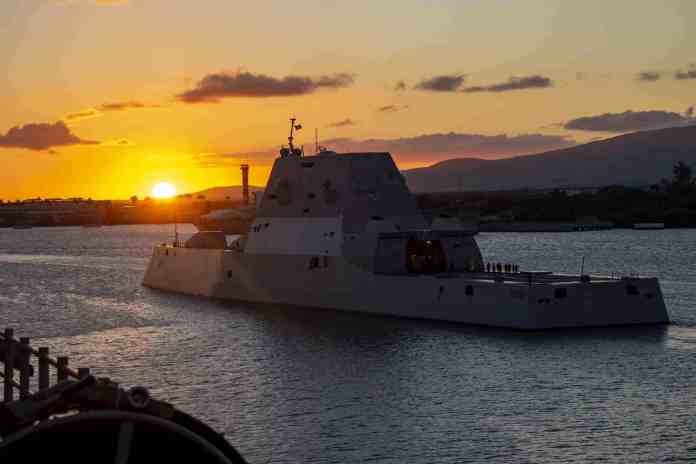
USS Zumwalt (DDG-1000) was once described as the future face of naval warfare – a next-generation high-tech destroyer with its sleek, stealthy design and not one but two 155mm Advanced Gun Systems (AGS) capable of launching shells deep into the target area. The Navy’s starting point was somewhat exaggerated: 32 ships of the Zumwalt-class, where each one would have been the most powerful in the world. However, the sky-high dream was gone with the second-hand wind. Expenses going up, problems becoming technical, and changing plans led to the production of only three ships. There still is a $22 billion monument of daring innovation and the catastrophe of overextending. One modern combat Desert Storm was a record-breaker even before the war started.

Image Source: Bing Image. License: All Creative Commons

Zumwalt’s initial showpiece was the AGS, which could launch GPS-guided Long Range Land Attack Projectiles (LRLAP). The projectiles could dive onto targets with near-vertical accuracy. The rub? Every shot would have had a mind-boggling price of approximately $800,000, much too expensive for prolonged use.

Image Source: Bing Image. License: All Creative Commons

With changing naval priorities away from the closer-shore bombardment and into the open ocean competition, the AGS soon lost its utility. Ideas such as railguns, planned originally for Zumwalt’s enormous power supply, were also abandoned, with much of the destroyer’s potential left unexplored.

Image Source: Bing Image. License: All Creative Commons

The break came with the decision to equip Zumwalt with hypersonic missiles. To accomplish this, the Navy refurbished the vessel at Ingalls Shipbuilding in Mississippi, taking her out of the water for a year of upgrades. The heavy AGS turrets were expunged—one replaced with launch canisters for the new Conventional Prompt Strike (CPS) missile, and the other left open for future configurations.

Image Source: Bing Image. License: All Creative Commons

Now, Zumwalt is capable of carrying twelve CPS missiles, each a boost-glide weapon with the ability to hit targets at ranges of up to 1,725 miles with velocities of over Mach 5.

Image Source: Bing Image. License: All Creative Commons

This change was not just a weapons upgrade—it was a shift in mindset. Hypersonic missiles can race toward their destinations so rapidly that defense systems have trouble responding, whether the target is a ship, command post, or key infrastructure. CPS tests have already been successful, and future refinements can potentially enable such missiles to change course during flight or even pursue moving targets. In an age where speed and accuracy are the measure of survival, Zumwalt suddenly found her niche.

Image Source: Bing Image. License: All Creative Commons

But the ship is about more than firepower. Her Integrated Power System (IPS), fueled by two Rolls-Royce MT30 gas turbines, produces 78 megawatts of electricity. Even operating at 20 knots, the destroyer has power to spare—enough to power 10,000 houses. That excess makes her an obvious proving ground for future directed-energy weapons and next-generation sensors. Her wave-piercing tumblehome hull and composite deckhouse make her harder to see, although subsequent modifications have minimized her stealth profile.

Image Source: Bing Image. License: All Creative Commons

Despite being challenged regarding her design, Zumwalt still holds formidable power. She is equipped with 80 PVLS or Peripheral Vertical Launch System cells for Tomahawk, Standard Missile, Evolved Sea Sparrow Missile, and anti-submarine rockets. The 147-strong, elegant complement of the Navy, with accommodation for 28 Marines, is a clear indication of the Navy’s move towards the efficient use of resources and reduced manpower requirements. Apart from that, her SPY-3 radar enables easy tracking of threats from the air or surface in enemy territories.

Image Source: Bing Image. License: All Creative Commons

The hypersonic upgrade adds actual heft to her mission. The CPS also has the same Common Glide Body design as the Army’s Long Range Hypersonic Weapon, making it easier and less expensive to produce. Navy leaders can’t wait to fully integrate it into its fleet, recognizing that having such an ability at sea has the potential to revolutionize fleet operations in the coming years.

Image Source: Bing Image. License: All Creative Commons

It’s a narrative of ambition and restraint in many senses. Risks are involved in taking pioneering new technologies—overruns, canceled projects, and shifting missions—but the ship’s power systems, stealth design, and now hypersonic strike capability are enormous accomplishments. What’s been learned is already influencing the next generation of DDG(X) destroyers, which are set to combine the innovations of Zumwalt with the reliability of established Arleigh Burke designs.

Image Source: Bing Image. License: All Creative Commons

As the Navy strides into the future, Zumwalt’s destiny remains to be written. Will she be the hypersonic giant in waiting, or a multi-billion-dollar experiment? Today, she remains evidence of what occurs when bold concepts are pushed at sea—a warship conceived in innovation, reshaped by pragmatism, and still at the vanguard of naval combat.