Home Blog Page 216

15 LGBTQ+ Powerhouses Making Waves Across Entertainment

0
Image Source: Bing Image. License: All Creative Commons

It’s really strong how the media can affect us when we see our own reflection there. LGBTQ+ game, anime, movie, and TV fans have mostly experienced representation as a transition from mere clues to being boldly visible. It has been exciting, annoying, and sometimes revolutionary, but always significant. Today, we honour 15 influential LGBTQ+ celebrities from music, film, and television who have dismantled obstacles, created paths for inclusivity, and made millions of people feel genuinely seen.

Image Source: Bing Image. License: All Creative Commons

15. Adam Lambert

Before he stepped onto the American Idol stage, openly gay male artists rarely occupied the mainstream spotlight. Following his 2009 coming-out interview with Rolling Stone, Lambert’s soaring vocals, glam-rock style, and fearless performances have made him a beacon of LGBTQ+ visibility in the music industry. From touring with Queen to releasing a spate of hit albums, Lambert has used his platform consistently to advocate for equality and has been awarded for it, including the GLAAD Media Award. He has made one thing crystal clear in pop culture: authenticity can-and should-go hand-in-hand with mainstream success.

Image Source: Bing Image. License: All Creative Commons

14. Troye Sivan

In 2013, Australian singer, actor, and YouTube personality Troye Sivan came out to his fans through an emotional video. Since then, he’s become an icon to young queer audiences around the world, mixing dreamy pop anthems with heartfelt storytelling. Sivan’s rise into film and music represents a commitment to bringing both visibility and hope to young LGBTQ+ people, proving that to be true to oneself has resonance far beyond the screen or stage.

Image Source: Bing Image. License: All Creative Commons

13. George Michael

George Michael made sure to leave his indelible mark upon pop history, from Wham! to his solo, legendary career. He came out in the late 1990s and used his celebrity platform to raise awareness about HIV/AIDS, speaking publicly about his own struggles and providing inspiration and solidarity to fans. Michael’s mix of vulnerability, honesty, and artistry forged a trailblazer whose influence can still be felt years following his eventual passing.

Image Source: Bing Image. License: All Creative Commons

12. Rob Halford

Rob Halford is a true innovator when it comes to heavy metal, being the frontman of Judas Priest. Coming out as gay in 1998, he disregarded long-standing stereotypes within such a genre defined by machismo and proved that being authentic is truly an act of rebellion. Halford opened doors to queer artists in rock and metal, revealing that identity and artistry are not mutually exclusive.

Image Source: Bing Image. License: All Creative Commons

11. Sam Smith

Sam Smith burst onto the world stage with their soulful voice and hits like “Stay With Me,” stealing hearts from the very beginning. From coming out as gay in 2014 and later identifying as non-binary in 2019, Smith has been commendably candid regarding both their process and their struggles. Using their platform through music and interviews, Smith advocates for LGBTQ+ rights and mental health. Their honesty about identity and body image has made them a trailblazer for non-binary representation in mainstream music, inspiring fans around the globe.

Image Source: Bing Image. License: All Creative Commons

10.​‍​‌‍​‍‌​‍​‌‍​‍‌ Ricky Martin

As a matter of fact, it was quite a challenge for Ricky Martin to decide between keeping his queerness a secret and risking his career. Eventually, in 2010, when he came out publicly, it was a great relief for him to be recognised, and he took part as a fervent advocate in the LGBTQ+ movement. Besides his music career, Martin also set up a non-profit organisation aimed at protecting children’s welfare and promoting human rights. His transformation from a pop star in the closet to a publicly outspoken activist has been a source of motivation for many of his fans to live authentically and accept ​‍​‌‍​‍‌​‍​‌‍​‍‌themselves.

Image Source: Bing Image. License: All Creative Commons

9. Lady Gaga

Few artists have intertwined queer visibility and mainstream pop as seamlessly as Lady Gaga. Openly multi-gender attracted and a fierce advocate for the LGBTQ+ community, Gaga’s music, activism, and her Born This Way Foundation have transformed countless lives. She has helped young LGBTQ+ fans feel comfortable in their own skin, showing that artistry and advocacy can amplify one another in profound ways.

Image Source: Bing Image. License: All Creative Commons

8. Elliot Page

Elliot Page has been a recognisable figure on-screen for years, from Juno to The Umbrella Academy. Since coming out as gay in 2014 and later as transgender in 2020, Page’s candour has ignited hope within countless fans navigating their own identities. Becoming the first openly trans man to ever grace the cover of Time magazine proved a historic moment, further cementing Page as a key figure in trans visibility for Hollywood.

Image Source: Bing Image. License: All Creative Commons

7. Lil Nas X

Lil Nas X broke through with the viral hit “Old Town Road,” rewriting the rules of genre and identity. After coming out as gay at the height of his fame, he has become a beacon for unapologetic self-expression, fusing rap, country, and queer aesthetics in ways that spark conversation and celebration. His boldness encourages LGBTQ+ youth to proudly be themselves, regardless of judgment.

Image Source: Bing Image. License: All Creative Commons

6. Sir Elton John

He is a living legend whose influence far exceeds the reaches of the music industry. After he came out in the 1970s and then identified as gay, Elton combined artistry with activism, particularly over HIV/AIDS awareness via the Elton John AIDS Foundation. Throughout his many-decade career, he evokes the power that visibility and philanthropy hold, and he has inspired literally thousands of artists and fans.

Image Source: Bing Image. License: All Creative Commons

5. Freddie Mercury

Queen’s Freddie Mercury rewrote the rules of rock stardom. With his powerhouse vocals, theatricality, and unapologetic individuality, he made a mark on music and queer visibility that will never be forgotten. His death from AIDS in 1991 brought worldwide attention to the disease and the LGBTQ+ community, setting in stone his status as a groundbreaking icon whose influence continues unabated.

Image Source: Bing Image. License: All Creative Commons

4. Kristen Stewart

Kristen Stewart is well-known through Twilight and indie films; she came out in 2017 as multi-gender attracted. Being open about her identity and the difficulties of representation, she challenges Hollywood stereotypes and provides a blueprint for authenticity in a restrictive industry. It’s Stewart’s openness that truly makes her a role model for a queer woman or non-binary fan navigating her path.

Image Source: Bing Image. License: All Creative Commons

3. RuPaul

Legendary are RuPaul’s contributions to television and queer culture alike. Through RuPaul’s Drag Race, this reality show has grown beyond a reality program; it is a cultural phenomenon, bringing drag to the mainstream and celebrating individuality. Through humour, glamour, and creativity, RuPaul inspired audiences to celebrate their uniqueness with pride, proving that queerness is something to be celebrated and not hidden.

Image Source: Bing Image. License: All Creative Commons

2. Billy Eichner

Comedian and activist Billy Eichner has championed the demand for more realistic LGBTQ+ representation in TV and film. His work on projects such as Bros and his vocal activism bring a spotlight to what is required: stories with queer characters front and centre, not as sidekicks or stereotypes. Eichner’s hilarious brand of activism places him among the most influential voices in the queer entertainment world today.

Image Source: Bing Image. License: All Creative Commons

1. Elliot Page (Honorable Mention)

Page’s continuing presence as a trans actor in major Hollywood productions serves to inspire millions. Their candid discourses about identity and the trials of being trans in the public eye have shifted perceptions and given young people a model for living authentically. Page’s impact underscores the importance of representation in shaping understanding and acceptance.

Image Source: Bing Image. License: All Creative Commons

All progress considered, there’s still a long way to go. In 2023, only 1.2% of speaking characters in top-grossing films were identified as LGBTQ+, and not one transgender character appeared in the 100 highest-grossing movies. Queerbaiting-hinting at queer identities without actually providing representation-is a frustratingly common tactic that more often than not leaves fans feeling unseen.

Image Source: Bing Image. License: All Creative Commons

But visible LGBTQ+ celebrities make a difference. They help reshape perceptions, give voice to young people searching for their identities, and remind us that queerness is something valid and beautiful. From the anthems of Lady Gaga, through the courageous truth of Elliot Page, to RuPaul’s runway revolution, they all prove that representation isn’t just about who’s onscreen but rather who feels like they are.

The 10 Most Powerful Acting Moments Ever on Screen

0
Image Source: Bing Image. License: All Creative Commons

There is something almost magical when an actor really loses himself in a part to such an extent that you forget that what you are witnessing is merely a play. The very essence of great acting is not merely the demonstration of skill, but also the skill of transformation, courage, and even a hint of madness at times. Here we have rounded up the 10 most striking performances in recent times, ranging from method acting to TV antiheroes to those film characters who have attained the status of legends, all listed in the reverse order of their greatness so as to keep the suspense intact.

Image Source: Bing Image. License: All Creative Commons

10. Cate Blanchett as Lydia Tár in Tár

Cate Blanchett gives a powerhouse performance as the fictional conductor Lydia Tár, instilling a sense of authority while retaining a high degree of fragility within her role, one that teeters close to obsession and unravelling. It’s a masterclass in psychological depth, compelling both the magnetism and frailty of this character spiralling out of control. Blanchett commands your attention on screen; Tár is the defining moment in her career.

Image Source: Bing Image. License: All Creative Commons

9. Jodie Comer – Villanelle, Killing Eve

Villanelle is more than a killer; she is stylish, unpredictable, and endlessly entertaining. Jodie Comer brings danger, charm, and an impeccable sense of humour to the character, making her terrifyingly captivating. From one-liners about killing to dramatic fashion choices, Comer proved time and again that villains can steal the spotlight just as well as heroes do.

Image Source: Bing Image. License: All Creative Commons

8. Christian Bale in The Machinist

Christian Bale has a reputation for being really methodical with his acting, and The Machinist stands as a pretty sharp example. His dramatic physical transformation for the role was nothing short of the stuff of legends, a commitment to realism that makes his performance impossible to ignore; Bale really pushes the boundaries of what it means to fully inhabit a character.

Image Source: Bing Image. License: All Creative Commons

7. Angelina Jolie as Maleficent

Jolie’s Maleficent is a study in elegance, menace, and emotional depth; with knife-sharp cheekbones, piercing eyes, and striking presence, she imbues what has been a staple Disney villain with depth and complexity to become an antihero. Elegant and substantive, Jolie gives audiences a villain who is as compelling as she is glamorous.

Image Source: Bing Image. License: All Creative Commons

6. Jennifer Lawrence in Silver Linings Playbook

As Tiffany, Jennifer Lawrence gives a raw, unpredictable, and very human performance. Her willingness to show the messy, imperfect side of her character resonates with audiences, making this performance both amazingly grounded and electrifying. Working with method actors like Christian Bale has helped refine her craft; this is probably one of her most memorable roles.

Image Source: Bing Image. License: All Creative Commons

5. Sharon Stone as Catherine Tramell in Basic Instinct

Catherine Tramell is the ultimate femme fatale, and Sharon Stone’s portrayal is seductive yet mysterious. She brings an inescapable blend of glamour, danger, and intelligence in a role that keeps one guessing until the last moment. Her performance remains iconic for its unflinching ambiguity and captivating screen presence.

Image Source: Bing Image. License: All Creative Commons

4. Jim Caviezel in The Passion of the Christ

Playing Jesus is a monumental challenge, but Jim Caviezel approaches it with deep conviction and vulnerability. His performance is marked by emotional intensity and spiritual dedication, reflecting a career guided by personal faith. Caviezel’s portrayal resonates with audiences as both moving and unforgettable.

Image Source: Bing Image. License: All Creative Commons

3. Mayim Bialik as Amy Farrah Fowler in The Big Bang Theory

Mayim Bialik brings authenticity and heart into Amy, adding much of her real personality and values to the character. She was serious about the portrayal of Amy, making her intelligent, quirky, and relatable-one of TV’s most memorable characters. From what she wore to how she presented herself on social media, the active participation of Bialik made Amy a whole and lovable character.

Image Source: Bing Image. License: All Creative Commons

2. Linda Bove as Linda the Librarian in Sesame Street

Beyond acting, Linda Bove’s role has been one of educating generations of children in American Sign Language and an authentic representation of the deaf community on screen. The character remains the longest-running recurring character for an actor with a disability on television true example of the power of representation. Her work continues to be an example and even an inspiration for more inclusive portrayals of characters with disabilities.

Image Source: Bing Image. License: All Creative Commons

1. Cate Blanchett as Carol Aird in Carol

Cate Blanchett plays Carol, a woman so utterly conflicted by the whims of love and longing amidst societal requirements, with one of the subtlest performances of her career. With spare gestures, glances, and restraint, Blanchett conveys volumes without ever saying a word. The quiet power of forbidden love reaches a peak in this performance, making it a truly unforgettable cinematic achievement.

Image Source: Bing Image. License: All Creative Commons

From breathtaking transformations to unforgettable screen presence, these performances remind us why acting can move us so profoundly. They don’t just tell stories-they make us feel and empathise, and remember. In modern film and television, they have set the standard for what it means to truly vanish into a role and leave an indelible mark in the minds of all of us.

10 Shows That Found New Life After a Major Cast Departure

0
Image Source: Bing Image. License: All Creative Commons

We all know it, the death of a beloved character is something really hard to take. No matter if they fire themselves out like a rocket into the sky or simply disappear unexpectedly, the fans get angry, write very deep analyses, and put away a lot of the handkerchiefs. Still on television, the exit of a leading character doesn’t always mean a disaster. It can be the very thing the show needs to rejuvenate itself. Below are 10 TV series that improved, got funnier, or more thrilling after a significant character was gone.

Image Source: Bing Image. License: All Creative Commons

10. Peaky Blinders – Freddie Thorne

Freddie Thorne had stirred up controversy since the very beginning; his storyline was inextricably linked with Tommy Shelby’s and Ada’s. But when he was surprisingly killed off between seasons, Peaky Blinders did not falter-it improved. Ada’s character grew more three-dimensional, and the Shelby family’s storyline deepened into even darker, more interesting areas, proving that a well-placed death serves to open doors rather than shut them.

Image Source: Bing Image. License: All Creative Commons

9. Community – Troy and Pierce

Season four, though usually deemed as the “gas leak year,” was a struggle for Community, but the show seemed to find its renewal through the loss of Troy and Pierce during season five. Their absence really shook up the dynamics of Greendale, allowed new storylines to open up, and created the opportunity for many guest characters. The uniqueness in the magic of the original ensemble was undeniable, but later seasons ultimately became more and more inventive, proving how fresh challenges can spark creativity.

Image Source: Bing Image. License: All Creative Commons

8. The Expanse – Josephus Miller

Detective Josephus Miller anchored the early seasons of The Expanse, bringing a noir sensibility and an emotional center to the series. But when his arc wrapped up in season two, the series didn’t falter-it really took off. The writers dove into other bold new narratives, expanding their universe solidly into modern sci-fi masterpiece territory. Miller’s exit marked a turning point that proved that sometimes following the source material is not only right but also results in even greater rewards.

Image Source: Bing Image. License: All Creative Commons

7. Torchwood – Owen Harper & Toshiko Sato

Owen and Toshiko were the heart of Torchwood’s early seasons, but their dramatic double-death in the finale of season two paved the way for Torchwood: Children of Earth, widely regarded as the show’s crowning achievement. Removing the original cast members gave the series narrative freedom, allowed for darker, higher-stakes storytelling, and proved that sometimes a dramatic exit is exactly what a show needs to hit its stride.

Image Source: Bing Image. License: All Creative Commons

6. Babylon 5 – Commander Sinclair

The character Sinclair, played by Michael O’Hare, led Babylon 5 throughout its first season, but his departure freed room for John Sheridan, and it was here that the series truly found its footing. Sheridan’s leadership merged with the rise of the show as one of the benchmarks for serialized sci-fi, showing how even early departures can be a boon to a story’s long-term arc, if handled thoughtfully.

Image Source: Bing Image. License: All Creative Commons

5. Game of Thrones – Ned Stark

Ned Stark’s shocking demise in the first season of Game of Thrones instantly told audiences that anything could happen. The killing of the supposed protagonist set the tone for the series’ ruthless approach to storytelling. From then on, tension, suspense, and unpredictability fueled the show, furthering its fantasy juggernaut reputation.

Image Source: Bing Image. License: All Creative Commons

4. The Walking Dead – Shane Walsh

Early on, Shane was the volatile presence who was Rick’s former best friend. His dramatic exit opened up new character dynamics and allowed the show to grow beyond early love triangle tensions. With Shane gone, the series could shift focus to larger threats, deeply develop more interesting storylines, and eventually hit some of its strongest seasons.

Image Source: Bing Image. License: All Creative Commons

3. Star Trek: The Next Generation – Tasha Yar

Tasha Yar’s premature demise was a shock, and it indeed left a gap in the Enterprise crew. Yet, it also allowed Worf to evolve into the Chief of Security position. Certainly, Worf’s continued presence helped enrich the storylines and character interplay on the show. In that regard, a major exit can sometimes strengthen a series’ ensemble and add new depth to its narrative.

Image Source: Bing Image. License: All Creative Commons

2. Angel – Allen Doyle

Allen Doyle brought humor and heart to Angel’s formative episodes, but his sacrifice in “Hero” forever changed the tone of the series. With Doyle gone, the show adopted darker, more mature storylines, and the arrival of Wesley Wyndam-Pryce completed the team. The series became something much grittier and emotionally resonant, which separated it from Buffy.

Image Source: Bing Image. License: All Creative Commons

1. Parks and Recreation – Mark Brendanawicz

Mark Brendanawicz’s exit from Parks and Recreation could have been a loss that proved a turning point. Once Ben Wyatt and Chris Traeger joined the ensemble, the show found its comedic rhythm, and the cast blossomed into one of TV’s most beloved teams. Sometimes the exit of a straight-laced character is just what a show needs to unlock its full potential.

Image Source: Bing Image. License: All Creative Commons

So the next time a favorite character disappears from your screen, don’t despair. While it may sting at first, their exit might be the catalyst that takes a good show to great.

10 Actors Who Stole the Show with Their Dance Skills

0
Image Source: Bing Image. License: All Creative Commons

Some actors just, simply, moveemotionally or physically. It doesn’t matter if they are doing a fight sequence at a high speed and with great fluidity, reciting a monologue with passion, or just going into a room as if it were their home; one cannot deny that their movement has “something”. Most of the time, that “something” is coming from dance, surprisingly.

Image Source: Bing Image. License: All Creative Commons

Many of the Hollywood stars that we see in the theaters today were not the creative students of acting, but of dancing. Their years of discipline, poise, and nonverbal communication through the body have been the foundation of screen presence that we are used to seeing today. Without a doubt, actors are dancers too: from ballet schools to hip-hop crews, here are ten actors who leveraged their dance origins into acting dynasties.

Image Source: Bing Image. License: All Creative Commons

10. Audrey Hepburn

Prior to Audrey Hepburn being the master of on-screen sophistication, she was a serious ballet student. She trained at the Arnhem Conservatory in the Netherlands under the celebrated ballerina Sonia Gaskell. Though later informed by her teachers that she didn’t exactly possess the build for a career in professional dance, the expressiveness, posture, and grace she had acquired lingered with her throughout her life. You can observe it in the fluid manner in which she glided through Breakfast at Tiffany’s and Roman Holiday—each step, each gesture exuding poise. Hepburn may have abandoned ballet, but dance never abandoned her.

Image Source: Bing Image. License: All Creative Commons

9. Julianne Hough

Julianne Hough’s career took off years before Hollywood knocked. As a teen, she wowed crowds on Dancing with the Stars, her precision and energy tending to make her the popular favorite. That same confidence translated over to her film career in Footloose and Safe Haven. Her capacity to inhabit rhythm and emotion allowed her performances to feel effortless, something that few others could match. Now, Hough still bridges her two worlds with her wellness and movement company, KINRGY, showing the world that dance isn’t a talent for her but rather a calling that lasts a lifetime.

Image Source: Bing Image. License: All Creative Commons

8. Jennifer Lopez

Jennifer Lopez is a self-declared “dancer first”—and it’s apparent in everything she does. Before becoming J.Lo, the international pop superstar and movie star, she was a backup performer for New Kids on the Block and one of the legendary Fly Girls on In Living Color. Her schooling provided her with unparalleled stage presence and tenacious physicality that permeates her work, whether she’s dominating the stage during a concert or firing up powerhouse scenes in Hustlers. Lopez’s success story is proof that when you can master movement, you can master a crowd.

Image Source: Bing Image. License: All Creative Commons

7. Penélope Cruz

Penélope Cruz spent nearly a decade immersed in classical ballet at Spain’s National Conservatory, where she learned the discipline, control, and emotion that would later define her acting. Although she eventually traded the barre for the big screen, that training shaped her resilience and precision as an artist. No matter if she’s portraying fiery or contained characters, Cruz has an attention to body language that serves her well. Her Oscar-winning performances are more about expression and movement than dialogue—a dancer’s talent in disguise.

Image Source: Bing Image. License: All Creative Commons

6. Diane Kruger

Growing up, Diane Kruger imagined a stage life as a ballerina. She attended London’s prestigious Royal Ballet School before a knee injury cut short her dancing dreams. That loss, though, steered her towards modeling and, ultimately, acting. Kruger has mentioned that her ballet years provided her with a sense of physical expression of emotion—something that is showcased in movies such as Troy and Inglourious Basterds. She may have no dance stage to perform on, but she still acts with the poise and control of one who’s learned how to convey a story in movement over the course of years. 

Image Source: Bing Image. License: All Creative Commons

5. Charlize Theron

Before she became one of Hollywood’s most formidable actresses, Charlize Theron was a serious ballet student at New York’s Joffrey Ballet School. But after a series of injuries compelled her to drop out, she redirected her focus to acting. That discipline and physical sensitivity remained with her, however, informing her authoritative on-screen presence. From the intensity of Mad Max: Fury Road to the eerie transformation in Monster, Theron has attributed her dance training with showing her how to be in her body, and thus, her characters, totally truthfully.

Image Source: Bing Image. License: All Creative Commons

4. Michelle Yeoh

Before she was jumping from rooftop to rooftop in Crouching Tiger, Hidden Dragon, Michelle Yeoh studied ballet at London’s Royal Academy of Dance. A spinal injury cut short her dancing dreams, but also provided a new type of artistry. Yeoh’s smoothness, poise, and control easily translated into action cinema. Her gift for blending elegance with brute force made her one of the most compelling action actresses of all time. And with her Oscar-winning performance in Everything Everywhere All at Once, Yeoh showed that a dancer’s instincts can deliver both poise and ferocity onto the screen.

Image Source: Bing Image. License: All Creative Commons

3. Zoe Saldana

Zoe Saldana’s entry into acting started in the dance studio. She was trained in ballet at ECOS Espacio de Danza Academy in the Dominican Republic and learned how to express emotion through body language years before she uttered her first line of dialogue. That training made her a natural candidate for physically demanding parts, such as Neytiri in Avatar or Gamora in Guardians of the Galaxy. Her movements look intuitive and strong—each action part of the narrative. Saldana’s success is evidence that a dancer’s physical storytelling works wonderfully in the world of cinema.

Image Source: Bing Image. License: All Creative Commons

2. Anya Taylor-Joy

Anya Taylor-Joy frequently attributes her ballet training as an integral aspect of her acting work. Ballet, she explains, instilled in her emotional concentration and precision—abilities she directs toward her richly nuanced characters. Director George Miller even attributed her background in dance as part of the reason he chose her to play Furiosa for Furiosa: A Mad Max Saga. Each deliberate gesture and look in The Queen’s Gambit feels choreographed in its purpose. For Taylor-Joy, the rigors of dance didn’t merely build her body up—it instructed her in how to convey entire worlds through stillness and movement both.

Image Source: Bing Image. License: All Creative Commons

1. Mason Thames

The youngest name on this list, Mason Thames, started his creative career doing tour work with a ballet company as a kid. That early exposure instilled him with an incredible sense of stage presence and storytelling in motion, which he carried into his breakout performance in The Black Phone. Now playing Hiccup in the live-action How to Train Your Dragon, Thames continues to draw on the focus and discipline he developed in dance. His ascension reminds us ballet isn’t just about elegance—it’s about determination, detail, and emotional expression.

Image Source: Bing Image. License: All Creative Commons

For some celebrities—Hepburn and Lopez among them—dance was the catalyst that fueled their defining on-screen charm. For others—Theron, Kruger, and Yeoh among them—injuries that could’ve derailed their careers steered them toward the screen, but their dancer’s discipline informed everything that came next. What these performers have in common is a latent physical intelligence—the capacity to tell a story not only through dialogue, but through movement, posture, and presence. In Hollywood, scripts can propel the plot, but for these actors, the true magic often begins in the beat of a dancer’s heart.

15 Black Entertainers and Musicians with Military Service

0
Image Source: Bing Image. License: All Creative Commons

Before they topped the charts, packed the arenas, or lit up the big screen, these entertainers and musicians answered a different call: to serve their country. For some, the military provided structure and opportunity. For others, it was a turning point that influenced their worldview and artistic voice. In each instance, their time in the military became a part of the story behind their success. Here are 15 Black celebrities and musicians whose military service contributed to the legends they became.

Image Source: Bing Image. License: All Creative Commons

15. Zach Bryan

Before his raspy, heartfelt songs turned him into a country sensation, Zach Bryan was serving as a Petty Officer Second Class in the U.S. Navy. Military service runs deep in his family, and he carried that legacy forward while stationed overseas in places like Bahrain and Djibouti. During deployment, he began writing and posting songs online. A simple iPhone video of him performing “Heading South” outside his Navy barracks went viral, launching his career almost overnight. Bryan stayed in the Navy until 2021, when he received an honorable discharge to pursue music full-time. His songwriting still carries the honesty and grit that defined his years in uniform.

Image Source: Bing Image. License: All Creative Commons

14. Sturgill Simpson

Sturgill Simpson enlisted in the U.S. Navy right after high school and was stationed in Japan with the Pacific Fleet. The experience exposed him to a world far beyond his Kentucky upbringing. After leaving the service, Simpson bounced between jobs before committing fully to music. His album Metamodern Sounds in Country Music pushed genre boundaries, while A Sailor’s Guide to Earth drew directly from his Navy years and life as a young father. His time in the military broadened his perspective, and that perspective reshaped modern country music.

Image Source: Bing Image. License: All Creative Commons

13. Shaggy

Born Orville Richard Burrell, Shaggy moved from Jamaica to New York and later joined the U.S. Marine Corps. He served as an artilleryman and deployed to the Middle East during the Gulf War. Even while in uniform, he pursued music, sometimes clashing with military responsibilities as he traveled for performances. After his discharge in 1992, he focused on his craft, eventually winning a Grammy Award and becoming one of reggae’s biggest global stars. Shaggy still honors his service by performing for troops, blending patriotism with rhythm.

Image Source: Bing Image. License: All Creative Commons

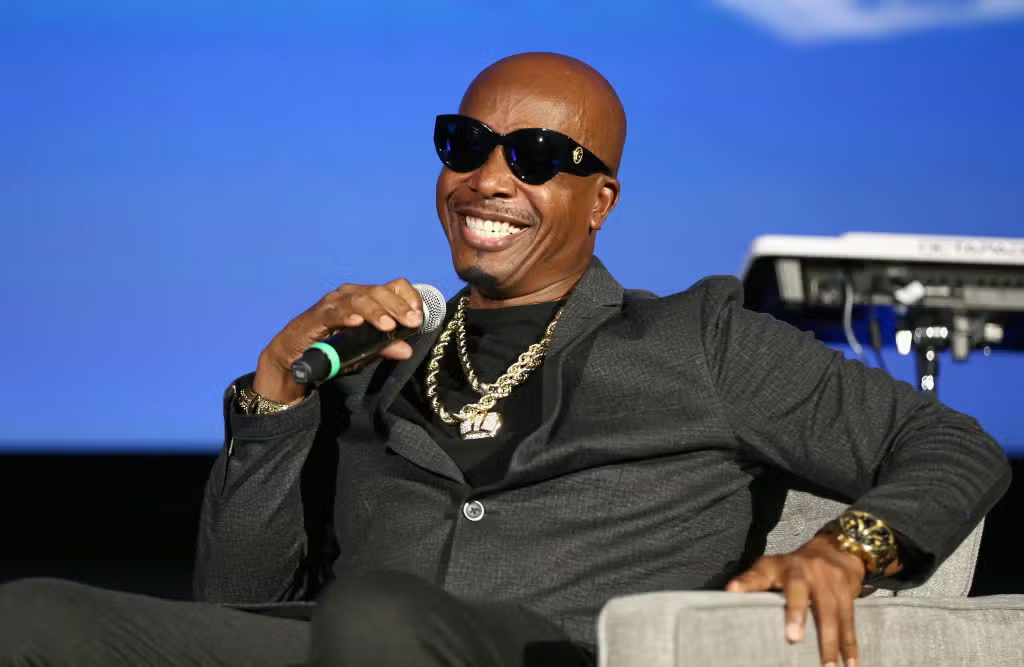
12. MC Hammer

Before the parachute pants and platinum records, Stanley “MC Hammer” Burrell served three years in the U.S. Navy as an Aviation Storekeeper. Faced with tough choices in his youth, Hammer chose the discipline of military life. That structure later fueled his meteoric rise in hip-hop, with hits like “U Can’t Touch This” dominating the early ’90s. His journey from Navy serviceman to pop culture icon shows how a strong foundation can change everything.

Image Source: Bing Image. License: All Creative Commons

11. Ice-T

Tracy Marrow, better known as Ice-T, enlisted in the Army to support his young family. He served four years with the 25th Infantry Division in Hawaii. During his time in service, he invested in music equipment and began developing his sound. After leaving the Army, he became a pioneering figure in hip-hop before transitioning into acting, where he’s long starred on Law & Order: Special Victims Unit. Ice-T’s discipline and drive were sharpened in the military tools he carried into every chapter of his career.

Image Source: Bing Image. License: All Creative Commons

10. Jimi Hendrix

Before revolutionizing rock music, Jimi Hendrix enlisted in the Army in 1961 and trained with the 101st Airborne Division as a paratrooper. An ankle injury cut his military career short, but after his discharge, he poured his energy into mastering the guitar. Forming The Jimi Hendrix Experience, he transformed rock with his innovative style and unforgettable performances. His road to greatness wasn’t straightforward, but it was unforgettable.

Image Source: Bing Image. License: All Creative Commons

9. Tony Bennett

Drafted during World War II, Tony Bennett served as an infantryman in Europe, witnessing some of the war’s most intense battles. He was also present during the liberation of the Dachau concentration camp. After returning home, he studied music on the GI Bill and launched a career that spanned decades, earning numerous Grammy Awards. His voice carried warmth and humanity qualities shaped by both hardship and hope.

Image Source: Bing Image. License: All Creative Commons

8. Willie Nelson

Willie Nelson enlisted in the Air Force after high school but was discharged less than a year later due to back problems. Though his service was brief, Nelson has long advocated for veterans, supporting healthcare initiatives and raising awareness about homelessness among former service members. His connection to the military community extends beyond his own experience.

Image Source: Bing Image. License: All Creative Commons

7. Kris Kristofferson

Kris Kristofferson followed a family tradition by joining the Army, where he trained as a helicopter pilot and became a Ranger. Though he considered a military career, music ultimately called him elsewhere. He later became one of country music’s most respected songwriters, penning classics like “Me and Bobby McGee.” His disciplined background and poetic instincts made for a rare and compelling combination.

Image Source: Bing Image. License: All Creative Commons

6. Johnny Cash

Johnny Cash served in the Air Force as a Morse code operator stationed in Germany during the early years of the Cold War. While overseas, he bought his first guitar and formed a band. After his discharge, he used the GI Bill to study broadcasting before launching his legendary music career. The “Man in Black” carried the lessons of service with him long after he hung up the uniform.

Image Source: Bing Image. License: All Creative Commons

5. John Fogerty

John Fogerty, frontman of Creedence Clearwater Revival, served in the Army Reserve during the Vietnam era. Though he remained stateside, the political climate of the time deeply influenced his songwriting. Songs like “Fortunate Son” became powerful commentaries on inequality and war. His service shaped both his worldview and his music.

Image Source: Bing Image. License: All Creative Commons

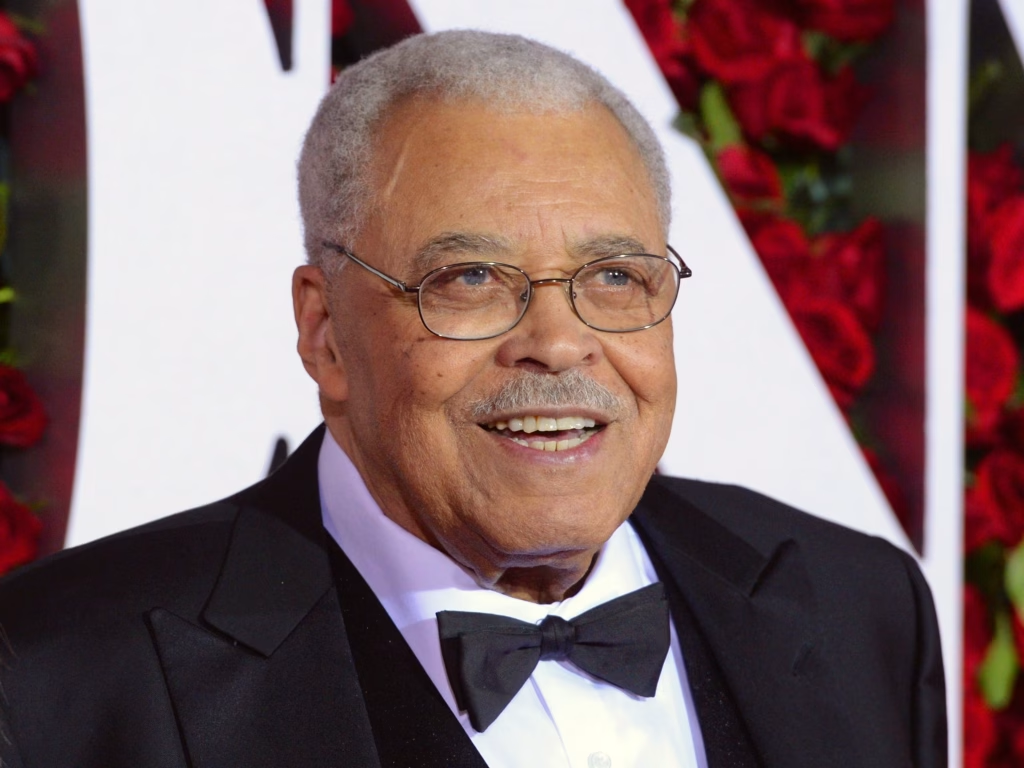
4. James Earl Jones

Before becoming the renowned voice of Darth Vader in the Star Wars series and Mufasa in The Lion King, James Earl Jones was an Army officer during the Korean War. He was commissioned as a second lieutenant but eventually became a first lieutenant before he chose to pursue an acting career. His authoritative demeanor and distinctive voice are a testament to the confidence and discipline he acquired during his stint as an Army officer.

Image Source: Bing Image. License: All Creative Commons

3. Morgan Freeman

Morgan Freeman enlisted in the Air Force in 1955, serving as a radar technician. Though he once dreamed of becoming a pilot, he ultimately left the service to chase acting. His calm authority and distinctive voice have made him one of Hollywood’s most respected actors, earning multiple Academy Award nominations and a win for Million Dollar Baby. The discipline he gained in uniform never left him.

Image Source: Bing Image. License: All Creative Commons

2. Jackie Robinson

Before breaking baseball’s color barrier with the Brooklyn Dodgers, Jackie Robinson served in the Army during World War II. He was court-martialed and later honorably discharged after refusing to move to the back of a segregated military bus. His courage in the military foreshadowed the strength he would show in Major League Baseball and the broader Civil Rights Movement. Robinson’s fight for equality extended far beyond the ballfield.

Image Source: Bing Image. License: All Creative Commons

1. Harry Belafonte

Harry Belafonte enlisted in the Navy at 17 and served during World War II. Stationed at Port Chicago, he witnessed firsthand the racial inequalities within the armed forces. After the war, he used the GI Bill to study acting, launching a career that would make him the “King of Calypso.” Beyond music and film, Belafonte became a tireless civil rights activist and close ally of Martin Luther King Jr. His life blended service, artistry, and activism in powerful ways.

Image Source: Bing Image. License: All Creative Commons

These artists and entertainers prove that service doesn’t end when the uniform comes off. For some, the military offered structure. For others, it provided perspective, resilience, or a spark that ignited creativity. Their stories remind us that talent and duty can coexist and that sometimes, the road to stardom begins with a salute.

15 Famous Actors Who Served in the Military

0
Image Source: Bing Image. License: All Creative Commons

Before they became household names, these actors wore something other than costumes; they wore uniforms. Long before red carpets and film sets, they answered a different kind of call to duty. Their time in the military shaped their discipline, resilience, and sense of purpose, qualities that later defined their careers on screen. Here’s a closer look at 15 legendary actors whose service is an important part of their story.

Image Source: Bing Image. License: All Creative Commons

15. James Earl Jones

Long before becoming the unforgettable voice of Darth Vader and Mufasa, James Earl Jones served in the U.S. Army during the Korean War. Commissioned as a second lieutenant, he later rose to first lieutenant and helped train fellow soldiers in Colorado. Jones, whose commanding voice became one of the most recognizable in film history, once struggled with a severe stutter. The structure and confidence he developed in the Army may have helped him find his strength. After his service, he built a remarkable acting career, starring in classics like Field of Dreams and Coming to America. His authority on screen wasn’t just acting; it was earned.

Image Source: Bing Image. License: All Creative Commons

14. Steve McQueen

Known as the “King of Cool,” Steve McQueen’s early days in the Marine Corps were far from glamorous. He even spent time in the brig. But during a dangerous Arctic training mission, he helped rescue fellow Marines, an act that changed his reputation and earned him an assignment guarding President Harry S. Truman’s yacht. McQueen’s rebellious edge and fearless attitude in films like Bullitt and The Great Escape reflected lessons learned in the Marines. His military years sharpened the grit that would later define his screen presence.

Image Source: Bing Image. License: All Creative Commons

13. Tom Selleck

Tom Selleck’s rise to fame paused when he was drafted during the Vietnam era. He served in the California National Guard from 1967 to 1973 and even appeared in recruitment campaigns. After returning to acting, he landed the iconic role in Magnum P.I., bringing a natural authority that felt authentic. Whether appearing in Friends, the Jesse Stone films, or Blue Bloods, Selleck’s steady, composed demeanor traces back to his years of service.

Image Source: Bing Image. License: All Creative Commons

12. Chuck Norris

Chuck Norris discovered martial arts while serving in the U.S. Air Force in Korea. That experience changed his life. He went on to earn an eighth-degree black belt in taekwondo, becoming the first Westerner to achieve that rank. After leaving the military, Norris trained celebrities before launching his own acting career, starring in Way of the Dragon and later Walker, Texas Ranger. The discipline he developed in uniform became the backbone of his action-hero legacy.

Image Source: Bing Image. License: All Creative Commons

11. Morgan Freeman

In 1955, Morgan Freeman enlisted in the U.S. Air Force, hoping to become a fighter pilot. Instead, he served as a radar technician for four years. Eventually, he realized his passion for acting outweighed his love of flying. Freeman’s calm authority and measured presence, seen in films like The Shawshank Redemption and Driving Miss Daisy, reflect a work ethic forged during his military years. His steady voice and grounded performances have made him one of Hollywood’s most respected figures.

Image Source: Bing Image. License: All Creative Commons

10. Elvis Presley

At the height of his early fame, Elvis Presley was drafted into the Army in 1958. Rather than accept a special entertainment role, he chose to serve as a regular soldier in an armored division. Stationed in Germany, Presley fulfilled his duties like any other serviceman. His time in uniform helped reshape his public image, bridging his youthful rock-and-roll persona with a more mature phase of his career. The King didn’t ask for special treatment, and that earned him lasting respect.

Image Source: Bing Image. License: All Creative Commons

9. Clark Gable

After the tragic death of his wife, Clark Gable enlisted in the Army Air Forces at age 41. Despite being one of Hollywood’s biggest stars, he started from the bottom and trained as an aerial gunner and photographer. He flew combat missions over Europe in B-17 bombers, documenting wartime operations. His service during World War II was driven by personal loss and patriotism. Fame didn’t shield him from duty.

Image Source: Bing Image. License: All Creative Commons

8. Paul Newman

Paul Newman joined the Navy’s V-12 program during World War II but was unable to train as a pilot due to colorblindness. Instead, he became a radioman and rear gunner aboard torpedo bombers in the Pacific. An ear infection kept him grounded during a particularly deadly mission, a twist of fate that likely saved his life. Newman left the Navy decorated for his service. His humility and resilience later shaped both his acting career and philanthropic work.

Image Source: Bing Image. License: All Creative Commons

7. James Doohan

Before becoming Scotty on Star Trek, James Doohan was a Canadian artillery officer who landed on Juno Beach during D-Day. He killed two enemy snipers and was shot multiple times, losing a finger in the process. Doohan overcame his injuries and built a beloved acting career, inspiring generations of fans. His wartime courage added depth to the engineer whom audiences came to adore.

Image Source: Bing Image. License: All Creative Commons

6. Lee Marvin

Lee Marvin served as a Marine scout sniper in the Pacific during World War II. He was wounded in combat, suffering an injury that affected him for life. That lived experience gave authenticity to his tough-guy roles in films like The Dirty Dozen. Marvin didn’t have to pretend to understand combat; he had been there.

Image Source: Bing Image. License: All Creative Commons

5. Rob Riggle

Rob Riggle spent 23 years in the Marine Corps Reserve, earning the Combat Action Ribbon after coming under fire in Kosovo. He also assisted with recovery efforts at Ground Zero and deployed to Afghanistan. Despite his comedic career in films and television, Riggle continues to support troops through USO tours. His transition from battlefield to comedy stage proves that service can take many forms.

Image Source: Bing Image. License: All Creative Commons

4. Michael Caine

Michael Caine saw combat during the Korean War as a soldier in the British Army. In one harrowing moment, he and two fellow soldiers charged enemy forces rather than surrender and survived. The experience gave Caine a sharpened perspective on life and risk, something visible in performances throughout his long career, including films like A Bridge Too Far.

Image Source: Bing Image. License: All Creative Commons

3. Charles Bronson

Drafted in 1943, Charles Bronson became a B-29 tail gunner in the Pacific during World War II. He flew 25 combat missions and earned a Purple Heart after being wounded. After the war, he used the GI Bill to study acting, eventually starring in The Great Escape and the Death Wish series. His hardened on-screen persona was rooted in real-life experience.

Image Source: Bing Image. License: All Creative Commons

2. James Stewart

Already an Academy Award winner, James Stewart enlisted in the Army Air Corps during World War II. A skilled pilot, he flew bombing missions over Europe and rose to the rank of brigadier general in the Air Force Reserve. He commanded large bomber groups and earned multiple decorations for bravery. Stewart remains one of the highest-ranking actors to ever serve. His quiet strength in films like It’s a Wonderful Life carried the weight of real-world leadership.

Image Source: Bing Image. License: All Creative Commons

1. Adam Driver

After the September 11 attacks, Adam Driver enlisted in the Marine Corps. He served as an 81mm mortarman before a training injury led to a medical discharge. Driver later attended Juilliard and rose to prominence in Girls and the Star Wars sequel trilogy as Kylo Ren. He also founded Arts in the Armed Forces, a nonprofit that brings professional theater to military communities. His journey from Marine to actor reflects discipline, purpose, and a commitment to service that continues off-screen.

Image Source: Bing Image. License: All Creative Commons

These actors remind us that fame and service aren’t mutually exclusive. Before commanding audiences, they followed orders. Before stepping into the spotlight, they stood alongside fellow service members. Their stories show that the path from military life to Hollywood isn’t unusual; it’s often transformative. And in many cases, the strength we see on screen was first forged in uniform.

15 Women Who Transformed Film, TV & Beyond

0
Image Source: Bing Image. License: All Creative Commons

Throughout history, some women haven’t just participated in culture and society; they’ve reshaped it. From sports and politics to journalism, entertainment, activism, and space exploration, these trailblazers challenged expectations and opened doors for generations to come. Here’s a look at 15 extraordinary women whose legacies still inspire today.

Image Source: Bing Image. License: All Creative Commons

15. Effa Manley

Effa Manley didn’t just love baseball; she changed it. As co-owner of the Newark Eagles in the Negro Leagues, she stood out in an industry largely controlled by white male executives. In 1946, the Eagles won the Negro League World Series, and after her husband’s death, Manley stepped up as sole owner. Her sharp leadership and deep commitment to the sport earned her a groundbreaking place in the Baseball Hall of Fame, making her the first and still only woman inducted. Her life story, told in She Loved Baseball, reminds us that passion and perseverance can redraw the boundaries of who belongs in the game.

Image Source: Bing Image. License: All Creative Commons

14. Judith Heumann

After contracting polio as a toddler, Judith Heumann grew up confronting barriers that many people never have to think about. Instead of accepting exclusion, she pushed back. She became the first teacher in New York State to use a wheelchair after successfully challenging discrimination by the Board of Education. A central figure in disability rights activism, she helped advance the Rehabilitation Act and later advised Presidents Bill Clinton and Barack Obama. Her work reached new audiences through the documentary Crip Camp. Heumann’s legacy is clear: accessibility is a civil right.

Image Source: Bing Image. License: All Creative Commons

13. Mahalia Jackson

Mahalia Jackson’s voice could quiet a room and ignite a movement. Revered as the Queen of Gospel, she delivered unforgettable performances of songs like “Take My Hand, Precious Lord.” But her influence extended beyond music. At the 1963 March on Washington, she encouraged Martin Luther King Jr. to speak from the heart, helping inspire the legendary “I Have a Dream” speech. Her life was later portrayed in Robin Roberts Presents: Mahalia. Jackson proved that music can be both art and activism.

Image Source: Bing Image. License: All Creative Commons

12. María Elena Salinas

For decades, María Elena Salinas served as a trusted voice for Hispanic communities. During her 36-year career with Univision, she became one of the most respected journalists in Spanish-language media. She made history as the first Latina to receive a Lifetime Achievement Emmy and later joined ABC News as a contributor. In her memoir, I Am My Father’s Daughter, she reflects on her career and cultural identity. Salinas showed how powerful representation can be when it’s paired with integrity and courage.

Image Source: Bing Image. License: All Creative Commons

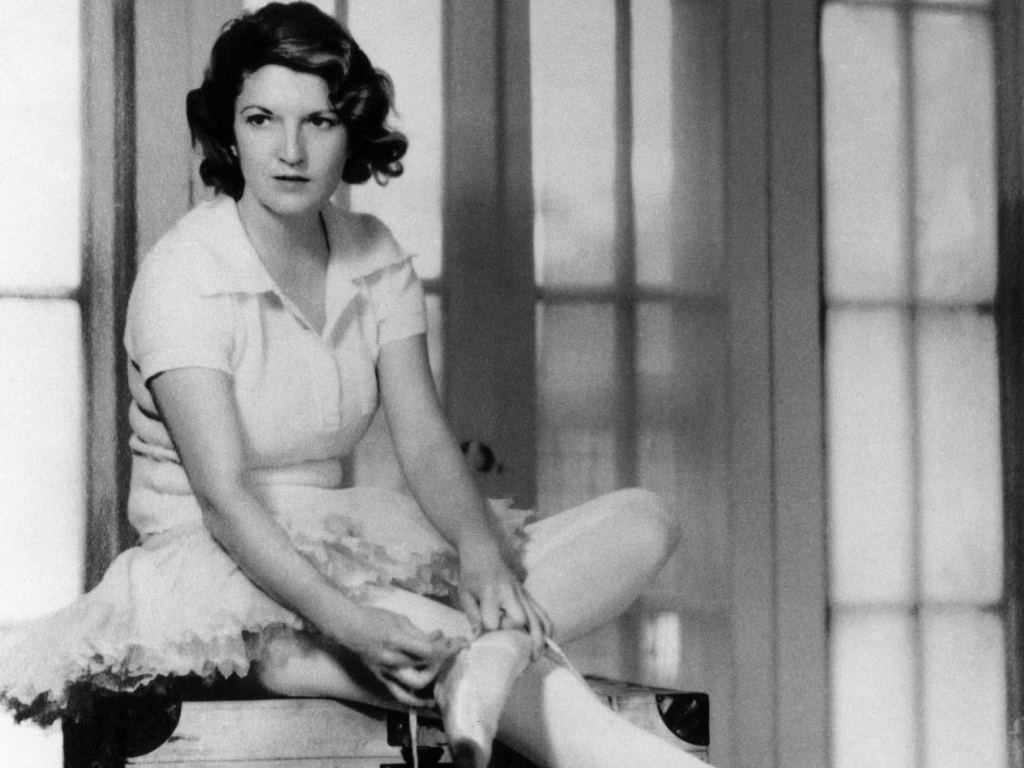
11. Zelda Fitzgerald

Often remembered as the wife of F. Scott Fitzgerald, Zelda Fitzgerald was an artist in her own right. A dancer, writer, and creative spirit of the Jazz Age, she influenced the era’s cultural landscape in more ways than many realize. Discussions about how much of her writing informed her husband’s work continue today. Her life is explored in Zelda: A Biography, which paints a portrait of a woman determined to be seen for her own talent. Zelda’s story is about reclaiming authorship of both art and identity.

Image Source: Bing Image. License: All Creative Commons

10. Junko Tabei

In 1975, Junko Tabei made history by becoming the first woman to summit Mount Everest. It was an achievement that challenged long-held assumptions about women in extreme sports. She later became the first woman to complete the Seven Summits, climbing the highest peak on every continent. Her memoir, Honouring High Places, captures her relentless drive and love of adventure. Tabei’s life reminds us that limits are often meant to be questioned.

Image Source: Bing Image. License: All Creative Commons

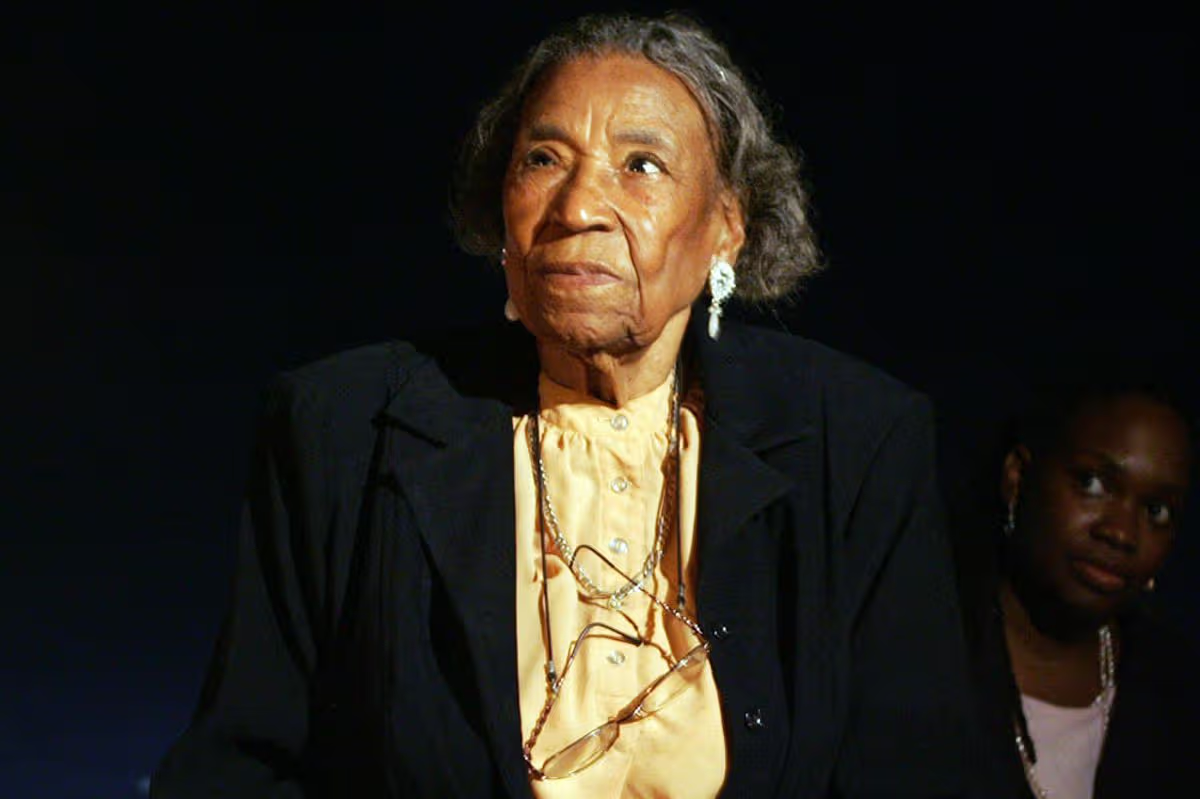
9. Amelia Boynton Robinson

Amelia Boynton Robinson stood at the heart of the voting rights movement. During the 1965 Selma to Montgomery march, she was violently attacked by law enforcement, an image that shocked the nation and helped accelerate change. Her activism is depicted in Selma, directed by Ava DuVernay. Robinson’s courage helped push forward legislation that strengthened voting protections across the country.

Image Source: Bing Image. License: All Creative Commons

8. Hattie McDaniel

In 1940, Hattie McDaniel became the first Black actor to win an Academy Award for her role in Gone with the Wind. It was a groundbreaking moment in Hollywood history. Though she often faced criticism and was confined to stereotypical roles, her Oscar win broke a major barrier in the film industry. Today, her legacy is recognized with two stars on the Hollywood Walk of Fame. Her career opened doors that had long been locked.

Image Source: Bing Image. License: All Creative Commons

7. Donyale Luna

Before the rise of modern supermodels, Donyale Luna was quietly changing fashion history. In 1966, she became the first Black woman to appear on the cover of British Vogue. She also ventured into film, working with avant-garde artist Andy Warhol in projects like Camp. Luna’s presence challenged narrow beauty standards and paved the way for greater diversity in fashion.

Image Source: Bing Image. License: All Creative Commons

6. Nellie Bly

Nellie Bly helped define investigative journalism. In the 1880s, she went undercover in a mental asylum to expose mistreatment, prompting significant reforms. Not long after, she captured global attention by traveling around the world in just 72 days, a daring feat that later inspired the film 10 Days in a Madhouse. Bly believed in chasing the truth, no matter the risk.

Image Source: Bing Image. License: All Creative Commons

5. Wilma Mankiller

Wilma Mankiller became the first woman elected Principal Chief of the Cherokee Nation. During her leadership, tribal enrollment grew, healthcare access improved, and economic opportunities expanded. She later received the Presidential Medal of Freedom, and her memoir, Mankiller: A Chief and Her People, shares her dedication to public service. Her leadership style blended strength with deep community care.

Image Source: Bing Image. License: All Creative Commons

4. Katharine Graham

As publisher of The Washington Post, Katharine Graham guided the paper through two defining moments in American journalism: the Pentagon Papers and the Watergate investigation. One of the first female CEOs of a Fortune 500 company, she later won a Pulitzer Prize for her memoir, Personal History. Graham’s steady leadership underscored the importance of a free and fearless press.

Image Source: Bing Image. License: All Creative Commons

3. Kalpana Chawla

Kalpana Chawla became the first woman of Indian origin to travel to space when she flew aboard a Space Shuttle mission with NASA. She orbited Earth hundreds of times, inspiring aspiring scientists around the world. Though her second mission ended in tragedy, her memory lives on, including through a spacecraft named in her honor by Northrop Grumman. Her story continues to encourage young people to dream beyond the horizon.

Image Source: Bing Image. License: All Creative Commons

2. Tammy Duckworth

Combat veteran and U.S. Senator Tammy Duckworth has built a career defined by resilience. After losing both legs while serving in Iraq, she continued her commitment to public service. She has broken multiple barriers, including becoming the first sitting U.S. senator to give birth while in office. In her memoir, Every Day Is a Gift, she reflects on perseverance and duty. Duckworth’s life demonstrates that strength is often forged in adversity.

Image Source: Bing Image. License: All Creative Commons

1. Shonda Rhimes

Few creatives have reshaped modern television like Shonda Rhimes. Through hit series such as Grey’s Anatomy, Scandal, and Bridgerton, she has brought more inclusive storytelling to mainstream audiences. Rhimes has long championed the idea that television should reflect real life with all its diversity and complexity. Her memoir, Year of Yes, offers insight into her creative philosophy and personal evolution. She hasn’t just produced television, she’s reshaped what audiences expect to see on screen.

Image Source: Bing Image. License: All Creative Commons

Each of these women challenged the status quo in her own way. Whether through activism, art, politics, journalism, or exploration, they expanded what was possible not just for themselves, but for those who followed. Their stories remind us that progress rarely happens quietly. It’s driven by courage, persistence, and the willingness to step forward when it would be easier to step back.

10 Performances Actors Later Admitted They Regretted

0
Image Source: Bing Image. License: All Creative Commons

Hollywood casting has always been a bit of a wild ride. Sometimes daring, sometimes confusing, and often simply acting as a great example of what not to do. As the discussions on representation and authenticity have intensified, many performers have reflected on their past roles and felt deeply embarrassed. Whether it is about whitewashing, impersonating an identity they shouldn’t have, or participating in a narrative that completely misunderstood the point, these acting roles have gained a bad reputation for the wrong reasons. Here are 10 controversial film roles that actors regret, or frankly, probably should.

Image Source: Bing Image. License: All Creative Commons

10. Emma Stone in Aloha

Casting Emma Stone as Allison Ng, written as part Hawaiian, partChinese, was met with instant backlash. Stone later acknowledged how misguided it was and said the experience had taught her just how deeply entrenched whitewashing is in Hollywood. She even publicly apologised at the Golden Globes after Sandra Oh joked about her casting. Stone says the character wasn’t meant to physically resemble her heritage, but the damage had already been done.

Image Source: Bing Image. License: All Creative Commons

9. Rooney Mara in Pan

Casting Rooney Mara as Tiger Lily, a character that is traditionally indigenous, made many scratch their heads as to how such a choice would get approved in this modern era. Mara has since spoken of heavy regret, stating she hated being part of a whitewashing controversy and never wanted to be on that side of the issue again. She openly acknowledged why such criticism was warranted.

Image Source: Bing Image. License: All Creative Commons

8. Jake Gyllenhaal in Prince of Persia: The Sands of Time

Jake Gyllenhaal playing an Iranian prince is a textbook example of the many times when Hollywood whitewashes over actors from ethnic casts. Years later, Gyllenhaal said it wasn’t a good fit and that it made him more deliberate and discerning with future roles. Rather, this movie remains a glaring reminder of the industry’s deep-seated casting blind spots.

Image Source: Bing Image. License: All Creative Commons

7. Eddie Redmayne in The Danish Girl

When the film was released, Eddie Redmayne’s Oscar-nominated performance as Lili Elbe received critical acclaim, though it has since become part of a broader critique of casting cisgender actors in trans roles. Redmayne said later that he wouldn’t accept the role today, which was a well-intentioned but mistaken decision. He added that more opportunities should be given to trans actors in such roles.

Image Source: Bing Image. License: All Creative Commons

6. Viola Davis in The Help

Viola Davis earned award recognition for her work on The Help, but she’s spoken candidly about complicated feelings regarding the film. She’s said she thinks the story didn’t actually centre the Black maids it claimed to honour, and Davis recently stated she feels she let herself and her community down. In retrospect, she feels the movie did not tell the complete truth.

Image Source: Bing Image. License: All Creative Commons

5. Scarlett Johansson in Ghost in the Shell

Casting Scarlett Johansson as Major Motoko Kusanagi was widely criticised for replacing a Japanese character with a white actor. Johansson tried to explain that the nature of the character complicated things, but the controversy endured nonetheless. The film became one of the most prominent examples of Hollywood erasing Asian characters in favour of bankable stars.

Image Source: Bing Image. License: All Creative Commons

4. Tilda Swinton in Doctor Strange

Marvel responded to perceived accusations of racism in the use of Asian stereotypes by reenvisioning the Ancient One as a Celtic mystic played by Tilda Swinton. Instead, the move erased a major Asian character, leading to widespread frustration. Marvel’s Kevin Feige later acknowledged the casting was a mistake and said they should have found a better solution that didn’t eliminate Asian representation.

Image Source: Bing Image. License: All Creative Commons

3. Jared Leto in Dallas Buyers Club

Jared Leto won an Oscar for his performance as Rayon, a transgender woman, but the decision not to cast a trans actor sparked intense criticism. Leto said acting is inherently transformative, but the role reignited debates about giving trans actors the space to tell their stories. The controversy only grew with evolving conversations about representation.

Image Source: Bing Image. License: All Creative Commons

2. Hilary Swank in Boys Don’t Cry

The character of Brandon Teena, played by Hilary Swank, was groundbreaking at the time, but now Swank herself says that if it were today’s industry, a trans actor should have played Brandon. She has pointed out the progress that has been made since and said she believes modern casting would and should look very different, allowing trans performers to take on trans roles.

Image Source: Bing Image. License: All Creative Commons

1. Gwyneth Paltrow in Shallow Hal

Gwyneth Paltrow has gone on record calling Shallow Hal one of her most regrettable projects. Wearing a fat suit for the role made her realise how humanising and problematic the film’s premise was. She has said she felt humiliated when people would avoid looking at her while she was in the suit, and now the movie is widely regarded as fatphobic.

Image Source: Bing Image. License: All Creative Commons

Hollywood has a long history of questionable casting decisions, and while some actors have owned up to their missteps, others have been slower to reckon with them. What’s clear is that audiences are watching-and they’re more than willing to call out the industry when it gets things wrong.

10 Movie-Making Partnerships That Became Legendary

0
Image Source: Bing Image. License: All Creative Commons

More often than not, a director is simply not very satisfied with the same actor’s performance after only a few times, the first thrill “flash of lightning doesn’t flygets worn and destroyed by the passage of time”. However, some collaborations are so perfectly in tune that it is almost unimaginable one without the other. They turn into the very face of different artistic fields, invent characters who become the new darlings of the culture, and among their audience, who sometimes can’t help but wonder at the ‘magic’ happening on the set, leave the question open. Here is a list of ten famous director-actor collaborations that demonstrate the flame does, in fact, strike twice. Or ten times.

Image Source: Bing Image. License: All Creative Commons

10. Sofia Coppola & Kirsten Dunst

It all began when Coppola hired teen Kirsten Dunst to star in The Virgin Suicides. Since then, they’ve formed a low-key but influential collaboration, getting together again for Marie Antoinette and The Beguiled. They’ve created dreamlike, ethereal narratives together that speak particularly to young women—and received a lot of critics’ affection in the process.

Image Source: Bing Image. License: All Creative Commons

9. Tim Burton & Johnny Depp

Wild wigs, wan makeup, and a sprinkle of gothic fantasy—if Depp’s sporting it, Burton likely imagined it. Across eight movies, from Edward Scissorhands to Ed Wood to Sweeney Todd, Depp has become one of Burton’s most out-there inventions. Their offbeat visions complement each other so seamlessly that it’s difficult to distinguish where Burton leaves off and Depp takes over.

Image Source: Bing Image. License: All Creative Commons

8. Wes Anderson & Bill Murray

At this juncture, it’s essentially a rule: no Wes Anderson film is ever whole without Bill Murray appearing somewhere in the shot. Occasionally, he’s the star (Rushmore), occasionally he merely appears in a few lines (The Grand Budapest Hotel), but his deadpan humor and Anderson’s fastidious approach are a match made in heaven. It’s indie cinema comfort food.

Image Source: Bing Image. License: All Creative Commons

7. Paul Thomas Anderson & Philip Seymour Hoffman

Five movies collectively, and not an unsteady link in the bunch. Hoffman was able to command a scene with one look—whether he played the sleazy audio guy in Boogie Nights, the cult leader in The Master, or somewhere in between. PTA knew just how to work his talent, which made their collaborations a highlight reel of contemporary acting.

Image Source: Bing Image. License: All Creative Commons

6. Frances McDormand & The Coen Brothers

Nine movies, three Academy Awards (including Fargo), and a mutual sense of humor that ranges from deadpan to goofy. Marrying Joel Coen couldn’t have hurt, but McDormand’s position in the Coens’ film world extends far beyond matrimony. She is as integral to their style as their signature dialogue and quirky storylines. 

Image Source: Bing Image. License: All Creative Commons

5. Steven Spielberg & Tom Hanks

One’s the greatest storyteller, the other’s the greatest everyman. Their first film, Saving Private Ryan, remade the war film. They’ve since bounced between genres—spy thrillers (Bridge of Spies), lighthearted capers (Catch Me If You Can)—and even directed milestone TV miniseries like Band of Brothers. Whenever these two collaborate, it’s a masterclass in simple yet heartwarming filmmaking.

Image Source: Bing Image. License: All Creative Commons

4. Alfred Hitchcock & James Stewart

Hitchcock had a cast of leading men, but James Stewart was his everyman with a dark underbelly. Over Rope, Rear Window, The Man Who Knew Too Much, and Vertigo are teshaped suspense films. Stewart’s warmth made the public empathize; Hitchcock’s economy kept them on the edge of their seats. The outcome? Four thrillers that continue to inspire filmmakers today.

Image Source: Bing Image. License: All Creative Commons

3. Akira Kurosawa & Toshiro Mifune

Sixteen movies—sixteen. Kurosawa and Mifune did not merely direct samurai classics such as Seven Samurai, Yojimbo, and Throne of Blood; they revolutionized the genre. Mifune’s physique and ferocity put flesh on Kurosawa’s grand narratives, be they feudal Japan or contemporary Tokyo. Their legacy runs from Sergio Leone to Star Wars.

Image Source: Bing Image. License: All Creative Commons

2. Quentin Tarantino & Samuel L. Jackson

Nobody says Tarantino’s knife-sharp dialogue like Jackson. From Pulp Fiction to Jackie Brown, Django Unchained to The Hateful Eight, Jackson makes every monologue shine. Whether he’s a hitman, a bounty hunter, or simply narrating, his zip and Tarantino’s words are nothing short of movie magic.

Image Source: Bing Image. License: All Creative Commons

1. Martin Scorsese & Robert De Niro

The gold standard. Ten movies over five decades, beginning with Mean Streets and rolling through Taxi Driver, Raging Bull, Goodfellas, Casino, The Irishman, and now Killers of the Flower Moon. Along the way, they’ve created some of movie history’s most indelible characters and narratives, racking up more than 30 Oscar nominations in the process. This is what trust-fueled creativity looks like.

Image Source: Bing Image. License: All Creative Commons

These aren’t merely collaborations—these are legacies. The next time you see these names combined on a poster, don’t merely purchase a ticket. Anticipate greatness.

15 Controversial Roles Celebrities Would Rather Forget

0
Image Source: Bing Image. License: All Creative Commons

Hollywood’s ability to reinvent itself is what keeps it alive. However, not every show is remembered positively. Some actors confront their drama only a few years later when they look at their old works and feel ashamed. In most cases, these characters caused uproar because of issues like whitewashing, stereotyping, or unintentional misrepresentations of minorities, and the actors have, in most cases, regretted their choice of taking up the role. Here is a list of 15 performances that have most of the time confronted and regretted.

Image Source: Bing Image. License: All Creative Commons

15. Emilia Pérez and the Trans Representation Debate

Netflix’s crime-musical Emilia Pérez was marketed as revolutionary, but trans critics disagreed. Too many felt it relied on dated stereotypes, queered transition for the sake of a disguise, and reduced its trans lead to manipulative and violent. The absence of Mexican voices in a Mexican-set narrative only made things worse, with debates around who can speak trans stories raging on.

Image Source: Bing Image. License: All Creative Commons

14. Benedict Cumberbatch in Zoolander 2

Cumberbatch portrayed a non-binary model called “All” in a performance that soon came under fire for ridiculing gender identity. Years on, the actor confessed he would not accept the role today, admitting the pain that it had inflicted. Activists went so far as to call for a boycott, stating that roles such as these should be offered to non-binary or trans actors.

Image Source: Bing Image. License: All Creative Commons

13. Rooney Mara in Pan

Mara was hired as Tiger Lily, a traditionally Native American character, for the 2015 fantasy Pan. The outcry was swift. Mara has since explained that she “hated” being on the “wrong side” of the issue of whitewashing and never wants to make the same error again.

Image Source: Bing Image. License: All Creative Commons

12. Eddie Redmayne in The Danish Girl

Redmayne’s performance as trans trailblazer Lili Elbe was a hit at the time, but he later termed it a mistake. The actor confessed the role must have belonged to a trans woman and accepted the wider issue of trans exclusion from casting ranks. 

Image Source: Bing Image. License: All Creative Commons

11. Emma Stone in Aloha

Casting Stone as a character of part-Chinese and Hawaiian descent sparked widespread criticism. She later apologized—famously shouting “I’m sorry!” at the Golden Globes—and said the experience taught her about the damaging prevalence of whitewashing in Hollywood.

Image Source: Bing Image. License: All Creative Commons

10. Jake Gyllenhaal in Prince of Persia: The Sands of Time

Portraying a Persian hero in Disney’s hit movie, Gyllenhaal was criticized for perpetuating Hollywood’s casting of whites to play Middle Easterners. He would later confess that the scandal made him work more critically to determine which roles he takes on.

Image Source: Bing Image. License: All Creative Commons

9. Scarlett Johansson in Ghost in the Shell

Johansson’s casting as Major Motoko Kusanagi, the original Japanese character, elicited outrage about whitewashing. Rumors that studios had even thought of digitally transforming her look only added to the backlash. Johansson subsequently commented that she wouldn’t portray somebody of another race again.

Image Source: Bing Image. License: All Creative Commons

8. Tilda Swinton in Doctor Strange

Marvel hired Swinton as the Ancient One, a Tibetan man in comics, in a bid to be respectful, but ultimately canceled out a potential Asian casting opportunity altogether. Years after, Marvel leader Kevin Feige confirmed that they got it wrong.

Image Source: Bing Image. License: All Creative Commons

7. Gary Oldman in Tiptoes

In this quirky indie, Oldman portrayed a man with dwarfism—though he didn’t have it himself—using prosthetics and camera illusions. Peter Dinklage, co-star, attacked the way the film made light of dwarfism. Oldman has never spoken about the controversy, but the film is a warning example.

Image Source: Bing Image. License: All Creative Commons

6. Robert Downey Jr. in Tropic Thunder

Downey’s Australian actor in blackface was intended to be satirical, but satirical or not, it made many uneasy. Even Downey himself has said it was risky, although he explains he can see why people were offended, even if he still maintains the film was for the right reasons.

Image Source: Bing Image. License: All Creative Commons

5. Mickey Rooney in Breakfast at Tiffany’s

Rooney’s over-the-top performance as Mr. Yunioshi, a Japanese man, is now notorious yellowface. Rather than apologizing, Rooney once admitted that he forgave those who were offended—remarks which only added to criticism.

Image Source: Bing Image. License: All Creative Commons

4. C. Thomas Howell in Soul Man

This 1986 comedy made Howell wear blackface to impersonate a Black student. Although the actor maintains the film contained an anti-racist message, audiences and critics broadly condemned it as offensive and tone-deaf.

Image Source: Bing Image. License: All Creative Commons

3. Hilary Swank in Boys Don’t Cry

Swank’s Oscar-winning performance as Brandon Teena, a trans man, was hailed then, but she later admitted that such casting would be wrong now. She has since stated that trans performers could have the right to play their own stories.

Image Source: Bing Image. License: All Creative Commons

2. Gwyneth Paltrow in Shallow Hal

After putting on a fat suit for this romantic comedy, Paltrow got really embarrassed, and the message of the movie—”inner beauty” being synonymous with ignoring the other person’s weight—that didn’t age well. Paltrow didn’t hesitate to declare the movie a “disaster,” telling how uncomfortable she was during the shoot and how it exposed the film industry’s attitude towards body image in Hollywood.

Image Source: Bing Image. License: All Creative Commons

1. Viola Davis in The Help

Although Davis received praise for her performance, she went on to regret it, stating the movie did not prioritize the voices of the Black maids it represented. She acknowledged feeling as if she’d “betrayed” herself for having been a part of a narrative that was not completely truthful.

Image Source: Bing Image. License: All Creative Commons

Those roles also point to how frequently Hollywood has let down communities through miscasting and destructive stereotypes. But they also illustrate how much has changed—actors are now more outspoken about regrets, and audiences expect more. With any luck, the stars of tomorrow won’t have to look back at their résumés with shame.