Home Blog Page 1140

Stargate: Reimagining History with Science Fiction

0

Few science fiction universes have combined ancient mythology and sci-fi storytelling as convincingly as Stargate. What started as a 1994 feature film by Roland Emmerich morphed into a vast franchise of television programs, novels, and spin-offs. Fundamentally, Stargate retells the myths and legends of Earth’s history using the framework of alien technology and space travel, making gods into galactic masters and sacred artifacts into old devices.

The Gate of Myth

Stargate’s premise is gracefully simple: a gargantuan, ring-shaped machine—the Stargate—enables simultaneous travel throughout the universe. But it’s the mythology that raises the show above generic sci-fi fare. In the franchise’s flagship television series, Stargate SG-1, humanity’s ancient deities are exposed as alien impersonators, controlling early civilizations with advanced technology.

Consider the Egyptian pantheon, for instance. Ra, Anubis, Apophis—names ripped directly from old myth—are Goa’uld, parasitic creatures who hold human hosts and command through fear and deception. They did not simply spark the myths—they are the myths, revised in the guise of science fiction.

This reinterpretation breathes new life into the legends we’ve known for centuries. The gods of Egypt, the Norse pantheon, and even the Arthurian knights aren’t divine figures but extraterrestrials, misunderstood by ancient societies who couldn’t explain their otherworldly technology.

Norse Gods, Lost Cities, and Legendary Kings

Stargate SG-1’s mythological investigation continues with the Asgard, a technologically advanced alien civilization portrayed as the foundation for Norse myth. Thor and Loki are not god—friendly scientists and warriors leading humanity from behind the scenes. This inventive spin does not merely make for good TV; it forces the viewers to reexamine the origins of mythology itself.

On Stargate Atlantis, the franchise explores the myth of the lost city of Atlantis. Not an island swallowed up by the ocean, as in myth, Atlantis is a giant intergalactic city-ship built by the Ancients—an advanced civilization that sowed human life throughout the galaxies. The combination of ancient myth and hard science fiction in the show not only expands the universe but also brings gravity and awe to the myth of Atlantis.

Even the Arthurian legends are reinterpreted in the Stargate universe. Characters like Merlin are revealed to be Ancients using technology so advanced, it was mistaken for magic. Tales of Camelot, Avalon, and the Holy Grail take on new meaning as artifacts and locations tied to alien influence and interdimensional warfare.

A Grounded, Human Touch

Despite its extensive mythology and cosmic scope, Stargate never gets lost. A lot of the show’s success is due to its ensemble cast and character-driven storylines. Richard Dean Anderson’s acting as Colonel Jack O’Neill added humor and humanity to the series, while Amanda Tapping (Major Samantha Carter), Michael Shanks (Dr. Daniel Jackson), and Christopher Judge (Teal’c) provided brains, moral depth, and brawn.

Working behind the lens, producers Brad Wright and Jonathan Glassner converted Stargate SG-1 into one of the most enduring sci-fi dramas on North American television. Their inspiration was based on investigating the “what ifs” of history—what if our myths were true? What if those gods were aliens? What if our past holds the secret to our future?

The Power of Pseudoarchaeology

Though rooted firmly in science fiction, Stargate goes all in on pseudoarchaeology—the belief that advanced extraterrestrial beings communicated with old civilizations. The subject appeals to those who enjoy alternative history and conspiracy theories, recalling ideas promoted in such bestsellers as Chariots of the Gods? by Erich von Däniken.

Of course, there’s no attempt to make the show strictly historically accurate. Rather, it takes common stories and symbols and stitches them together into something new—a new type of storytelling that brings together speculative fiction and actual mythology in a style that’s inventive, exciting, and even occasionally brainy. 

A Lasting Legacy

It’s a world where history and fantasy blend, and where legends are not just stories—they are markers to the stars.

For sci-fi fans, mythology buffs, and just plain good storytellers, Stargate is a brand that stands the test of time. It reminds us that the past is not just something to learn about, but rather something to uncover—across the universe, through wormholes, and beyond our imaginations.

Why So Many Video Game Adaptations Fall Short, Except for “The Last of Us”

Converting video games to films or television programs has been a challenging undertaking for Hollywood over the years. It is not easy to retain the interactive, immersive nature of gaming in a medium meant for passive consumption. But now and then, a production arrives that thwarts the usual dangers of video game adaptation. HBO’s “The Last of Us” is one such, initiating significant conversations not just about narrative, but also representation.

Why Video Game Adaptations Usually Fail

It’s no surprise that video game adaptations tend to struggle. A big reason is the basic difference between films and games. Games like “Assassin’s Creed” live and breathe on player choice—stealth strategies, discovery, and decision-making—that are hard to transfer to a straight movie storyline without diluting what makes the experience special.

The other problem is the temptation to lean on gimmicks. Consider the “Doom” film, which for a moment adopted first-person point of view to simulate the game, with the result being confusion instead of thrills. As the co-creator of “The Last of Us,” Craig Mazin, writes, overreliance on a game’s mechanics or brand recognition has the effect of alienating existing fans as well as attracting new ones.

Furthermore, most games take strong cues from successful film genres. “Halo” borrows from sci-fi classics such as “Alien,” for instance, while “Tomb Raider” takes an Indiana Jones-inspired adventure. When such familiar tales come back to the screen, they tend to seem stale or unoriginal. Open-world games such as “Skyrim,” with their focus on player choice, create another problem—how do you summarize such vast, choice-based worlds in one narrative? Typically, you can’t.

Why Television is a Better Fit for Video Game Stories

One of the secrets to the success of “The Last of Us” is its decision to become a limited television series instead of a feature film. Video games provide hours of content, so it would be almost impossible to cut the story down to two hours without sacrificing necessary depth. Television has the room to flesh out characters and establish relationships over several episodes.

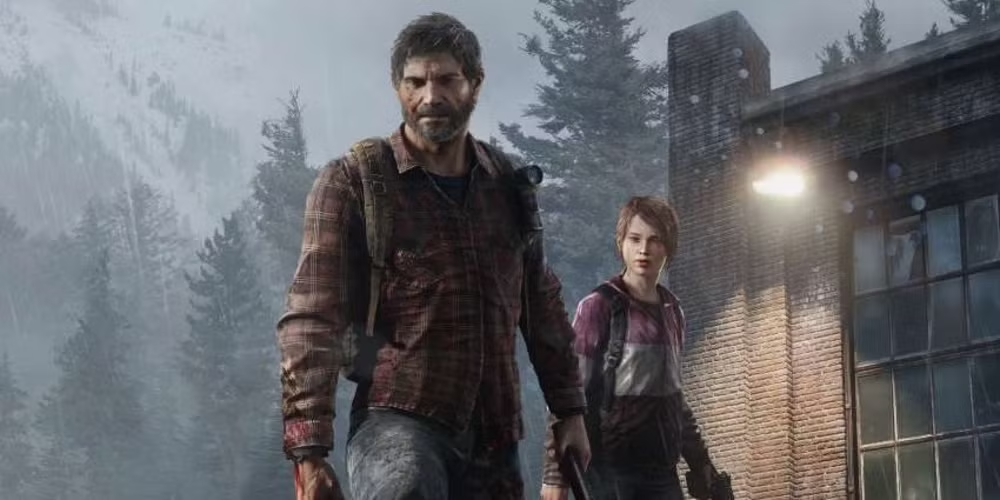
Neil Druckmann, the game’s creator, initially resisted adapting the story into a movie because it would require significant cuts. Partnering with Craig Mazin, they realized a series format could capture the emotional nuance and complex storytelling of the game. The episodic approach allows viewers to invest in the relationship between Joel and Ellie, mirroring how players grow attached to these characters over time.

Adapting “The Last of Us”: Changes and Decisions

It’s not about merely replicating its narrative when adapting a favorite video game for television. Druckmann and Mazin carefully adjusted things to make the show new yet respectful of the original material. The game is largely Joel and Ellie-centric, engaging players through their viewpoints. The series opens up with fresh characters and even ventures outside the U.S. to depict the pandemic’s worldwide effects.

Violence, a major aspect of the show, is treated differently on screen. While repeated fighting by the players is common in the show, violent scenes are given seriousness in the series, and each loss counts. Mazin clarifies that seeing someone die in real life must not be the same as viewing “pixels die” in the show.

Joel, played by Pedro Pascal, is also more earthly. This Joel, unlike the nearly superhuman one in the game, has the physical cost of years of suffering—unhearing in one ear, creaking knees—small touches that create realism and depth.

Representation and Casting Debates

Although highly acclaimed, the series has been controversial in some ways, particularly concerning representation. One of these is casting Maria, initially a white character, as a Black woman. This has initiated debates about “race-swapping” in adaptations.

Critics suggest that race-swapping a character can come across as tokenistic in nature, rather than a solid step forward, wondering why creators can’t just add new diverse characters instead. This argument is reminiscent of analogous controversies, such as with the outrage over casting a Black actress as Ariel in Disney’s “The Little Mermaid.” For some, such modifications appear to be lip service towards diversity, rather than actual inclusion.

Supporters counter that, especially in fictional universes, race is sometimes not central to a character’s identity and changing it can bring fresh perspectives. However, this logic isn’t always applied consistently—imagine if a historically Black character like Blade were recast as white; such a decision would likely provoke strong criticism.

Finding the Right Balance

What makes “The Last of Us” stand out is the way it handles these issues with care. The series doesn’t avoid nuanced discussions of representation without losing its emotional center. Strong character development and careful storytelling help it steer clear of video game adaptations’ most common missteps.

Whether a seasoned gamer or new to the story, “The Last of Us” proves how to effectively bring video games to the screen. It is not as much about re-creating the game as it is about finding worthwhile ways to get people involved while keeping in mind the original material.

Gaming Innovation at Its Best: Far Cry 5, WWE 2K22, and Beyond

The world of gaming is always evolving, providing new avenues for gamers to be creative, engage in storytelling, and be tasked with challenging mechanics. It’s through custom builds, refined game systems, or strategic missions that current titles are pushing boundaries in innovative ways. Let’s dive into how Far Cry 5, WWE 2K22, and Classified: France ’44 each bring something new to the table.

Far Cry 5: A Sandbox of Creativity That Still Glows

While Far Cry 6 might be the most recent installment in the series, Far Cry 5 is still a favorite among fans because of its one-of-a-kind feature: Arcade Mode. This mode still powers the game’s popularity, providing players with an arena for unlimited creativity.

One really standout instance? A WWE-themed arena built by a Reddit user. With pyrotechnics, a rousing NPC crowd, and a fully detailed wrestling ring, the build showcases the extent to which the in-game creation tools can be stretched. It was a good reminder that even years down the road, Far Cry 5 continues to empower players to create and share experiences that amaze and inspire.

WWE 2 K22: A Reboot to Refresh the Wrestling Franchise

WWE 2 and WWE 2K22 marks a watershed moment for the series, coming out on the next generation of consoles and giving the core gameplay a much-needed rethink. The biggest change is in the combat system. The game dispenses with the tired reversal stock system and has a far more fluid and responsive defensive system instead, injecting new life into matches and making them more responsive and interactive.

With its enormous cast of more than 150 wrestlers, including a couple of surprise AEW guest stars, WWE 2K22 provides a rich and diverse experience for wrestling enthusiasts. It’s not only back to its best; it’s a great leap forward for the series. 

Classified: France ’44 – Strategic Depth in a WWII Setting

From wrestling rings to war strategy, Classified: France ’44 offers something new to WWII gaming. Ditching the emphasis on quick first-person action, this game concentrates on turn-based tactical combat, where players are encouraged to plan thoroughly and construct their team out of a tiny resistance cell.

Taking cues from games such as X-COM, Classified: France ’44 has diverse mission styles, such as stealth and ambush missions, which pay dividends for clever thinking. While some players have complained about problems such as respawning foes, the game’s depth of strategy and more relaxed pace make it a strong choice for fans of the series.

These three titles each demonstrate different strengths—Far Cry 5 with its boundless creative tools, WWE 2K22 with its refined gameplay systems, and Classified: France ’44 with its cerebral, tactical experience. Whether you’re into building, brawling, or battlefield strategy, there’s something here to enjoy.

Gaming continues to thrive on innovation, and these titles prove that fresh ideas and thoughtful design can keep players engaged long after a game’s release.

Pixel Artist Revives Iconic Moments from the Pokémon Anime

0

For fans of Pokémon who watched Ash grow up, certain moments from the anime left a lasting emotional impression. Now, one skilled pixel artist is bringing back those memories by remaking classic scenes from the original Pokémon anime — and the reactions are generating buzz throughout the community.

Identified as u/addyxiii, the artist is skilled at bringing the heart of the initial Pokémon shows to life in pixel art based on the nostalgic FireRed & LeafGreen game aesthetic. Their most recent piece perfectly captures the bitter goodbye between Ash and his Butterfree from episode 21, “Bye Bye Butterfree.” The scene is painted with incredible detail, complete with a warm sunset and a cloud of Butterfree flying away — a poignant reminder of the emotional richness of Ash’s exploits.

Aside from that, u/addyxiii has crafted the emotional scene from “Charmander the Stray,” in which Ash and his friends find a deserted Charmander fighting to live. The artist’s attention to minor details in the background, such as water full of Pokémon like Tentacruel and Horsea, adds more brightness and realism to the scene while bringing viewers back to the nostalgic setting of the anime.

The anime has continually added to the franchise its distinctive elements beyond the games. From presenting individual Pokémon personalities to background characters such as the Team Rocket group, the anime has conditioned how the fans live Pokémon’s world. Memorable moments in the form of the initial double battle with Ekans and Koffing, or the introduction of shiny Pokémon by way of the female Butterfree, have left an indelible mark on the community and have impacted game mechanics.

Whereas certain aspects from the anime, such as walking with your Pokémon, have been added to the games, much remains a sole aspect of the show. The anime’s development of Pokémon as well-rounded characters helped create innovative things such as Pokémon-Amie, which enables players to engage with their Pokémon in fresh, meaningful ways.

This pixel art tribute from u/addyxiii perfectly captures the nostalgia and creativity the Pokémon anime continues to inspire. Whether you’ve been a lifelong Pokémon trainer or are new to the franchise, these artistic recreations offer a heartfelt glimpse into the stories and emotions that have made Pokémon a beloved part of many lives.

The Cyborg Ninja: A Symbol of Cyberpunk’s Impact on Gaming

In video game and science fiction worlds, there are perhaps no more captivating types of characters than the Cyborg Ninja. This unique character is the combination of the historical tradition of ninjutsu and the latest in cybernetic technology into a fascinating blend of stealth, martial arts, and high-tech power. But how did such an intriguing fusion become so widespread and enduring a presence in modern pop culture?

The popularity of the Cyborg Ninja trope is directly related to the growth of the cyberpunk genre during the 1980s. Pioneering writers such as William Gibson contributed to the development of this idea through influential pieces such as Johnny Mnemonic and Neuromancer. These works brought readers the concept of cybernetically augmented assassins, essentially combining the mystique of the classic ninja with the fascination of cybernetic enhancement. This blend set the stage for the Cyborg Ninja trope we recognize today.

Cyberpunk’s unifying themes—opposition to authoritarianism and pervasive permeation of technology—are an organic narrative context for the Cyborg Ninja. In these dystopian and utopian futures, technology invades every aspect of existence, and individuals who control it with skill and finesse are icons of rebellion and freedom. The Cyborg Ninja embodies this tension, breaking through the confusion between machine and man to overturn exploitative systems, and the trope resonates so intensely with audiences.

Japanese culture is also instrumental in forming the identity of the Cyborg Ninja. In the 1980s, Japan’s rapid technological advances and global cultural impact influenced cyberpunk creators to integrate components such as samurai honor, katana swords, and futuristic cutting-edge design into their narratives. This cultural crossover makes the Cyborg Ninja richer, linking ancient traditions with the hope—and at times the danger—of technological progress in a globally influenced context.

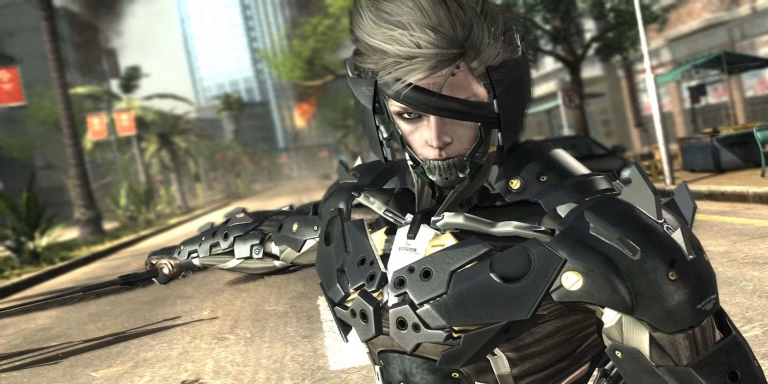
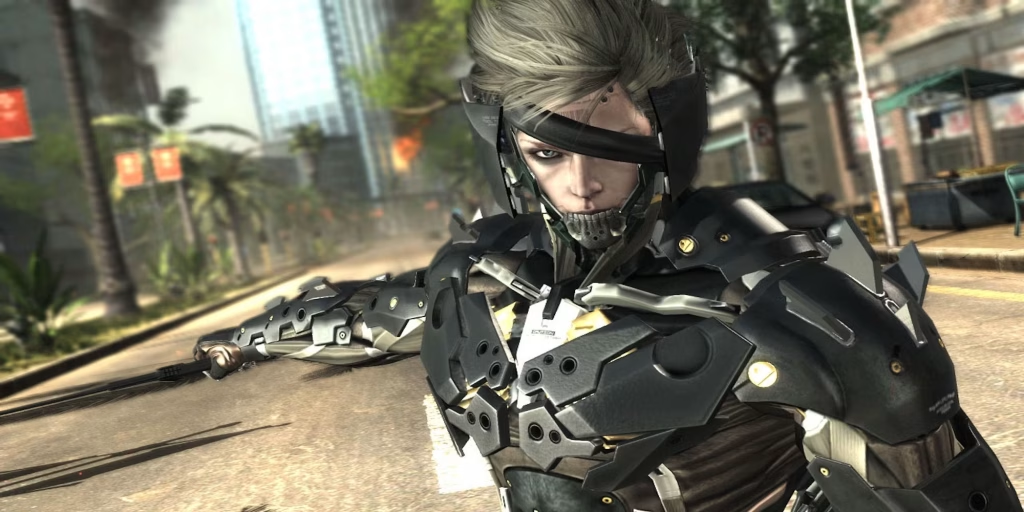
Video games have played a key role in making the Cyborg Ninja real, enabling players to live the experience of being these great warriors. No series better illustrates this than the Metal Gear series, with characters such as Raiden that incorporate stealthy methods combined with advanced combat potential. Ghostrunner and Mega Man are other games that follow this archetype with varied gameplay but combine agility, strategy, and advanced features. For players, the Cyborg Ninja is an addictive blend of past and present, heritage and futurism.

At its essence, the Cyborg Ninja is not just a character trope, but an inspiring symbol of imagination wherein the power of history and the accuracy of technology converge. While the medium of science fiction and gaming continues to evolve, this archetype remains a favorite, captivating audiences with its intriguing mix of timeless martial arts and advanced cybernetics. As heroes, villains, or mysterious antiheroes, Cyborg Ninjas offer an intriguing vision of human potential pushed beyond old limits.

The Last of Us Episode 3: A Bold Reimagining of Love and Survival

Episode 3 of HBO’s adaptation of The Last of Us has created a great deal of controversy—and rightly so. This installment diverges boldly from the first video game, giving us a new and intimate introduction to the bond between Bill and Frank. Gamers will remember Bill as a gruff, lone survivor in a booby-trapped town, where little is revealed of his relationship with Frank. The series itself, however, goes much further, providing a touching and engaging narrative that is unique to the show’s overall narrative.

Joel and Ellie journey to the town of Lincoln in hopes of finding Bill, who may have a car to aid them on their quest. Bill is shown to be a nervous loner, and the extent of his relationship with Frank is only inferred from a heartbreaking suicide letter. The game is mostly about survival and action, and much of their past and their connection has to be imagined by the player.

The television series does things differently. Episode 3 spends almost its entire length detailing Bill and Frank’s life together, building a poignant love story amidst the devastation of a world devastated by an apocalypse. Nick Offerman’s Bill is a grizzled survivalist who has militarized his town to the point where it is all but impenetrable. When Frank, portrayed by Murray Bartlett, unwittingly sets off one of Bill’s traps, their lives become connected in surprising and lovely ways. What ensues is a poignant examination of love, friendship, and the pursuit of meaning in a shattered world.

Executive producer Craig Mazin has said that this episode is not just about survival, but about finding purpose and deciding how to live and die on one’s terms. That richer understanding of Bill’s experience is a refinement of the game’s more solitary and melancholy vision for the character, adding themes of love and satisfaction to an otherwise bleak environment.

Reactions to this episode have been varied. Numerous critics and audience members have responded positively to it, commending its emotional resonance and how it further develops the series. Others have criticized, complaining that the episode deviates too much from the original storyline of the game by developing a subplot that does not advance the main plot directly. Nevertheless, the warm and honest relationship that is shown on screen is immensely powerful, providing a new angle on the post-apocalyptic storyline.

In the end, Episode 3 of The Last of Us stands as a brilliant demonstration of how adaptation can take old ideas and give them fresh life. Whether a veteran of the game or new to the narrative, this episode provides a deeply moving and unforgettable encounter that attests to the lasting strength of love in the darkest of times.

HBO’s “The Last of Us”: How a Video Game Became Prestige TV

HBO’s adaptation of The Last of Us has had a significant impact, transposing one of the most highly regarded video game stories into a new format. While the show has elicited a variety of responses, it certainly brings the game’s emotional storytelling to a far wider audience, many of whom might never have held a controller.

Drawn from the award-winning video game of Naughty Dog, the series has also been praised highly for sticking to the tone, story, and emotional depth of the original. Nevertheless, with just nine episodes to fit in as much detail as this very complex story contains, a few fans have complained that it is a little rushed. Moments that previously played out over hours of engaged gameplay now whiz by, sometimes leaving viewers hungering for more time to become attached to main characters Joel and Ellie. The game offers almost 20 hours of play to develop those connections—something a finite series necessarily can’t match.

Despite these limitations, the series discovers moments of excellence, none more memorable than in Episode 3. It is a bold divergence from the game’s narrative, opting instead to explore the romance between Bill and Frank. In the game, Bill is depicted as a rough, solitary survivor, with only veiled suggestions regarding his relationship with Frank, whose tragic fate is offscreen. The series, though, reimagines their tale as a sweet, emotionally powerful love story against the apocalyptic backdrop.

Episode 3 has been widely acclaimed as a among the most emotional hours of television in years. It presents a sensitive exploration of a same-sex relationship—satisfactorily executed with nuance, authenticity, and complexity—without deviating thematically from the universe of The Last of Us. Bill and Frank’s tale, resolved on their terms, is an otherwise scarce breath of peace and love amid an otherwise savage environment.

As showrunner Craig Mazin explains, the intention was to bring the game into a form that was suitable for television while remaining true to its central themes and emotional arcs. That meant taking liberties with the story where necessary, but always with the story itself in mind. The series does tone down some of the action-oriented scenes from the game, but it embraces character development and emotional connection, two things that have resonated so deeply with so many fans.

HBO’s The Last of Us is a fearless and considerate adaptation that holds on to change while never forgetting why the original was so effective. It redefines what an adaptation of a video game can be, demonstrating that, with respect and imagination, reimagining dear source material can result in something truly unforgettable.

Level Up Your Look with Pokémon Jewelry from U-Treasure

0

Ready to bring a touch of whimsy and sophistication to your jewelry wardrobe? Japanese jewelry favorite U-Treasure has been winning hearts with its stunning Pokémon-inspired jewelry. Whether for engagement rings or solitaires, these pieces are ideal for the person who wants to express their passion for Pokémon in sophisticated style.

Picture proposing with a diamond shaped like a Poké Ball. This 0.3-carat gem, with 143 facets, is a work of art that captures all the iconic features of the beloved franchise. At $2,300, it’s just one of the one-of-a-kind pieces U-Treasure retails to Pokémon fans. They have their website filled with a range of engagement rings modelled on beloved characters such as Pikachu, Eevee, Umbreon, Espeon, and Mew — all beautifully crafted in gold.

U-Treasure’s collaborations with The Pokémon Company have some of their most beautiful work thus far. Take, for example, the Pikachu Carat Solitaire Rings, which feature two Pikachu characters standing on the band. The rings come in silver, platinum, and K18 yellow gold, ranging from ¥38,500 to ¥1,825,000. And the wonderful news? They ship worldwide, so that enthusiasts everywhere can get their hands on these one-of-a-kind pieces.

If you’re looking for something a bit more personal, the Pikachu Carat Solitaire Ring can be personalized with as many as eight characters to be engraved. This gorgeous ring is encircled by a 1-carat diamond with two Pikachus of the opposite sex, representing loyalty and companionship — an appropriate tribute to the enduring connection between Ash and Pikachu.

But U-Treasure isn’t just about Pokémon. They also offer collections inspired by Sanrio, Sailor Moon, Kingdom Hearts, and Cardcaptor Sakura. Whether you’re hunting for a meaningful gift or a one-of-a-kind addition to your collection, their website is full of enchanting designs worth exploring.

As the franchise continues to expand with new characters and plots, the opportunities for more fantastic jewelry designs are limitless. U-Treasure’s designs allow fans to commemorate their beloved franchise in style, so these pieces are must-haves for every Pokémon fan.

Cloud Gaming Gets a Boost with the ASUS Chromebook Vibe CX34

ASUS has made a large leap in gaming Chromebooks with its introduction of the ASUS Chromebook Vibe CX34 Flip. The latest model indicates ASUS’s commitment to enhancing its gaming Chromebook offerings by pitting strong specs against intelligent design decisions that will make sense for cloud gaming enthusiasts.

The Vibe CX34 Flip draws attention with its slim design and rugged construction. Unlike the previous CX55, which had the feel of being a reused design, the CX34 is a new, well-designed device that addresses most of the problems of the last model. Its 14-inch, 16:10 aspect ratio screen is a highlight in itself, with a smooth 144Hz refresh rate and radiant visuals at 400 nits. And it’s intelligent enough to scale down to 60Hz in disconnected mode, conserving battery life, which can go up to 10 hours based on usage.

Within, the CX34 Flip features Intel’s 12th-gen processors from i3 to i7. The advanced models feature Intel Iris Xe graphics, so they can comfortably take on demanding tasks and gaming sessions. You can avail up to 16GB RAM and 512GB SSD storage, providing you with ample speed and storage space, whether you’re working or gaming.

ASUS has also paid attention to user experience. The RGB backlit keyboard that’s customizable is a nice feature, and the fact that it’s spill-resistant is a thoughtful touch for gamers who prefer to have a drink at hand. The anti-ghosting feature of the keyboard ensures that every keystroke counts, which is crucial in fast-paced games. That being said, the backlight can be a bit difficult to view in well-lit rooms, so you may have to adjust the settings.

Connectivity is strong as well, with Wi-Fi 6E and Bluetooth 5.2 for quick and strong wireless connections. The CX34 Flip has a decent set of ports, including USB Type-C and Type-A, an HDMI output, and a microSD card reader, so it’s prepared for all sorts of peripherals and outside displays.

It has a few drawbacks. The webcam is just 720p, which could be a letdown if you use it for lots of video calls. Additionally, the Chromebook is almost 4 pounds, which may be slightly heavy if you’re looking for something extremely portable.

Overall, the ASUS Chromebook Vibe CX34 Flip is a top contender among both gamers and power users. With its stable performance, sleek design, and considerate features, it excels in the gaming Chromebook market and offers an excellent experience, particularly for cloud gaming.

Jinx to Heimerdinger: How Old Are Your Favorite Arcane Characters?

Netflix’s Arcane, based on the League of Legends world, has taken fans by surprise with how deep its characters are and the huge divide between Piltover’s elite and Zaun’s gritty undercity. The interesting thing that many fans pick up on is the ages of these characters, which makes sense of their development and how they act around one another.

Let’s begin with Jinx, who was initially named Powder. When we initially encounter her, she’s merely a little girl of 11 or 12 trying to make her way around Zaun’s rough streets. She has an interesting life of curiosity and imagination, but also undergoes some intense trauma, such as losing Vander, who was more of a father figure to her, which influences who she becomes as a character. By the time Jinx becomes Powder, she’s about 17 to 19 years old, struggling with a lot of emotional instability and with a darker outlook on the world.

Vi, Powder’s older sister, shows up as a protective and strong-willed teenager, somewhere between 14 and 16 years old. She often puts herself at risk to keep Powder safe. Fast forward to Season 2, and Vi is in her early 20s. She’s spent about seven years in prison after the Season 1 events, and the distance from her sister weighs heavily on her, fueling her drive to protect the people of Zaun.

Then there’s Caitlyn Kiramman, whose exact age isn’t clearly stated but is thought to be close to Vi’s. Caitlyn starts around 16 years old, coming from a wealthy family, but searching for purpose beyond that. By the time Season 2 rolls around, she’s a Piltover Enforcer, working alongside Vi to bring justice.

Jayce Talis is a master inventor who started his career at age 24. He’s heavily invested in Piltover’s revolutionary Hextech technology. Later, he’s in his early 30s and must maintain peace in a city more divided than ever.

Viktor, another scholar such as Jayce, also begins at the age of 24. He’s working on enhancing life in Zaun with technology. By Season 2, he is somewhere around the ages of 30 to 31, but his Hextech experiments call his level of humanity into question.

Mel Medarda, a politician who is ambitious in Noxus, is met at 26. She is one of the council members of Piltover and plays the political game cautiously, allying with Jayce on Hextech. By the second act, Mel is in her early 30s and most committed to the future of Piltover.

Ekko is one of the younger characters in the show, a Zaun street kid who’s around 13 when we meet him. By Season 2, he’s a 20-year-old leader of the Firelights, a team defending Zaun’s green areas and its citizens.

Vander, who acts as a father to Zaun, is about 45 years old during Season 1. His advice has a huge impact on both Vi and Powder, influencing much of what drives them.

Ambessa Medarda, Mel’s mom and Noxus’s influential leader, makes an appearance toward the latter half of Season 1. She’s approximately 60 years old and her role in Piltover politics brings so much depth to the storyline.

Finally, there’s Cecil B. Heimerdinger, the oldest character in Arcane—a venerable, 307-year-old Yordle who’s passionate about science and the safety of Piltover. At the time skip, he’s around 314, still curious and willing to learn despite his age.

Every character’s age in Arcane brings a special depth to their narrative and the decisions they make. As the series goes on, viewers can’t wait to discover how these characters evolve and transform as they deal with the continuous rivalry between Piltover and Zaun.