Glitch has been a beloved domain of coders, tinkerers, and anyone who enjoys remixing and sharing web applications. But all of this is about to change, and Glitch is embarking on a new era—one that’s filling the community with nostalgia and doubt.
What’s going on? Glitch is sunsetting its most essential feature: web hosting for user apps. According to Glitch CEO Anil Dash, “We’ll be ending web hosting for your apps on Glitch,” with project hosting and user profiles shutting down on July 8, 2025. The dashboard will remain accessible through the end of the year, allowing users to download their code and set up redirects for their project subdomains. This allows your Glitch URLs to continue to lead visitors to your new site, at least for a little longer.
Glitch is doing this for a reason. The reasons are more than one. It’s expensive to host millions of apps, and as time has passed, the platform has come under heavy abuse. But there’s more to it than that. Dash said the larger picture includes how the landscape for developers has shifted. Emergent platforms such as Fly.io, Deno, GitHub Pages, and Netlify have set a new standard for building and hosting apps. What was once revolutionary architecture at Glitch now seems less necessary in a world saturated with strong competitors.
The news was a shock to many veteran users. One community user said, “Glitch is such an integral stepping stone for learning to code or creating one’s websites.” There is an actual feeling of loss, with some likening this to finding out Scratch could close down. Some are already thinking about how to keep the ethos alive—either by joining forces with other platforms or even by starting a Kickstarter for a “Glitch 2.0.
For those worried about their projects, Glitch is not leaving anyone behind. The dashboard will remain accessible until the end of 2025, providing users with enough time to download their work. A new redirect feature will assist in keeping links active throughout migration. The team is also working on elaborate guides on exporting projects, producing git repositories, and migrating to other platforms. As Dash explained, “We plan to update the guide as our pals at other platforms make it simpler to transfer your projects over to their platforms.”
Pro subscriptions are also being discontinued. No new accounts are being taken, and current subscriptions will be serviced through July 8, 2025. Pro users will receive refunds for unused time, with more information to follow.
So what remains of Glitch after July 8? Not much, at least for now. Dash informed The Verge that the dashboard, app redirects, and code download tools are the only features that have been confirmed to still be available after that date. After that, things are still up in the air.
Glitch’s tale isn’t merely one of a platform folding—it’s about how the web changes and communities adapt. The tidal wave of recollections and concepts serves to demonstrate just how significant Glitch has been to its users. As the world of coding changes, Glitch’s reputation as a starting point for creativity and discovery will remain long after its primary offerings slowly disappear.
Image Source: Bing Image. License: All Creative Commons
There’s something irrepressibly exciting about an amazing fight scene. Done well, it’s more than a display of punches and kicks—it’s a kind of visual narrative. In the right director and choreographer’s hands, fight choreography is akin to a precision dance: emotional, expressive, and unforgettable. Action cinema has refined and intensified over the last two decades into something more nuanced and impactful, wherein each move on the screen is done with intent and purpose.
Image Source: Bing Image. License: All Creative Commons
Here’s a preview of three top-notch movies that’ve revolutionized the way fight choreography can be achieved—and why action scenes now constitute one of the strongest weapons in cinema.
Image Source: Bing Image. License: All Creative Commons
The Raid 2: Emotional Impact Through Brutal Precision
Gareth Evans’ The Raid 2 isn’t just one of the best martial arts films of the 21st century—it’s an action storytelling masterclass. Choreographed by Iko Uwais and Yayan Ruhian (co-stars in the film, too), the combat scenes aren’t just technically proficient—they’re emotionally potent. Each fight is heavy with narrative meaning, revealing character depth and building tension without the need for exposition.
Image Source: Bing Image. License: All Creative Commons
Think of the moment Hammer Girl loses her sunglasses during combat, briefly showing her sole eye. It’s a brief moment that is full of promise of more backstory—tragic and unspoken—but leaves an indelible emotional impression. These aren’t just fights; they’re moments of revelation. And not to be overlooked is the kitchen battle of Rama (Iko Uwais) with The Assassin (Cecep Arif Rahman). It starts in deference and descends into a desperate, dark fight. The choreography is so frenetic and close up, it’s been called one of the greatest fight scenes ever—each movement a beat in an execution dance.
Image Source: Bing Image. License: All Creative Commons
In addition, Evans saturates the film with rich, expressive characters, like Hammer Girl, Baseball Bat Man, and Prakoso. Each one has an exceptional combat style and emotional tone, and their brief scenes as minor characters are made to be remembered in action storytelling.
Image Source: Bing Image. License: All Creative Commons
John Wick: The Ballet of Violence
Whereas The Raid 2 is raw and up close, John Wick is refined and stylized. Director Chad Stahelski, who is himself a seasoned stuntman, helped pave the way for action choreography—a combination of martial arts and surgical gunplay that has been dubbed “gun fu.” What is great about John Wick, however, is how violence and rhythm so easily blend in it, choreographed almost as music.
Image Source: Bing Image. License: All Creative Commons
Keanu Reeves, with close choreographic coordination from Jonathan Eusebio and Jon Valera, delivers a performance that is at once technically impressive and emotionally moving. The standout comes when Wick fights his way through a nightclub on multiple floors, each sequence of combat perfectly synchronized to the rhythms of the music. It’s not just a fight scene—it’s a movie spectacle akin to a dance, each floor bringing a different rhythm, a different mood.
Image Source: Bing Image. License: All Creative Commons
More than spectacle, each fight reinforces Wick’s character—his utility, his grieving, his seething rage. Choreography subverts expectation at each step, keeping the audience on the sharp edge while confirming the mythic status of its reluctant hero.
Image Source: Bing Image. License: All Creative Commons
Captain America: The Winter Soldier – Grounded Heroics
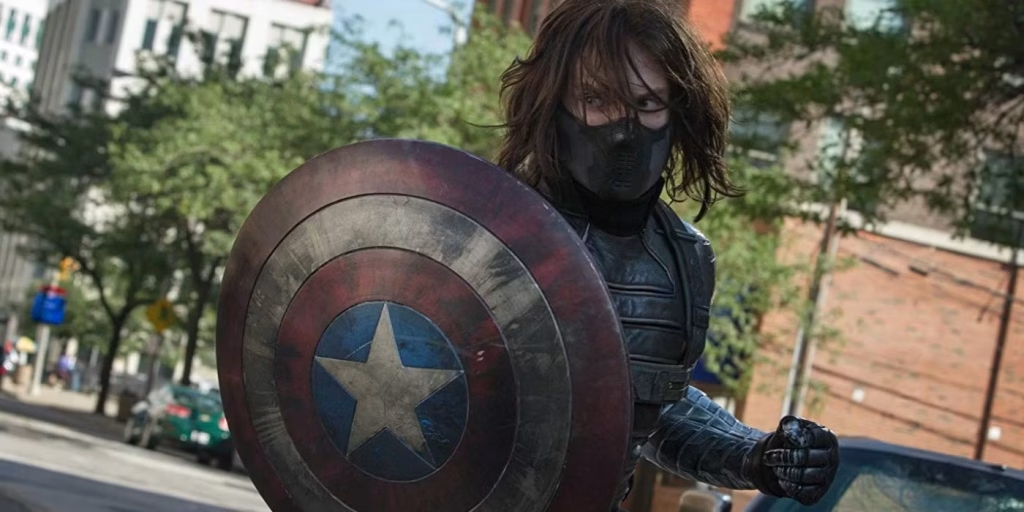
No wonder Captain America: The Winter Soldier, like other Marvel blockbusters, features breathtaking visual effects and over-the-top proportions, but it stands out for something earthier: its choreography. Brought down a peg by the Russo brothers and choreographed by Chris Carnel and James Young, the movie eschews gritty realism and is less concerned with practical effects and close-quarters combat than spectacle fueled by CGI.
Image Source: Bing Image. License: All Creative Commons
From the bone-rattling elevator ambush to the gasping knife fight in the streets, every punch and kick in The Winter Soldier is done with a sense of payoff. The action is cut quickly, neat and efficient, designed to depict Steve Rogers’ muscle, athleticism, and combat brain, never at the expense of plausibility.
Image Source: Bing Image. License: All Creative Commons
What renders the choreography here so effective is its lucidity. The camera pauses just long enough for the audience to be able to admire the athleticism and fluidity of every scene, so even the most disorganized parts appear to make sense and have a strong impact.
Image Source: Bing Image. License: All Creative Commons
Why Modern Fight Scenes Matter More Than Ever
So, what makes the greatest fight scenes in modern times? It’s not merely the technical expertise or the showmanship—it’s the storytelling. Filmmakers such as Gareth Evans, Chad Stahelski, and the Russo brothers are all aware that action does not need to intrude into the story. It is the story.
Image Source: Bing Image. License: All Creative Commons
The greatest fight choreography says something about the character, ratchets up tension, and inspires emotion. Whether it’s Rama’s desperate struggle to survive, Wick’s poetic revenge, or Captain America’s gritty sense of right and wrong, the action never takes a backseat. It’s as revealing as a monologue—sometimes more so.
Image Source: Bing Image. License: All Creative Commons
When in the hands of great filmmakers, violence transcends into art. And in the age of over-stuffed blockbusters, that kind of choreography is the difference between forgettable action and unforgettable.
Image Source: Bing Image. License: All Creative Commons
Let’s face it—Mortal Kombat has never simply been about gruesome fatalities and gratuitous button-pushing. It’s about establishing dominance in the gore-soaked arena, getting bragging rights, and showing your superiority across worlds. Over the past 30 years, enthusiasts have ardently debated which fighter is the supreme one. And with a fighting roster that’s grown well past 90 characters, the argument has only grown more bloody.
Image Source: Bing Image. License: All Creative Commons
From demi-gods and gods to guest legends and top fighters, these are the 19 greatest Mortal Kombat characters of all time, ranked on a combination of lore, legacy, and raw destructive power.
Image Source: Bing Image. License: All Creative Commons
1. Motaro
The centaurian sub-boss in Mortal Kombat 3 is a horror in hooves. Invulnerable to projectiles and with teleportation, Motaro is beyond a mere brute—he’s a supernatural tank. Even after his curse into the two-legged state, his power and presence on the battlefield are undeniable.
Image Source: Bing Image. License: All Creative Commons
2. Sheeva
Too often in Goro’s shadow, Sheeva is a power unto herself. As Shokan queen and once Sindel’s bodyguard, she unleashes brutal strength and royal authority. Her stomp alone on the ground ended friendships and scores of rounds.
Image Source: Bing Image. License: All Creative Commons
3. Argus
You won’t catch him in every match, but Argus, the god of Edenia, is the secret mastermind of Armageddon. As a god who manipulates timelines and fates, Argus might not throw the most punches, but he pulls the most strings.
Image Source: Bing Image. License: All Creative Commons
4. Daegon
Daegon is the hot-headed son of Argus, driven by ambition and fire. The founder of the Red Dragon clan, this demi-god is a ruthless and powerful character with a villain path that secures him as one of the most dangerous non-elder existences in the realms.
Image Source: Bing Image. License: All Creative Commons
5. Rain
Once a cheeky purple ninja Easter egg, Rain is now an outright powerhouse. A half-god who can wield hydromancy and control the weather, he’s as lethal as he is graceful—and he’s finally embracing his royal background and killing potential.
Image Source: Bing Image. License: All Creative Commons
6. Goro
The first Mortal Kombat sub-boss and Outworld’s 500-year ruler. Goro’s four-armed aggression put him in myth status, and his sheer physical authority still remains the benchmark for boss-level dangers within the franchise.
Image Source: Bing Image. License: All Creative Commons
7. Taven
A more obscure demi-god, Taven, was foretold to rescue the realms by defeating Blaze and redefining reality. With fire abilities, time control, and Elder God heritage, he’s got serious secret-boss juice—even if his popularity hasn’t yet caught up.
Image Source: Bing Image. License: All Creative Commons
8. Quan Chi
Deceptive and deadly, this necromancer masterfully uses soul manipulation, teleportation, and control over minds. Quan Chi may not be the best fighter in a melee, but as an expert strategist and dark sorcerer, he’s one of the most lethal entities in Mortal Kombat history.
Image Source: Bing Image. License: All Creative Commons
9. Scorpion (Hanzo Hasashi)
The franchise’s fiery face. Brought back from revenge, Scorpion rides hellfire, a killing spear, and centuries of war fury. Whether revenant or redeemed warrior, he’s always one of the most dreaded fighters in any chronology.
Image Source: Bing Image. License: All Creative Commons
10. Shujinko
He trained with all but one of the Mortal Kombat masters and learned their powers. Despite being used by Onaga, Shujinko’s mimicry and adaptability make him one of the most skilled kombatants in history—essentially a one-man roster.
Image Source: Bing Image. License: All Creative Commons
11. Stryker
He lacks powers, perhaps, but Stryker compensates with strategy, resilience, and sheer human determination. A tough-as-nails cop who outlasts supernatural assaults, he’s a testament to the fact that courage and ability still matter, no matter the presence of gods.
Image Source: Bing Image. License: All Creative Commons
12. Johnny Cage
What began as comic relief has become a legacy. Johnny’s shadow abilities, fighting prowess, and survival of several world-ending dangers (with a wisecrack, naturally) demonstrate that charisma and raw ability can get you a long way—even in the Netherrealm.
Image Source: Bing Image. License: All Creative Commons
13. Sonya Blade
A military legend and OG combatant, Sonya’s ferocity, strategic thinking, and hand-to-hand combat skills make her one of Earthrealm’s most dependable protectors. She’s a leader who’s battled and earned her scars and her position.
Image Source: Bing Image. License: All Creative Commons
14. Batman (Guest Character)
When Batman invaded Mortal Kombat vs. DC Universe, he introduced intellect, gadgetry, and maximum human conditioning to the fray. He may not have abilities, but he makes up for it with prep time, self-discipline, and raw willpower.
Image Source: Bing Image. License: All Creative Commons
15. Mileena
Fearsome, swift, and utterly unpredictable. Mileena is a genetically spliced combination of royalty and beast, and her ferocity on the battlefield is matched only by her guile. When she briefly ruled Outworld, it was in fear and rage.
Image Source: Bing Image. License: All Creative Commons
16. Jax Briggs
After losing his arms, Jax came back stronger—literally—with cybernetic upgrades that turned him into a juggernaut. He’s been the backbone of Earthrealm’s resistance for decades, and his resilience is as legendary as his fists.
Image Source: Bing Image. License: All Creative Commons
17. Kenshi
Blind but far from helpless, Kenshi’s telekinetic swordplay and spiritual powers make him a standout warrior. His mix of mysticism, tragedy, and martial skill has secured his place among Mortal Kombat’s most respected champions.
Image Source: Bing Image. License: All Creative Commons
18. Skarlet
She’s blood magic personified—born of blood and using it as a tool of destruction. Skarlet is perhaps the grimmest and most innovative combatant in the roster, and her lethal beauty has made her popular with fans in later installments.
Image Source: Bing Image. License: All Creative Commons
19. Alien (Guest Character)
When the Xenomorph appeared in Mortal Kombat, it took every ounce of horror along with it. Acid blood, quick combos, and the frightening capability to utilize other species’ attributes (such as Tarkatan blades) make it stand out as one of the most unforgettable and savage guest fighters.
Image Source: Bing Image. License: All Creative Commons
The universe of Mortal Kombat is a violent playground of gods, demons, and mortal fighters, all fighting for supremacy across worlds. Though some fighters are brute, others are magic or tech, the most powerful characters are notable for their lore, adaptability, and sheer influence on the franchise. Whether glory, gore, or grind is your thing, these 19 kombatants have earned their place in the pantheon of power.
Image Source: Bing Image. License: All Creative Commons
Anime and sneaker culture have long held a passion for dramatic, expressive storytelling, whether in fight choreography that goes completely over the top or shoes that are equally visually striking.
Image Source: Bing Image. License: All Creative Commons
That shared enthusiasm gets a dynamic new spin with the Record of Ragnarok x Nike custom sneaker collection.
Image Source: Bing Image. License: All Creative Commons
For enthusiasts looking to rock their beloved series outside of posters and merchandise, this collaboration presents something new, wearable, and unequivocally awesome.
Image Source: Bing Image. License: All Creative Commons
Inspired by the popular anime Record of Ragnarok, featuring intense battles and mythological giants, this official sneaker series transports legendary heroes such as Hades and Brunhilde from the screen to the streets.
Image Source: Bing Image. License: All Creative Commons
Every model captures the spirit of its character, not only in colors but in symbolism and detail that every fan will recognize immediately.
Image Source: Bing Image. License: All Creative Commons
Whether it’s the dark authority of Hades or the aggressive beauty of Brunhilde, these sneakers are as much about style as they are about connecting you to the narrative.
Image Source: Bing Image. License: All Creative Commons
From symbols drawn directly from the series to nuanced color schemes that capture each warrior’s personality, every shoe has a story with every step you make.
Image Source: Bing Image. License: All Creative Commons
In the contemporary fashion scene, customized sneakers have become a platform for self-expression, and this line follows that trend with ease.
Image Source: Bing Image. License: All Creative Commons
These are not mass release affairs—they’re works of art created for fans who desire more than casual fandom gear. With one-of-a-kind designs and limited drops, they erase the distinction between high-fashion clothing and collectible merchandise.
Image Source: Bing Image. License: All Creative Commons
Wearing a pair of these customs isn’t just about making a fashion statement—it’s a way of showing your love for the series in a bold, personal way.
Image Source: Bing Image. License: All Creative Commons
It’s no surprise fans are already sharing their looks online using hashtags like RecordOfRagnarok and Nike, joining a global community that celebrates the intersection of anime, fashion, and creativity.
Image Source: Bing Image. License: All Creative Commons
The Record of Ragnarok x Nike collection demonstrates one fact boisterously clear: anime is not only something you watch—it’s something you live.
Image Source: Bing Image. License: All Creative Commons
As fandom continues to permeate fashion, get used to seeing even more collaboration like this, where the stories don’t stop with the credits—they continue going with each step you take.
Image Source: Bing Image. License: All Creative Commons
Spin-offs are television’s highest high-wire act. They draw on something known—a favorite character, a familiar world. But they must also demonstrate that they can stand alone. Some quickly flame out, but when they succeed, spin-offs can equal—or even beat—the series that spawned them. From sitcoms to science fiction to cartoon favorites, here are 13 of television’s greatest spin-offs that left their mark in the annals of pop culture.
Image Source: Bing Image. License: All Creative Commons
1. Frasier (from Cheers)
Few anticipated that Dr. Frasier Crane’s life in Seattle after Cheers would be a phenomenon. Yet Frasier went on to rewrite the book on how intelligent a sitcom could be, combining urbane wit with complexity of feeling. It did more than keep pace with Cheers—it was itself a critical favorite, garnering over 30 Emmy Awards.
Image Source: Bing Image. License: All Creative Commons
2. The Simpsons (from The Tracey Ullman Show)
What began as a string of rapid-fire animated shorts on The Tracey Ullman Show evolved into a cultural phenomenon. The Simpsons revolutionized the world of television, shaping generations of writers and animators in addition to being the longest-running American sitcom ever.
Image Source: Bing Image. License: All Creative Commons
3. Better Call Saul (from Breaking Bad)
Coming off of one of the greatest dramas in the history of television was no small task, but Better Call Saul managed it. Tracking the tragic transformation of Jimmy McGill into Saul Goodman, the show brought low-key storytelling, deep character work, and a tone separate from Breaking Bad, while being lauded as one of the greatest dramas in its time.
Image Source: Bing Image. License: All Creative Commons
4. The Jeffersons (from All in the Family)
All in the Family spawned several spin-offs, but none did so loudly as The Jeffersons. Following George and Weezy’s relocation to a “deluxe apartment in the sky,” the show was revolutionary in its depiction of Black achievement and its unflinching approach to race and class in America.
Image Source: Bing Image. License: All Creative Commons
5. NCIS (from JAG)
First introduced via a backdoor pilot on JAG, NCIS was soon a ratings behemoth. Its mix of police investigations, offbeat character relationships, and military setting resonated with audiences, resulting in a continually expanding franchise with several hit spin-offs of its own.
Image Source: Bing Image. License: All Creative Commons
6. Angel (from Buffy the Vampire Slayer)
When Angel departed Sunnydale, fans did the same. Angel brought the moody vampire to Los Angeles and reveled in dark, mature storytelling. With storylines involving redemption, isolation, and moral complexity, the show established a unique identity while enriching the Buffy universe.
Image Source: Bing Image. License: All Creative Commons
7. Star Trek: Deep Space Nine (from The Next Generation)
While The Next Generation broadened Star Trek’s reach, Deep Space Nine boldly went further. Founded on a space station rather than a starship, it delved into long-form storytelling, political maneuvering, and warfare in new ways the franchise had not yet done. While initially polarizing, it’s now universally acclaimed by fans.
Image Source: Bing Image. License: All Creative Commons
8. The Andy Griffith Show (from The Danny Thomas Show)
What started as a solitary episode of The Danny Thomas Show spawned one of television’s most beloved classics. The Andy Griffith Show combined subtle humor and warm lessons in a small town, becoming a staple of 1960s television and American nostalgia.
Image Source: Bing Image. License: All Creative Commons
9. Family Matters (from Perfect Strangers)
Originally focused on the Winslow household, Family Matters soared due to breakout star Steve Urkel. His offbeat charm and catchphrases made the show a ’90s staple, incorporating broad comedy with sincere moments of heart and family bonding.
Image Source: Bing Image. License: All Creative Commons
10. MASH (from the movie MASH)
Although taking its inspiration from the 1970 film, the MASH series evolved into a cultural phenomenon in its own right. Blending seamlessly humor and war atrocities, it expanded the limits of what a sitcom was capable of. Its series finale is one of television’s most-watched episodes ever, a tribute to its emotional power.
Image Source: Bing Image. License: All Creative Commons
11. Batman Beyond (from Batman: The Animated Series)
The DC Animated Universe is populated with iconic spin-offs, and Batman Beyond is still one of the best. Featuring a high-tech, futuristic world and a fresh teen hero in the tutelage of Bruce Wayne, the series infused the Batman mythos with new vitality and appealed to a new crop of fans.
Image Source: Bing Image. License: All Creative Commons
12. The Flash (from Arrow)
One of the sprawling Arrowverse shows, The Flash, got off to a running start—literally. Its lighter tone, strong performances, and emotionally driven storytelling separated it from Arrow, and its first several seasons were singled out for their blend of superhero spectacle and character-driven drama.
Image Source: Bing Image. License: All Creative Commons
13. Young Sheldon (from The Big Bang Theory)
Delving into Sheldon Cooper’s early life might have seemed gimmicky, but Young Sheldon struck a balance between family drama and character humor. With the help of Iain Armitage’s performance and the presence of a fine supporting cast, the show added fresh depth to a beloved character.
Image Source: Bing Image. License: All Creative Commons
Spin-offs begin with a question: “What if we followed that character?” or “What happens next in that world?” Well-crafted, they transcend fan service and instead become innovative new chapters in their own right. These shows didn’t ride the coattails of their predecessors but shaped the legacy of television itself.
Image Source: Bing Image. License: All Creative Commons
The moment you hear the terms climate fiction or post-apocalyptic, your mind probably goes straight to burned-out wastelands, societal breakdown, and an unbearable atmosphere of gloom. And yes, many tales ride that bleak wave—but they’re not the only narrative. There’s an increasingly crowded shelf of books (even a few excellent manga) that reframe the post-apocalypse not as a cul-de-sac, but as a turning point. These books don’t merely describe what we lose—they envision what we could rebuild. Below are 11 climate and post-collapse novels that dream big. They present something revolutionary: not mere survival, but hope.
Image Source: Bing Image. License: All Creative Commons
1. Island by Aldous Huxley
Huxley’s follow-up to Brave New World substitutes utopia for dystopia. Island describes a world that combines awareness, environmental awareness, and communal knowledge. Even in the presence of an outside threat, the book has a resounding message that hope and nature are likely to reassert themselves.
Image Source: Bing Image. License: All Creative Commons
2. Woman on the Edge of Time by Marge Piercy
This 1976 classic is just as prophetic today. In time travel and feminist science fiction, Piercy offers us two possible futures: a dark, dehumanizing one and an equalitarian, sustainable, caring one. Her message is clear: the decision is ours.
Image Source: Bing Image. License: All Creative Commons
3. Nausicaä of the Valley of the Wind by Hayao Miyazaki
In a world overrun by toxic jungles and towering insect gods, Nausicaä stands as a beacon of empathy and environmental healing. Miyazaki’s manga (and the film it inspired) is a moving tribute to understanding—not conquest—and the idea that compassion can restore even the most broken worlds.
Image Source: Bing Image. License: All Creative Commons
4. Pacific Edge by Kim Stanley Robinson
Robinson imagines a near-future California that’s just. Working. Not without challenges, but with real efforts toward balance, equity, and sustainability. The story doesn’t ask what a perfect world looks like—it asks what it takes to keep one going.
Image Source: Bing Image. License: All Creative Commons
5. Earth by David Brin
It begins with a crisis—a black hole within the planet—and builds into a rich, global story of climate change, extinction, and rebirth. Throughout it, Brin injects his epic with hope regarding human resilience and scientific acumen.
Image Source: Bing Image. License: All Creative Commons
6. The Dispossessed by Ursula K. Le Guin
Le Guin’s double-world story juxtaposes a decaying capitalist world with a stark, anarchist one attempting to live by its principles. In physicist Shevek’s journey, she explores what it means to create anew—even when the plans are flawed.
Image Source: Bing Image. License: All Creative Commons
7. Parable of the Talents by Octavia E. Butler
Yes, it’s in a bleak, fractured America. But Butler’s heroine dares to envision a new faith system—Earthseed—based on transformation, compassion, and survival off-world. It’s an inspiring challenge to forge the future instead of simply living through it.
Image Source: Bing Image. License: All Creative Commons
8. Zahrah the Windseeker by Nnedi Okorafor-Mbachu
In a colorful universe of biotechnological wonder, quiet Zahrah finds her strength and explores a forbidden jungle. Okorafor’s tale weaves Afrofuturism with coming-of-age courage, reminding us that at times, reaching into the unknown is where transformation starts.
Image Source: Bing Image. License: All Creative Commons
9. The World We Made by Jonathon Porritt
Told retrospectively from a teacher in 2050, this picture book is an elaborate, realistic, and unexpectedly hopeful chronology of how the world united to prevent climate catastrophe. Imagine it as futuristic nonfiction with an optimistic soul.
Image Source: Bing Image. License: All Creative Commons
10. Suncatcher: Seven Days in the Sky by Alia Gee
It’s 2075, and human society has not only endured climate anarchy—it’s evolved. Scientist Radicand soars through the skies in a solar-powered airship, examining gender, psychology, and post-collapse politics with panache and intelligence. A lesser-known jewel to uncover.
Image Source: Bing Image. License: All Creative Commons
11. New York 2140 by Kim Stanley Robinson
Manhattan’s underwater, but life continues. Robinson’s book is throbbing with defiance and ingenuity as its inhabitants walk through a climate-change-ravaged half-submerged city, and the will to restore it from unregulated capitalism.
Image Source: Bing Image. License: All Creative Commons
These are not survival stories—they’re roadmaps for envisioning better worlds. In a time of climate despair and political exhaustion, these kinds of stories are more than solace—they’re necessary. They remind us that hope isn’t merely a possibility—it’s a force.
Image Source: Bing Image. License: All Creative Commons
Spinoffs on TV are a gamble. For each smash hit, there’s an extensive list of canceled flops. But when they succeed, they don’t simply prolong a franchise—they become instant classics themselves. Some have even overshadowed the programs that spawned them. Here’s a rundown of some of television’s greatest and most influential spinoffs—shows that demonstrated lightning really can strike twice (or thrice) if the proper story meets the proper audience.
Image Source: Bing Image. License: All Creative Commons
1. Better Call Saul
Whereas Breaking Bad was a breakneck character study in reinvention, Better Call Saul proceeded at a more deliberate, contemplative pace—and produced one of the greatest character studies in television history. From its outset as an offbeat legal dramedy, it became a tragic, suspenseful study in morality, identity, and loss. Bob Odenkirk’s portrayal of Jimmy McGill, the man behind Saul Goodman, added depth and pathos to the character. Thoughtful, careful, and superbly written, this spin-off richly deserved its place in the TV pantheon.
Image Source: Bing Image. License: All Creative Commons
2. Frasier
As Cheers came to a close, few could have foreseen that one of its supporting actors would front one of the most award-winning sitcoms of all time. Kelsey Grammer’s Frasier Crane relocated to Seattle, presented us with a new group of lovable misfits, and presented sharp, urbane comedy into our living rooms. With its blend of wit, warmth, and highbrow humor, Frasier became a defining series of the 1990s and a rare spinoff that felt entirely fresh.
Image Source: Bing Image. License: All Creative Commons
3. The Simpsons
It’s simple to overlook the fact that The Simpsons began life as short animated segments on The Tracey Ullman Show. What ensued was a pop culture transformation. More than three decades on, it’s the longest-running TV sitcom ever and a staple of American television. With satire, heart, and social commentary, The Simpsons remade what animated comedy could achieve—and influenced countless others that came afterwards.
Image Source: Bing Image. License: All Creative Commons
4. Star Trek: The Next Generation
Resurrecting a popular franchise is no easy task, but The Next Generation accomplished it with aplomb and sensitivity. Decades in the future from the original Star Trek, this show presented us with new faces, new challenges, and a new captain in Patrick Stewart’s Jean-Luc Picard. Intelligent, enlightened, and willing to explore big concepts, TNG was an instant phenomenon that spawned yet more spin-offs and solidified Star Trek as an intergenerational franchise.
Image Source: Bing Image. License: All Creative Commons
5. The Jeffersons
Spin-off of All in the Family, The Jeffersons introduced a new type of sitcom storytelling by placing a prosperous Black family at the center of life in a high-rise Manhattan luxury building. Sherman Hemsley and Isabel Sanford starred in a show that confronted racial and class themes with humor and feeling. One of the best theme songs in television history and a pioneering legacy make The Jeffersons a cultural landmark.
Image Source: Bing Image. License: All Creative Commons
6. Law & Order: Special Victims Unit
When SVU first debuted in 1999, few suspected it would set a record as the longest-running primetime drama in the history of American television. Committed to telling stories of particularly sensitive crimes, the series carved out its unique voice in the Law & Order franchise. Mariska Hargitay’s performance as Olivia Benson turned the character into an icon of compassion and tenacity, grounding a show that continues to be both relevant and powerful more than twenty years on.
Image Source: Bing Image. License: All Creative Commons
7. NCIS
Introduced initially through a backdoor pilot on JAG, NCIS soon took on a life of its own—and then some. With its blend of procedural suspense, workplace buddy shows, and character-based tales, it was a worldwide phenomenon. Mark Harmon’s Gibbs headed up a team that people fell in love with, and the series has since spawned several successful spinoffs in its own right, making NCIS its franchise overhang.
Image Source: Bing Image. License: All Creative Commons
8. The Legend of Korra
In the shadow of Avatar: The Last Airbender’s critical acclaim, its follow-up, The Legend of Korra, was no small feat, but it stepped up to the challenge. Taking place in a more mechanized world and working through issues such as inequality, identity, and trauma, Korra’s adventure felt ambitious and current. Stylistically different from Avatar, the show forged its path with beautiful animation, well-rounded characters, and compelling storytelling.
Image Source: Bing Image. License: All Creative Commons
9. Angel
While Buffy the Vampire Slayer embraced high school horror and empowerment, Angel went darker and more adult. David Boreanaz’s dark antihero found atonement in the streets of Los Angeles, battling supernatural evils and moral ambiguity. With a changing cast and shifting storylines, Angel delved into themes of sacrifice, justice, and identity that spoke powerfully to audiences.
Image Source: Bing Image. License: All Creative Commons
10. Laverne & Shirley
From the wholesome universe of Happy Days, Laverne & Shirley added a blue-collar voice and slapstick appeal to the small screen. Penny Marshall and Cindy Williams formed a dynamic duo whose relationship grounded the show’s success. It was one of the top-rated sitcoms of its time and demonstrated that spinoffs could provide both laughter and heart in abundance.
Image Source: Bing Image. License: All Creative Commons
11. Maude
One of All in the Family’s most successful spinoffs, Maude pushed Norman Lear’s social commentary to its most daring extremes. Starring Bea Arthur, the show was not hesitant to take on incendiary issues such as mental illness, feminism, and abortion. Maude Findlay was loud, smart, and unrepentantly liberal—a character beyond her time in a show that expanded the parameters of what a sitcom could do.
Image Source: Bing Image. License: All Creative Commons
TV Spinoffs: More Than Just Side Stories
Spinoffs are usually a roll of the dice—but these shows demonstrate that, with vision and proper execution, they can outdo their beginnings and stand on their own proudly. Whether to expand a universe, to explore further a character’s arc, or to bring something new, the greatest spinoffs aren’t follow-ups. They’re reinventions, reflections, and in some instances, revolutions in storytelling.
Image Source: Bing Image. License: All Creative Commons
Legendary Pokémon aren’t merely scarce discoveries—they’re the soul of the Pokémon world. From determining the lore and competitive metagame to starring in unforgettable film moments, these icons have more than mere power—they have stories, enigmas, and emotional significance. Over nine generations, the franchise has introduced dozens of legendaries, but few stand out above the rest. Here are 11 of the best Legendary Pokémon of all time—ranked not only based on stats, but by influence, design, and legacy.
Image Source: Bing Image. License: All Creative Commons
1. The Treasures of Ruin – Cursed Quartet with a Twist
Wo-Chien, Chien-Pao, Ting-Lu, and Chi-Yu aren’t the most glamorous questline in Pokémon Scarlet & Violet, but the idea behind them is genius. Every one of them is bred from a cursed artifact—a spooky mashup of myth and elemental power—and they possess powers that drain strength from every Pokémon in combat. Their backstories are chilling, their appearances are unique, and their combined presence injects new mystery into Gen 9’s mythology.
Image Source: Bing Image. License: All Creative Commons
2. Lugia – The Sea Guardian
Lugia’s regal concept finds a harmony between the grace of birds and the power of dragons. Though its in-game usability in Pokémon Silver is astonishingly low, it flies high on popularity due to its appearance in the second Pokémon movie. As the monarch of the legendary birds and the guardian of the seas, Lugia’s sheath of silent power and its iconic roar have consigned it to an ageless favorite.
Image Source: Bing Image. License: All Creative Commons
3. Zacian – Galar’s Noble Warrior
With the grace of a knight combined with the power of a warrior wolf, Zacian stands out from its Galar roots. Its Crowned Sword form is a visual treat and terror to behold in battle, particularly at the peak of its time in competitive play. Zacian’s late-game capture provides mystique, and its background, with its connection to old legends and the history of Galar, makes it stand with the greats.
Image Source: Bing Image. License: All Creative Commons
4. Ogrepon – The Legendary with a Heart
Unlike with most legendaries, Ogrepon isn’t presented as a deity, but as an outsider who is misunderstood. Her Scarlet & Violet DLC storyline is highly emotional, and the player’s connection to her feels personal and deserved. Mix in her special masks, Terastal appearances, and respectable battle statistics, and Ogrepon is one of the most lovable and remembered legends in recent history.
Image Source: Bing Image. License: All Creative Commons
5. Xerneas – The Life-Giver
With its crystal antlers glinting like stained glass, Xerneas exudes sophistication and life. As the embodiment of life itself in Pokémon X, its design is a tutorial in how to create a legendary design. Its staple move, Geomancy, has made its mark on competitive battling, and its existence lends an unusual aura of tranquil power to the legendary ranks.
Image Source: Bing Image. License: All Creative Commons
6. Suicune – The Flowing Stream
Suicune’s appearance is all about elegance in movement—its flowing mane and serene temperament capture the essence of a flowing stream. Unlike some of its peers, Suicune appears prominently in several games, most notably Pokémon Crystal and HeartGold/SoulSilver. Its powerful character and dignified reserve have served it well in enduring.
Image Source: Bing Image. License: All Creative Commons
7. Rayquaza – The Sky Serpent Supreme
Rayquaza is a legend in all respects. With its sleek, snake-like body and emerald green glow, it demands attention—and the airspace. Its introduction in Emerald as the peacemaker between Groudon and Kyogre is legend, and its Mega Evolution (which involves no Mega Stone) is both game-changing and graphics-tastic. Rayquaza even battles Deoxys in space. Do we need to say more?
Image Source: Bing Image. License: All Creative Commons
8. Giratina – Master of the Distortion World
Giratina expands the scope of legendary design into horror. As the king of the Distortion World in Pokémon Platinum, it has an otherworldly feel—and an outright sense of foreboding. Its appearance in Legends: Arceus, with a second phase boss fight, only adds to its mythology. A terror of legend, Giratina is more usually a reluctant protector, making it one of the series’ most nuanced characters.
Image Source: Bing Image. License: All Creative Commons
9. Mewtwo – The Original Powerhouse
Born from human experimentation, Mewtwo was the very first Pokémon to capture profound narrative themes such as ethics and identity. From its mysterious backstory in Red & Blue to its central role in the first Pokémon film, Mewtwo was a quick idol. Even years later, it’s still one of the best battles and most iconic Pokémon ever.
Image Source: Bing Image. License: All Creative Commons
10. Solgaleo & Lunala – The Twin Guardians of Alola
Solgaleo and Lunala are a rare narrative arc, growing from endearing Cosmog (Nebby) into legendary protectors. Their growth isn’t only formidable—it’s emotional, connected to the bond between player and Lillie and the cosmic narrative of Sun & Moon developing. These twin gods show that world-shaping legendaries can also be friend-like.
Image Source: Bing Image. License: All Creative Commons
Though not in the same sense as traditional legendaries, like some on this list, the Galarian forms of Articuno, Zapdos, and Moltres should be recognized for their highly ambitious redesigns and new lore. Each of their new forms is exciting and revitalized yet respectful of the originals.
Image Source: Bing Image. License: All Creative Commons
From cosmic dragons to haunted artifacts, these mythical Pokémon are more than stats and moves—they bear the burden of myths, memories, and emotional lives. Whether they defend oceans, warp space-time, or just won’t fit in a Poké Ball, they embody the heart and soul of the Pokémon franchise—each a legend unto themselves.
Image Source: Bing Image. License: All Creative Commons
Disaster movies are cinema’s ultimate thrill ride—part spectacle, part absurdity, and all adrenaline. Whether you’re marveling at top-tier special effects or delighting in the campiest CGI imaginable, these films serve one universal purpose: to show us what happens when everything goes spectacularly wrong. From end-of-the-world epics to gloriously over-the-top SyFy originals, here are 15 of the most unforgettable disaster movies ever made.
Image Source: Bing Image. License: All Creative Commons
1. The Day After Tomorrow (2004)
Superstorms unleash hell across the globe, plunging New York into a fresh Ice Age. It’s large, brash, and scientifically questionable, but Roland Emmerich’s eerie visuals and heart-stopping tempo make it a genre classic.
Image Source: Bing Image. License: All Creative Commons
2. Twister (1996)
There is no better encapsulation of storm-chasing chaos than Twister. With cattle flying through the air, ear-shattering tornadoes, and the late, great Bill Paxton and Helen Hunt in charge, it remains a classic of ’90s disaster films.
Image Source: Bing Image. License: All Creative Commons
3. Independence Day (1996)
Aliens invade. The White House blows up. Will Smith slugs one in the face. There were few blockbusters that defined disaster quite like this, combining sci-fi spectacle with box-office-fueled patriotism and quotable one-liners.
Image Source: Bing Image. License: All Creative Commons
4. Sharknado (2013)
A shark-filled hurricane? Why not. Sharknado goes all in with its absurd premise and is an instant cult hit. It’s not here to be realistic—it’s here to be outrageously entertaining, and it succeeds fabulously.
Image Source: Bing Image. License: All Creative Commons
5. San Andreas (2015)
Dwayne Johnson fights the mother of all earthquakes in this California-shaking thrill ride. Amidst buckling skyscrapers and tidal waves, it’s a visual constant diet of mayhem with just the right dash of action-hero charm.
Image Source: Bing Image. License: All Creative Commons
6. 2012 (2009)
If you want to see the world end in every which way—earthquakes, tsunamis, volcanoes spewing their guts out—this is your movie. Roland Emmerich does not hold back in this end-of-the-world epic where nothing is sacred… not even Mount Everest.
Image Source: Bing Image. License: All Creative Commons
7. The Poseidon Adventure (1972)
This disaster classic establishes the gold standard for survival ensemble films. When a luxury cruise liner sinks, a group of passengers must climb to the top to escape in one of the most suspenseful and emotionally charged journeys in the genre.
Image Source: Bing Image. License: All Creative Commons
8. Titanic II (2010)
No, not that Titanic. This no-budget spiritual follow-up features a replica ship squaring off with a century-later iceberg—and a tsunami, just for kicks. It’s glorious over-the-top and great for fans of so-bad-it’s-good film.
Image Source: Bing Image. License: All Creative Commons
9. Armageddon (1998)
Bruce Willis and an oil driller crew blast off into space to save the world from a giant asteroid. It’s Michael Bay at his over-the-top best, featuring a heartstring-pulling soundtrack and as many slow-motion hero shots as they could fit into a dozen trailers.
Image Source: Bing Image. License: All Creative Commons
10. Deep Core (2000)
Picture Armageddon, but within the Earth. A B-movie classic in which scientists have to drill into the Earth’s core to stop humanity from being wiped out. Budget is small, but the ambition (and the camp) are huge.
Image Source: Bing Image. License: All Creative Commons
11. The Hurricane Heist (2018)
What if Fast and Furious merged with Twister? This action movie crossover of high concept has robbers trying to rob the U.S. Treasury as a Category 5 hurricane whips by outside. It’s loud, it’s absurd, and it downright indulges in the chaos.
Image Source: Bing Image. License: All Creative Commons
12. The Wave (2015)
This Norwegian thriller brings a more realistic spin to the genre, as a geologist must rush to save his family when a tsunami spawned by a fjord endangers their village. Intense, well-acted, and visually stunning—it’s proof that foreign disaster movies can deliver the same kind of wallop as Hollywood’s biggest hits.
Image Source: Bing Image. License: All Creative Commons
13. 500 MPH Storm (2013)
A “hypercane” devastates the U.S. at—you guessed it—500 mph. The science is preposterous, but this SyFy channel mainstay wins on sheer entertainment. It’s a crash course in anarchy, starring Casper Van Dien.
Image Source: Bing Image. License: All Creative Commons
14. Outbreak (1995)
Disaster needn’t befall us, either. In Outbreak, it’s a deadly virus that spreads like fire, and Dustin Hoffman struggles to keep it under control. Foreboding and tragically prescient, one of the most realistic takes in the genre.
Image Source: Bing Image. License: All Creative Commons
15. Metal Tornado (2011)
A test with energy gets out of hand and creates—you guessed it—a metal-consuming magnetic tornado. It’s a gloriously absurd entry to the SyFy disasterplex, full of zany CGI and Lou Diamond Phillips battling science gone mad.
Image Source: Bing Image. License: All Creative Commons
Whether you’re attracted to the awe-inspiring devastation of blockbuster behemoths or the tacky humor of budget-busters, these disaster movies assure one thing: there’s no incorrect method for ending the world—on the big screen, that is. So get some popcorn and buckle up. The next movie calamity is a play button away.
Image Source: Bing Image. License: All Creative Commons
The Flash is more than DC’s quickest hero—his is a pop culture legend who’s moved at lightning speed through comics, cartoons, and live-action retreads for over 80 years. With every fresh generation, another actor has donned those iconic red boots, bringing his bit of magic to the Scarlet Speedster. But who’s taken lightning in a bottle? From touching TV moments to cartoonish standouts, here are the 11 greatest actors ever to portray The Flash, listed according to fan adoration, critical acclaim, and sheer speedster appeal.
Image Source: Bing Image. License: All Creative Commons
1. Grant Gustin
Grant Gustin is the Flash for many fans. Playing Barry Allen on The CW’s The Flash (2014–2023), Gustin infused the character with emotional resonance, likability, and actual heroic passion. Even as the series faltered in writing or tone, his performance stayed consistent, stabilizing the Arrowverse’s longest-running show. With an affinity for his supporting cast and a talent to naturally balance both tiny emotional scenes and huge crossover episodes, Gustin’s Flash was a new generation favorite, e—and many still wish to see him back.
Image Source: Bing Image. License: All Creative Commons
2. John Wesley Shipp
Well before the Arrowverse, John Wesley Shipp first brought Barry Allen to life on the small screen in the 1990 The Flash series. His adult, earthy interpretation of the character was a breath of fresh air when superhero tales were still discovering their tone. Shipp later returned to the Arrowverse in several iterations, such as Jay Garrick and even his own original Flash. His legacy status and multiverse cameos seal his position as a fan-favorite, ageless figure in Flash lore.
Image Source: Bing Image. License: All Creative Commons
3. Michael Rosenbaum
As Wally West in Justice League and Justice League Unlimited, Michael Rosenbaum made the Flash the smart-alecky, wisecracking center of the animated team. His take on Wally was well beyond comic relief—he was deep, charming, and full of unexpected emotional resonance. Rosenbaum’s high-energy performance helped establish the character for a generation of viewers who came up with the DCAU.
Image Source: Bing Image. License: All Creative Commons
4. Christopher Gorham
In the DC Animated Movie canon, Christopher Gorham played Barry Allen in several films, such as Justice League: War and Justice League Dark: Apokolips War. Gorham’s Flash was intelligent, mature, and quietly charming, with a dependably solid center to the high-octane animated action. His version might not be so flashy as others, but it’s intensely consistent and lovable.
Image Source: Bing Image. License: All Creative Commons
5. Charlie Schlatter
Charlie Schlatter originally provided the voice for The Flash in Superman: The Animated Series and has gone on to contribute his voice to many DC efforts. His energetic, youthful approach—mostly as Wally West—felt nostalgic but flexible, suiting itself to a range of tones and narratives. His longevity and versatility have made him a comfortable favorite amongst long-time animation buffs.
Image Source: Bing Image. License: All Creative Commons
6. James Arnold Taylor
Best recognized for providing the voice of The Flash in Young Justice and the DC Lego Universe, James Arnold Taylor is a blend of fun and mentorship in the role. His Barry Allen in Young Justice is that of an older hero and benevolent uncle combined, while his Lego incarnation is pure energy. Both are balanced between wisdom and enthusiasm.
Image Source: Bing Image. License: All Creative Commons
7. Neil Patrick Harris
In Justice League: The New Frontier, Neil Patrick Harris played Barry Allen with retro-style superhero flair. His take on the character had the Silver Age optimism and confidence to a tee, fitting the film’s 1950s setting. Although it was a one-off, his Flash left an impression.
Image Source: Bing Image. License: All Creative Commons
8. Keiynan Lonsdale
Keiynan Lonsdale brought Wally West to the screen in The Flash and Legends of Tomorrow, first as Kid Flash. His teen energy and emotional journey—particularly as he filled in for Barry temporarily—connected with fans. Lonsdale’s Wally provided representation, emotion, and a sense of legacy to the Arrowverse.
Image Source: Bing Image. License: All Creative Commons
9. Kyle Gallner
In Smallville, Kyle Gallner played Bart Allen—a charming, outlaw Flash who dates back to many other 2000s live-action Flashes. His iteration, while not always comic-accurate, possessed youthful swagger and a dedicated fan base. Had he been given more time, Gallner’s Flash might have become something special.
Image Source: Bing Image. License: All Creative Commons
10. Ezra Miller
Ezra Miller’s Barry Allen first appeared in Batman v Superman and came to the forefront in Justice League and The Flash (2023). Their performance was quirky, hyper, and emotionally rich, but divisive. Though Miller introduced a new cinematic Flash, uneven storytelling and off-screen drama tainted this take’s reception and prospects.
Image Source: Bing Image. License: All Creative Commons
11. Notable Mentions: Rod Haase, Kenny Johnston, Josh Keaton, Jack Angel, Alan Tudyk
Rod Haase played Barry Allen in the 1979 TV special Legends of the Superheroes, a cult favorite among early fans. Kenny Johnston had a campy but sincere appearance in the 1997 TV movie Justice League of America. Flash was voiced by Josh Keaton in Crisis on Two Earths, and Jack Angel (Super Friends) and Alan Tudyk (Batman: The Brave and the Bold) provided humor and heroism to their animated interpretations.
Image Source: Bing Image. License: All Creative Commons
From the earnest heroism of Grant Gustin to Michael Rosenbaum’s signature one-liners, the heritage of The Flash is founded on a multiverse of iconic performances. In live action or animation, every actor brought something special to DC’s speediest man alive—something that substantiated the argument that the correct performance can make the speed force tangible.