Home Blog Page 1015

Nazi Forced Labor in Eastern Europe: A WWII History

0
Image Source: Bing Image. License: All Creative Commons

When we reflect on the destruction of World War II, our attention tends to land on battles and campaigns. But perhaps one of the darkest, and not-as-widely-discussed, themes of Nazi domination of Eastern Europe was the pervasive practice of forced labor. This wasn’t merely an incidental side effect of occupation—it was a concerted policy, based on racial ideology, employed to power the German war machine and annihilate the groups it opposed.

Image Source: Bing Image. License: All Creative Commons

Underlying this cruel system was the Nazi conviction that Slavs were racially inferior—barely superior to Jews, Roma, and others deemed “undesirable.” To the Nazis, Slavs were intended to serve, not flourish. Leaders such as Erich Koch, one of the region’s highest-ranking Nazi officials, confirmed that they viewed the native population as expendable. In a grim 1941 speech, Koch declared the average Slavic laborer “a thousand times inferior” to the worst German worker. That sort of mentality established the basis for a system that would take advantage of millions.

Image Source: Bing Image. License: All Creative Commons

In Poland, preparations were underway nearly as soon as the Germans invaded. The Nazis tore down existing labor protections, dismantled unions, and introduced strict laws requiring all Polish citizens between the ages of 18 and 60 to work for the occupying forces. Within a few weeks, labor offices sprouted everywhere. By late 1939, hundreds of thousands of Poles were being channeled into jobs in Germany. The figures continued to rise exponentially—by mid-1940, almost 700,000 were employed in German factories, farms, and industries, often in atrocious conditions.

Image Source: Bing Image. License: All Creative Commons

Things only worsened after the Germans began their invasion of the Soviet Union in June 1941. With enormous new territory now under their control—including the Baltic states, Ukraine, and Belarus—the Nazis set their eyes further outward to build their pool of workers. Initially, they attempted to encourage people to come to Germany voluntarily.

Image Source: Bing Image. License: All Creative Commons

Posters offered good wages, decent food, and better conditions than in their home countries. These enticements attracted some optimistic workers from cities such as Kharkiv and Kraków, but the situation they encountered was in no way like that promised.

Image Source: Bing Image. License: All Creative Commons

Soon, the news trickled back to the families and friends. Reports of starvation, brutality, and endless work seeped quickly, and the number of volunteers dried up. The Nazi war machine, having suffered high losses and requiring more manpower, could not wait. That is when Fritz Sauckel took over as the head of labor conscription. His assignment was straightforward: obtain bodies for Germany, no matter what it took.

Image Source: Bing Image. License: All Creative Commons

Sauckel’s tactics were brutal and merciless. Quotas were established, and recruiters were sent out armed with the potential for violence. Recruiters and police went from door to door, dragging individuals from their homes. Local authorities, frequently under pressure to produce results, had no qualms about rounding up political opponents or members of opposing ethnic groups. Frequently, there was no sense or logic—only a frantic attempt to stuff German factories with workers from Eastern Europe.

Image Source: Bing Image. License: All Creative Commons

As time went on, the process grew increasingly violent and indiscriminate. Families were ripped apart, and communities existed in fear of the next raid. Survivors testified later to horrifying scenes—individuals snatched from streets, removed from schools or churches, beaten before their loved ones.

Image Source: Bing Image. License: All Creative Commons

Resistance met only with more violence. In other villages, the recalcitrants had their homes destroyed or their families held hostage. In severe instances, whole communities were annihilated as a punitive measure. Bilozirka in Ukraine and Sumyn in Poland were among the sites that became pitiful lessons of the extent to which the Nazis went.

Image Source: Bing Image. License: All Creative Commons

Naturally, individuals did not lie down and accept this. Young men and women risked everything not to be taken. Some pretended they were sick, others hurt themselves to make themself unfit for work. Thousands went into the forests, joining resistance movements and partisan forces. All of these acts of resistance made the job of the Nazis more difficult and compelled the Nazis to stretch their forces thinner over the occupied land.

Image Source: Bing Image. License: All Creative Commons

Ultimately, the effect of this coerced labor policy reached well beyond the factories and fields of Germany. It disrupted families, destroyed communities, and left a legacy of fear, resistance, and trauma. The wounds it inflicted in Eastern Europe were felt long after the war was over. But even with the brutality, the resilience of the people remained. Their testimonies remind us not only of the atrocities of war but also of the resilience necessary to survive—and resist—systemic violence. The lessons of the time are eternal and worth remembering, not merely as history, but as a warning for the future.

Elevate Your Sound: Dolby Atmos FlexConnect Comes to TCL TVs

0

Dolby Atmos FlexConnect is now available on select TCL TVs and speakers, revolutionizing the home audio experience. If you’ve ever found traditional surround-sound systems to be a hassle—fussing over speaker placement, managing cables, or dealing with awkward room layouts—this is the kind of upgrade that might make your day.

Image Source: Bing Image. License: All Creative Commons

So, what is Dolby Atmos FlexConnect exactly? Plain and simple, it enables your TV to connect wirelessly with external speakers anywhere in your room. No need for a soundbar, an AV receiver, or some compulsive regimentation of the setup. Dolby describes FlexConnect as being able to “easily adapt as more devices are added, no matter where they’re placed” and automatically adapting the Dolby Atmos experience to the room and speaker setup. In short, you have a must-have immersive, spatial audio without the typical setup hassles.

TCL is the first in the U.S. to introduce FlexConnect on its 2025 QD-Mini LED TVs, as part of the Precise Dimming Series. That means the QM8K, QM7K, and QM6K models. To complement these TVs, TCL is also introducing the Z100 smart speaker, designed to play well with FlexConnect. You can pair a maximum of four Z100 speakers with a compatible TV, and co-opt the TV’s speakers for a complete Dolby Atmos system. The Z100 is already out in China, but U.S. pricing remains unknown.

What sets FlexConnect apart is simply how flexible it actually is. You can position the speakers wherever they suit you—no more fussing with getting them lined up or running wires across the floor. The system adjusts for itself with microphones to scan your room’s dimensions and tone the sound for you. TCL employs the TV’s microphones for this process, so the entire thing remains easy and seamless.

There are a couple of technical things to keep in mind. The four-speaker limit isn’t something built into Dolby’s tech—it’s more about the processing power available in TCL’s current TV lineup. And if you’re looking to add a subwoofer, TCL says you’ll need to use their specific model. More details on that are still to come.

John Couling, Dolby’s senior vice president of entertainment, put it nicely: “With Dolby Atmos FlexConnect, consumers can unlock even more flexibility and adaptability in the way they plan their home entertainment systems, without the hassle of wondering if their speakers are in the right spot to receive an amazing Dolby Atmos experience.”

And there’s also industry buzz building in this space. Since Dolby’s FlexConnect announcement, Fraunhofer IIS—the same group responsible for the MP3—has come out with its immersive sound solution, called Fraunhofer UpHear Flexible Rendering. The competition is heating up, and that means more innovation and more options for those who want to level up their home entertainment systems.

Currently, TCL’s FlexConnect-compatible TVs and Z100 speakers lead the charge in this transition, offering more easy access than ever before to cinema-quality sound, without making your living room look like a puzzle of wires.

8 Unusual Motives Behind Horror’s Most Twisted Killers

0
Image Source: Bing Image. License: All Creative Commons

Let’s get real—horror films just wouldn’t be the same without the bad guys. Sure, the jump frights and eerie soundtracks pound your heart into your chest, but it’s the villains—the crazy, the insane, the diabolical-who linger with us long after the credits have finished rolling.

Image Source: Bing Image. License: All Creative Commons

But what makes a horror villain unforgivable? Not the body count or the mask—it’s motive. The best horror villains aren’t dim-witted killing zombies; they have motivation (albeit misguided). Occasionally, their motivations are so insane, so perverted, or so surprisingly deep that you just find yourself giving credit where credit is due, right before they do something awful.

Image Source: Bing Image. License: All Creative Commons

So, in the spirit of all creepy things, here’s a countdown of eight horror villains and some of the wackiest, weirdest, and most unexpected motives in movie history. Fasten your seatbelts, horror enthusiasts.

Image Source: Bing Image. License: All Creative Commons

8. Norman Bates (Psycho) – A Killer with a Split Personality

Norman Bates is not only one of the genre’s first major monsters—he’s also one of its greatest psychological landmarks. Having killed his domineering mother, Norman’s psyche shatters under the load of guilt and sorrow. He begins to adopt her personality, allowing “Mother” to assert herself whenever he feels endangered. The consequence? One of the most jaw-dropping twists in cinematic history and an exploration of mental madness that remains effective all these years later.

Image Source: Bing Image. License: All Creative Commons

7. Julia Cotton (Hellraiser) – Fatal Desire

Julia isn’t trying to break a curse or avenge a disaster. Nope—she’s motivated by one thing: desire. After being reunited with her ex-lover Frank (who’s returned from hell looking pretty filthy), Julia begins killing men so he can heal. Why? Because he was simply that good in bed. It’s likely the only time ever lust has prompted a murder spree in the interest of romance. Creepy? Without a doubt. But also… unusual.

Image Source: Bing Image. License: All Creative Commons

6. Pamela Voorhees (Friday the 13th) – A Mother’s Bereavement Made Lethal

Before her son Jason ever laid hands on a machete, Pamela Voorhees was massacring camp counselors to avenge his death. In her mind, she wasn’t just getting even—she was safeguarding other children from irresponsible grown-ups. Her sorrow evolved into an outright killing spree, but there is something repugnantly human in her fury. It’s helicopter parenting run amok to a killer’s level.

Image Source: Bing Image. License: All Creative Commons

5. Leslie Vernon (Behind the Mask) – Career Slasher

Leslie Vernon approaches serial killing as a dream job. He trains, researches, and prepares to become part of horror’s elite. He even lets a documentary crew tag along, providing behind-the-scenes access to his warped ambitions. It’s satire, of course, but it also muddles the distinction between reality and fiction, making us wonder about our obsession with killers. When Leslie finally turns the switch and goes full-on slasher, it’s terrifying and weirdly earned.

Image Source: Bing Image. License: All Creative Commons

4. Annie Wilkes (Misery) – The Most Hazardous Fan

Annie Wilkes isn’t motivated by madness or revenge—she’s motivated by fandom. When her favorite author offends her favorite character, she doesn’t react kindly. Rather, she takes him hostage and makes him rework the tale. Her love of storytelling and control make her one of horror’s greatest villains. After all, what’s scarier than someone who loves you just a little bit too much?

Image Source: Bing Image. License: All Creative Commons

3. Rob (Nekromantik) – Necro Nightmare Fuel

Some bad guys test limits. Rob tosses the limits off a cliff. In Nekromantik, he brings a dead body home for a threesome with his girlfriend. When she leaves him—for the dead body—Rob loses it. It’s nauseating, unsettling, and totally in there, but you can’t help it: you’ve never seen anything quite like it. Rob’s tale is horror at its most raw and taboo.

Image Source: Bing Image. License: All Creative Commons

2. Jigsaw (Saw) – Death with a Message

John Kramer, or Jigsaw, doesn’t kill with rage or for amusement—he’s convinced he’s assisting individuals. His victims must navigate lethal traps to determine if they want to live. If they manage to survive, they should emerge with a new sense of living. Morally twisted? Perhaps. But his rationale provides him with an edge so terrifying, it made Saw one of the greatest franchise successes of all time.

Image Source: Bing Image. License: All Creative Commons

1. Mickey (Scream 2) – A Killer Who Blames Hollywood

Mickey of Scream 2 brings meta to the next level. He schemed to kill a series of people and then claim the media is forcing him to do it. It’s a perfect time capsule of the ’90s, when violence in real life and entertainment were being put under the microscope. Mickey is more than a killer—he’s a walking critique of pop culture, and thus one of the most strangely prescient villains in horror history.

Image Source: Bing Image. License: All Creative Commons

Bonus: Why We Can’t Get Enough of These Twisted Minds

So, what keeps us coming back to these terrifying characters? According to behavioral expert Dr. Sarah Lechago, horror gives us a rush of adrenaline and endorphins—our brain’s way of saying “you’re safe, but that was wild.” It’s a thrill ride from the comfort of your couch. Plus, fear becomes fun when shared. Talking about horror movies with friends helps turn that lingering dread into laughs and bonding.

Image Source: Bing Image. License: All Creative Commons

And if you’re someone who loves trying to predict the killer or spot the twist before it hits? That’s morbid curiosity at work. Studies show people with higher levels of this trait actually enjoy horror more and feel less freaked out afterward. They might even prefer watching alone—because sometimes, facing fictional fear is its kind of therapy. And in the end, they’re so compelling to us because they are something greater than monsters. They’re mirrors of obsession, of grief, of ambition, and twisted logic—and that makes them unforgettable.

The 15 Best Netflix Miniseries You Need to Watch Now

0
Image Source: Bing Image. License: All Creative Commons

Netflix has perfected the miniseries. These limited series bypass the fluff and go for the jugular—be it with white-knuckle suspense, emotional impact, or sleek storytelling. From spooky terrors to intense true crime and thought-provoking sci-fi, here are 15 of the top Netflix miniseries to watch now, listed by critical success, originality, and watchability.

Image Source: Bing Image. License: All Creative Commons

1. The Haunting of Bly Manor (2020) – 88% Rotten Tomatoes

Mike Flanagan’s follow-up to The Haunting of Hill House eschews jump scares for emotional resonance. Adapted from The Turn of the Screw, the series follows a young au pair (Victoria Pedretti) as she discovers supernatural secrets within a grand but foreboding countryside mansion. Melancholic and romantic, Bly Manor is a slow-burning tale of heartbreak and the supernatural.

Image Source: Bing Image. License: All Creative Commons

2. Boy Swallows Universe (2024) – 87% Rotten Tomatoes

This coming-of-age crime drama set in Brisbane in the 1980s traces the life of a 13-year-old boy, Eli Bell, whose home life is marked by a drug-dealing stepfather and a mute older brother. Based on Trent Dalton’s award-winning novel, the show is notable for its emotional storytelling, with special performances from Felix Cameron and Phoebe Tonkin.

Image Source: Bing Image. License: All Creative Commons

3. Midnight Mass (2021) – 87% Rotten Tomatoes

Another Flanagan production, Midnight Mass is set on a distant island where the arrival of a magnetic priest brings an outpouring of so-called miracles—and something much more sinister. A slow-burning, philosophical horror that delves into guilt, religion, and redemption, this is one of Netflix’s most intellectually stimulating limited series.

Image Source: Bing Image. License: All Creative Commons

4. Ripley (2024) – 86% Rotten Tomatoes

Andrew Scott is unforgettable as the charming but chilling Tom Ripley in this black-and-white neo-noir adaptation of Patricia Highsmith’s novel. With stunning visuals and a simmering sense of dread, Ripley offers a refined psychological thriller that keeps you guessing to the end.

Image Source: Bing Image. License: All Creative Commons

5. Griselda (2024) – 86% Rotten Tomatoes

Sofía Vergara becomes Griselda Blanco, the notorious drug queenpin who created a narcotics empire during the 1970s and ’80s in Miami. From the producers of Narcos, this high-gloss, stylish show offers a high-stakes crime drama and a career-making performance by Vergara.

Image Source: Bing Image. License: All Creative Commons

6. The Residence (2025) – 85% Rotten Tomatoes

Murder mystery and political thriller collide in this offbeat whodunit set in the White House. Uzo Aduba plays Cordelia Cupp, a socially awkward detective sorting out a state dinner that became a murder scene. Joined by Giancarlo Esposito and Randall Park, it’s a fun mix of oddball characters and political backroom dealing.

Image Source: Bing Image. License: All Creative Commons

7. Maniac (2018) – 85% Rotten Tomatoes

This visually creative sci-fi drama traces two strangers (Emma Stone and Jonah Hill) who enroll in a pharmaceutical study promising to cure all their ills—only to be subjected to an otherworldly emotional odyssey. Cary Fukunaga directs the bold, surreal, and surprisingly moving Maniac.

Image Source: Bing Image. License: All Creative Commons

8. The Brothers Sun (2024) – 84% Rotten Tomatoes

Following an attempt on the life of their patriarch, a son heads back from Taiwan to Los Angeles to defend his mom and brother. What ensues is a whip-savvy combination of action, comedy, and family drama. Michelle Yeoh shines as the no-nonsense matriarch in this high-energy genre-bender.

Image Source: Bing Image. License: All Creative Commons

9. Apple Cider Vinegar (2025) – 83% Rotten Tomatoes

This gripping real-life crime drama follows Belle Gibson, a wellness influencer who posed as having cancer to sell her brand. Kaitlyn Dever is subtle in the portrayal, and the series’ probing of internet fame, manipulation, and responsibility is thrilling television.

Image Source: Bing Image. License: All Creative Commons

10. Bodies (2023) – 82% Rotten Tomatoes

A corpse appears in four disparate eras, each with a detective attempting to crack the same case. This brain-twisting British thriller combines crime drama and sci-fi with historical fiction to deliver an intelligent, layered plot supported by solid performances by a top-tier ensemble cast.

Image Source: Bing Image. License: All Creative Commons

11. Adolescence (2025)

Shot in lengthy, continuous takes, this four-part miniseries is a visceral deep dive into the consequences of a 13-year-old boy’s arrest for murder. Directed by Philip Barantini and starring Stephen Graham, Adolescence is raw, visceral, and emotionally captivating—episode 3 in particular is already being celebrated as one of the year’s standout episodes.

Image Source: Bing Image. License: All Creative Commons

12. Black Rabbit (2025)

Based in the shiny mayhem of New York nightlife, Black Rabbit features Jason Bateman and Jude Law as estranged brothers who are embarking on a high-stakes return to the hospitality industry. The series, which is co-written with Cleopatra Coleman and Laura Linney, is full of character drama, secrets, and high-end tension. 

Image Source: Bing Image. License: All Creative Commons

13. The Haunting of Hill House (2018)

The series that kicked off Mike Flanagan’s Netflix career, Hill House, is equal parts frightening and surprisingly sweet. An updated retelling of Shirley Jackson’s novel, it’s about a dysfunctional family and their struggle with the horrors of their supernatural past. A horror classic that haunts long after it finishes.

Image Source: Bing Image. License: All Creative Commons

14. Unbelievable (2019)

Based on actual events, this tense miniseries tracks two detectives (Toni Collette and Merritt Wever) who pursue a series of sexual assaults that were initially ignored by law enforcement. Rooted in compassionate storytelling and superb performances, Unbelievable is must-watch television.

Image Source: Bing Image. License: All Creative Commons

15. When They See Us (2019)

Ava DuVernay’s eloquent drama tells the real story of the wrongly accused five teenagers in the Central Park jogger case. Heart-wrenching, heartbreaking, and stunningly performed, this series is still one of Netflix’s most acclaimed and socially relevant originals.

Image Source: Bing Image. License: All Creative Commons

Netflix’s miniseries game is stronger than ever. Whether you’re craving creepy mysteries, addictive true crime, or daring dramas with huge emotions, these limited series show you don’t need a long season to tell a great story—just the right cast, trenchant direction, and a binge-worthy plot.

Top 10 Anime Every Cowboy Bebop Fan Should Watch

0
Image Source: Bing Image. License: All Creative Commons

Cowboy Bebop is more than an anime—it’s a coming-of-age experience for anyone who can appreciate concise storytelling, haunting music, and characters with more emotional luggage than a spaceport lost-and-found. If you’ve ever found yourself whistling “Tank!” or thinking about one of Spike Spiegel’s philosophical one-liners, then you already have your answer: once Bebop has you, nothing else really holds up.

Image Source: Bing Image. License: All Creative Commons

But here’s the silver lining—there are other programs out there that strike those same emotional, fashionable, and sonic chords. From jazzy soundtracks to genre-bending narratives, or a quirky cast of misfits who just want to make it through another day, these anime borrow the essence of Cowboy Bebop in the best ways possible. Here are 10 anime that every Cowboy Bebop fan will want to see—beginning with the most surprising choices and counting down to the nearest spiritual relatives.

Image Source: Bing Image. License: All Creative Commons

10. Ghost in the Shell (1995 and thereafter)

If Cowboy Bebop is space noir, Ghost in the Shell is its cerebral cyberpunk cousin. Based in a world that is both familiar and strange, where consciousness can be downloaded and identity is malleable, this franchise explores what makes us human in a world of computers and robot servants. The animation is beautiful, the action is crisp, and the concepts are heavy. If you enjoyed Bebop’s philosophical bite, you’ll enjoy this as a natural progression. The Times of India even declared it a cornerstone of cyberpunk anime—and it is easy to understand why.

Image Source: Bing Image. License: All Creative Commons

9. Kids on the Slope (2012)

What do you get when Shinichirō Watanabe swaps outer space for high school corridors? You end up with this richly emotional series about first love, friendship, and jazz. Based on 1960s Japan, it tracks a bashful piano genius and a free-spirited drummer who bond through music. The writing is as earthy as Bebop is otherworldly, but the musical soul and emotional payoff are equally strong. Screen Rant dubbed it a must-watch for Bebop enthusiasts, and they’re not exaggerating.

Image Source: Bing Image. License: All Creative Commons

8. Michiko & Hatchin (2008)

Imagine Bebop set in a sun-drenched, Latin American-inspired world, and you’ve got Michiko & Hatchin. It’s a high-octane, character-driven road trip featuring an escaped convict and a sharp-tongued kid on the run. The dynamic between the leads is chaotic but full of heart, and the visuals and soundtrack give it a style all its own. With Watanabe providing the music, this one borrows not just a vibe—it borrows Bebop’s soul. The Times of India goes so far as to describe it as an ideal mix of action and emotion.

Image Source: Bing Image. License: All Creative Commons

7. Outlaw Star (1998)

Outlaw Star is the space cowboy template, alongside Bebop. It follows Gene Starwind and his team as they do questionable jobs, evade space pirates, and hunt for an infamous galactic treasure. There’s wit, there’s heart, and just the right amount of edge to keep one interested. If what you enjoyed most about Bebop was the chemistry between the crew and their misadventures, this one will ring true. It’s an excellent way to scratch the “space outlaw” itch. 

Image Source: Bing Image. License: All Creative Commons

6. Carole & Tuesday (2019)

Set in the same universe as Cowboy Bebop—just a few years later—Carole & Tuesday substitutes bounty hunting with the quest to become a musician on Mars. The atmosphere is more optimistic but no less filled with social commentary, touching character development, and great music. It’s a softer, more introspective ride, but one that feels closely related to Bebop’s heritage. Screen Rant even referred to it as Bebop’s “chiller sister series.”

Image Source: Bing Image. License: All Creative Commons

5. Psycho-Pass (2012)

What if we tracked law enforcement officers instead of bounty hunters in a world where justice is determined by an omniscient AI? Psycho-Pass is a dark, fashion-forward plunge into a dystopian universe where morality is mechanized and everything’s not quite so black and white. The inner turmoil of the lead character and the series’s giant moral dilemmas will strike a chord with anyone who enjoyed Bebop’s more cynical, more introspective moments. The Times of India applauded its mix of noir atmosphere and social commentary.

Image Source: Bing Image. License: All Creative Commons

4. Gungrave (2003)

Gungrave is from the same brain that produced Trigun, but takes a darker path, with a narrative that is about friendship, betrayal, and vengeance. It is about two best buddies who climb the ladder of a criminal syndicate—until everything unravels. The show is filled with emotional depth, brutal action, and loyalty themes that will surely resonate with Bebop enthusiasts. The Times of India cited its emotional storytelling as one of the major reasons it fits into this list.

Image Source: Bing Image. License: All Creative Commons

3. Samurai Champloo (2004)

If Cowboy Bebop is jazz, Samurai Champloo is pure hip-hop. Another Watanabe masterpiece, it blends Edo-period Japan with breakbeats and a trio of unforgettable characters. The structure is episodic, the action is slick, and the emotional depth sneaks up on you—just like Bebop. The Times of India highlighted its character-driven storytelling, stylish visuals, and inventive tone, making it a perfect follow-up for Bebop fans.

Image Source: Bing Image. License: All Creative Commons

2. Space Dandy (2014)

Take the space bounty hunter concept from Bebop, crank up the absurdity, and you get Space Dandy. Also directed by Watanabe, this show is a hilarious, colorful, often surreal take on interstellar adventuring. It’s unpredictable, creative, and surprisingly poignant at times. While it’s more playful than Bebop, the heart is still there, just hidden under a lot more jokes and neon. Screen Rant referred to it as the lighthearted, wild cousin to Bebop, and that about captures it.

Image Source: Bing Image. License: All Creative Commons

1. Trigun (1998)

Of all the series on this list, Trigun is perhaps the most spiritually in tune with Cowboy Bebop. Vash the Stampede, like Spike, is a tragic character with a carefree facade, torn between pacifism and violence, laughter and loss. The series combines comedy, philosophy, and shootouts in a gritty, dystopian environment. It’s a space Western in the purest sense, with as much sorrow and as many questions about living with your past. Screen Rant puts it best—Trigun contains the comedy, the anarchy, and the soul that every Bebop fan is searching for.

Image Source: Bing Image. License: All Creative Commons

So if you’re missing the Bebop cast, in pursuit of that perfect soundtrack, or just looking for your next great anime adventure, these shows have got you covered. They won’t replace Cowboy Bebop—nothing ever will—but they’ll get you damn close.

10 True Crime Series That Will Leave You Stunned

0
Image Source: Bing Image. License: All Creative Commons

Something about true crime will pull you in and refuse to let go. Perhaps it’s the unadulterated human drama, the psychological surprises, or the knowledge that it all occurred. If you’re just wading into the genre or you’ve already gone whole armchair detective, true crime tends to draw you in further than you initially planned. The addiction is real, and with streaming sites always battling to outdo one another, there’s always an abundance of crazy, bizarre, and frightening content to watch. Let’s count down the 10 most memorable true crime documentary shows and series—names that didn’t merely amuse, but lingered long after the lights went out.

Image Source: Bing Image. License: All Creative Commons

10. Amanda Knox

Few crimes have generated so much controversy and international media hysteria as the Amanda Knox murder case. This film doesn’t simply report the facts—it burrows into the court of public opinion, media hype, and the cultural dynamics that constructed the story. It’s as much concerned with perception and prejudice as with finding out what happened.

Image Source: Bing Image. License: All Creative Commons

9. Shiny_Flakes: The Teenage Drug Lord

What happens when a teenager builds a drug empire from his childhood bedroom? This mind-bending documentary shows just how far one clever kid went in the digital age. It’s a story that feels like it belongs in a movie—except it’s all true.

Image Source: Bing Image. License: All Creative Commons

8. The Confession Tapes

This series is the kind that will keep you up all night. It explores actual cases in which individuals made confessions to crimes they may not have committed. Were they pressured? Misled? Was something else behind the scenes? It’s a chilling glance at the fault lines of the justice system.

Image Source: Bing Image. License: All Creative Commons

7. House of Secrets: The Burari Deaths

When 11 members of a family were discovered dead in their Delhi home, the whole nation was stunned. This documentary uncovers the layers of spiritual belief, family dynamics, and psychological trauma in one inexplicable case.

Image Source: Bing Image. License: All Creative Commons

6. Dirty Money

Not everything criminal is bloody. This international series delves into white-collar crimes in the high-stakes world of finance—corporate corruption, to say nothing of scandalous plots—demonstrating that greed can be deadly. Every episode exposes the unsavory business that goes on right under their noses.

Image Source: Bing Image. License: All Creative Commons

5. Athlete A

The story behind this one is tough, but essential. It focuses on the survivors of the USA Gymnastics sexual abuse scandal and the reporters who wouldn’t let the truth stay buried. It’s a powerful look at what it takes to hold powerful institutions accountable.

Image Source: Bing Image. License: All Creative Commons

4. I’ll Be Gone in the Dark

Born out of a single woman’s determination to get at the truth, this series follows Michelle McNamara’s tireless hunt for the Golden State Killer. Part crime drama, part tribute to amateur detectives, it’s an emotional, thrilling ride through decades of cold-case evidence. 

Image Source: Bing Image. License: All Creative Commons

3. The Curious Case of Natalia Grace

This one reads like a psychological thriller—but it’s true. A woman and her husband adopted a Ukrainian orphan, then asserted she was an adult who was impersonating a child. The controversy surrounding this strange story fueled discussions of identity, mental illness, and what occurred behind closed doors.

Image Source: Bing Image. License: All Creative Commons

2. The Fox Hollow Murders

Indiana-based, this disturbing tale revolves around Herb Baumeister and the gruesome findings on his farm. Using interviews, crime scenes, and eerie archival footage, this documentary uncovers one of the darkest serial killer cases ever in the state of Indiana.

Image Source: Bing Image. License: All Creative Commons

1. Our Father

This one’s hard to get your head around. A well-respected fertility physician secretly used his semen to impregnate dozens of women without their knowledge. The emotional repercussions of the revelation are mind-boggling, and the tale itself reads like something out of a horror novel—only it’s all too true.

Image Source: Bing Image. License: All Creative Commons

Whether it’s a cult, a scam, or a spine-tingling cold case, true crime still holds up society’s darkest reflection. These 10 unforgettable titles are evidence that reality really is stranger than fiction—and far more terrifying.

10 Comedy Anime That Take Humor Way Too Far

0
Image Source: Bing Image. License: All Creative Commons

Comedy in anime never runs out of surprises. One moment you’re watching a straightforward gag, and the next, you’re questioning your life choices after a punchline so absurd you don’t even know why you’re laughing. This is the magic of anime humor: bold, ridiculous, and sometimes downright fearless. Some are safe, but others ditch the rulebook and turn the weird up to eleven. These are the ones that don’t just reach for laughter—they set out to redefine the rules. These are ten comedy anime series that go all-out on boundary-pushing humor, raw absurdity, and good old-fashioned anarchy.

Image Source: Bing Image. License: All Creative Commons

10. Golden Boy

Golden Boy is that kind of show that resides rent-free in your brain long after the credits have finished rolling. It chronicles Kintaro Oe, a good-natured vagrant who works odd jobs to “learn about life,” which happens to be more about him humbling himself before attractive women. It’s sure raunchy, but it’s also strangely genuine. Kintaro isn’t ever mean-spirited—only haplessly enthusiastic, wildly clumsy, and trying his best. The animation completely loses its grip at moments to keep up with the energy, and somehow, everything pays off. 

Image Source: Bing Image. License: All Creative Commons

9. Excel Saga

Excel Saga is the type of anime that is throwing everything at you—fast, loud, and utterly unfiltered. It doesn’t only break the fourth wall; it punches through it, sets fire to it, and dances on the embers. Excel, our chaotic heroine, works for a shady organization trying to take over the world, but the plot is kind of optional here. Each episode parodies a different genre, trope, or real-world trend, and the pacing is so relentless, you’ll feel like you’ve run a marathon by the end of each one. It’s insane in the best way.

Image Source: Bing Image. License: All Creative Commons

8. Shimoneta: A Boring World Where the Concept of Dirty Jokes Doesn’t Exist

Imagine a dystopian society where merely uttering a swear word is punishable by law. Now add in a band of teenage revolutionaries rebelling against the authorities—complete with DIY lewd puns and underwear masks. That’s Shimoneta. It’s as tasteless as it sounds, and yet, amazingly, it’s both outrageously funny and astoundingly intelligent. Under all the innuendo and mayhem lies incisive observation on censorship and the freedom of speech. But mainly, it’s just a crazy ride that owns its absurdity. 

Image Source: Bing Image. License: All Creative Commons

7. Cromartie High School

What if your usual rough-around-the-edges high school was filled with the weirdest possible cast of delinquents—a robot, a gorilla, a man who is a dead ringer for Freddie Mercury—and no one batted an eye. That’s Cromartie High. The comedy is dry, surreal, and straight-faced, which in some way makes it even funnier. The more dramatically these characters take themselves, the more absurd everything around them is. It’s absurdist comedy done well.

Image Source: Bing Image. License: All Creative Commons

6. Prison School

If there was ever an anime that gleefully crossed every line imaginable, it’s Prison School. Five boys get caught peeping on the girls’ bath and are sent to the school’s underground prison, where they’re “rehabilitated” by the student council. It’s crude, it’s shameless, and it’s hilarious—if you’re not too easily scandalized. But under all the fanservice and pervy jokes is surprisingly sharp writing and brilliant comic timing. You’ll laugh—and probably feel guilty for it.

Image Source: Bing Image. License: All Creative Commons

5. Sayonara, Zetsubou-Sensei

This show is dark, sarcastic, and off in its world. The eponymous Mr. Despair is a teacher who finds the worst in everything, and his students each embody a different over-the-top element of contemporary Japanese society. The humor is a blend of wordplay, satire, and plain existential horror. It’s humorous because it’s real—and also because it’s not afraid at all to lampoon anything from politics to popular culture to depression. The artwork is chic, the mood is dark, and the gags are clever. 

Image Source: Bing Image. License: All Creative Commons

4. Arakawa Under the Bridge

You know that sensation when life suddenly turns left and you find yourself dwelling beneath a bridge with a would-be Venusian and a guy wearing a star costume? No? Well, that’s life in Arakawa Under the Bridge. A stiff businessman owes an unusual girl money and moves into her quirky riverside village. What ensues is a gentle, dreamlike, and always hilarious tale about acceptance, identity, and learning to abandon reason.

Image Source: Bing Image. License: All Creative Commons

3. Ghost Stories (English Dub)

This one earns a special mention for how it unwittingly turned into comedy gold. The original Japanese series was a typical supernatural series. But when the English dubbing team was granted nearly complete creative license, they made it something else altogether—a crude, irreverent spoof of the entire genre. Jokes are completely uncensored and loaded with cultural references, political zings, and ridiculous improvisation. It’s one of the few instances where the dub became an entirely different (and possibly better) show.

Image Source: Bing Image. License: All Creative Commons

2. Detroit Metal City

Detroit Metal City is the tale of a nice, gentle guy who has a dream of singing pop ballads… but finds himself instead fronting a death metal band in the form of the obscene, demon-masked “Johannes Krauser II.” The flip-flopping between his true nature and on-stage persona provides some of the humor anime has to offer. The humor is cranked up for maximum cringe, and each episode is filled with hostile humor, absurd lyrics, and critique of the music scene. It’s rough, loud, and completely unforgettable.

Image Source: Bing Image. License: All Creative Commons

1. Gintama

No list of comedy anime would be complete without Gintama, and it should be. This show is the undisputed king of parody, awareness, and genre-bending madness. It’s set in an alternate-history Edo Japan that’s been conquered by aliens, and it follows the laziest but most lovable Gintoki and his similarly bizarre friends through whatever odd tasks (or quests) come their way. Gintama can go from having you cry-laughing over fecal matter jokes to shattering your heart in the same episode. Its fourth-wall breaks are the stuff of legend, its references endless, and its timing perfect. It’s not only a comedy—it’s a full-blown celebration of all anime.

Image Source: Bing Image. License: All Creative Commons

If you’re a fan of biting satire, off-color humor, or simply flat-out absurdity, these anime do more than deliver and bring on the guffaws. They don’t pull any punches—and that’s just what makes them unforgettable.

10 Dark Comedy Anime That Push the Boundaries of Laughter

0
Image Source: Bing Image. License: All Creative Commons

Dark comedy anime strikes differently. It’s not sunshine, it’s not slapstick—it’s laughing at what you really shouldn’t. These shows take life’s darker, stranger, more painful edges—depression, failure, death, loneliness—and turn them into something warpedly funny. You will laugh, yeah… but it may be accompanied by a wince, or the feeling of “should I be having fun here? ” And that’s kind of the magic. If you’ve ever laughed at the absurdity of your misfortune or cracked a joke just to keep from crying, this list is for you. Here are 10 unforgettable dark comedy anime that revel in the beautifully bleak, counting down to the one that does it best.

Image Source: Bing Image. License: All Creative Commons

10. Hozuki’s Coolheadedness

Hell has never been better organized. This series brings us inside the Japanese underworld, where punishment is standard and paperwork is paramount. Hozuki is a cold, detached, and ruthlessly competent bureaucrat who solves all manner of hellish HR challenges and underworld politics with a mordant wit and a blank expression. It’s a dead-humor masterclass—excuse the pun. Full of mythology, satire, and torments-gone-wrong gags, it manages to find suffering funny.

Image Source: Bing Image. License: All Creative Commons

9. Life Lessons with Uramichi Oniisan

One for anyone who has ever smiled through a meltdown. Uramichi is a former gymnast turned children’s television host, and his sunny on-screen personality routinely falters to expose the broken man behind it. Whether he’s coaching children about disappointment or monologuing over his sore back, his candor is merciless—and somehow hilarious. It’s that painfully real kind of humor that hits home, especially if you’ve ever worked a job that drained your soul one polite grin at a time.

Image Source: Bing Image. License: All Creative Commons

8. Welcome to the N.H.K.

Bleak, brilliant, and deeply uncomfortable, this anime dives into the messy, paranoid mind of Satou, a shut-in who’s convinced he’s being targeted by a mysterious conspiracy. Though that premise in and of itself might slide into drama or horror, the show consistently teeters on satire’s tightrope. You’ll be laughing one minute, then gut-punched the next. It’s a harsh examination of isolation and mental health, with just enough ridiculousness to get you wondering if you should be crying or laughing.

Image Source: Bing Image. License: All Creative Commons

7. Gintama

Aye, Gintama’s off-the-walls crazy, but don’t be fooled by the slapstick—the show has a dark side a mile wide. Among the crap jokes and parodies, it tackles themes of war, trauma, and existential nihilism, and then turns them around into the most inappropriate punchlines humanly possible. It’s wildly unpredictable in the best possible way, with characters who can veer from deeply emotional to insane at a moment’s notice. And that’s precisely what makes it unforgettable.

Image Source: Bing Image. License: All Creative Commons

This cringeworthy comedy doesn’t get much more intense than this. Tomoko is agonizingly clumsy, socially nervous, and irretrievably out of her element in high school. Her internal monologue is full of self-deception, but her every action culminates in disaster, broadly the sort that drives you to scream into a pillow. And yet, there’s something strangely endearing about her mishaps. It’s bleak, sure, but it’s also a reflection for anybody who’s ever felt that the world just didn’t have a handbook.

Image Source: Bing Image. License: All Creative Commons

5. Prison School

Unapologetically raunchy, this anime isn’t for the weak of stomach or easily offended. Five boys break into a girls’ school and end up in a dominant student council-run private prison. What ensues is sheer anarchy: brutal punishments, raunchy wit, and one crazy sequence after another. It’s crude, it’s loud, it’s crazy—and it knows exactly where it’s going. There’s a pointed satire beneath all the pervy hijinks, but even if you don’t catch that, it’s still a wild ride.

Image Source: Bing Image. License: All Creative Commons

4. You’re Being Summoned, Azazel

If you prefer your comedy unapologetic and morally reprehensible, say hello to your new favorite show. This series centers around a detective firm that calls on demons to assist them in solving crimes, although “assist” is the wrong word. Unhappy Azazel, the namesake demon, takes the brunt of the show’s jokes, and his misery is both boundless and darkly comedic. This anime doesn’t do boundaries. It happily jumps on taboos, pokes fun at social norms, and puts it all together in dark, anarchic humor that’s equally addictive as it is offensive.

Image Source: Bing Image. License: All Creative Commons

3. Panty & Stocking with Garterbelt

This anime doesn’t just break rules—it explodes past them. Panty and Stocking are angels who fell to fight ghosts, but they’d rather go clubbing and get naked than rescue souls. The style is cartoonish, bordering on Western, but don’t let that fool you—it’s full of sex puns, crap puns, and everything in between. It moves fast, it’s loud, it’s dirty, and it’s completely unrepentant. A punk-rock fever dream with a healthy dose of profanity.

Image Source: Bing Image. License: All Creative Commons

2. Detroit Metal City

Suppose there was a nice, respectful young man who moonlighted as the lead singer of Japan’s most brutal death metal band and detested every moment of it. That is Souichi, whose stage persona Krauser II is a hellish, unpredictable rock legend. The disagreement between his public and private lives is where the humor resides, and it only becomes more ridiculous as the series commits to its satire of celebrity, identity, and bottled-up anger. If you’ve ever wanted to scream into a mic while still being nice to your mom, this one’s for you.

Image Source: Bing Image. License: All Creative Commons

1. Sayonara, Zetsubou-Sensei

Nothing captures the essence of dark comedy anime quite like this. Nozomu Itoshiki is a teacher so pessimistic he considers everything—from seasonal changes to social etiquette—a reason to despair. His students are equally unhinged, each one embodying a bizarre social commentary or psychological issue. The painting is surreal, the dialogue replete, and the humor cutting. Underneath all the insanity is a vicious criticism of contemporary life, delivered in bursts of visual slapstick and verbal acrobatics.

Image Source: Bing Image. License: All Creative Commons

It’s not only humorous—it’s brilliant. If your humor is of the dark kind, these anime dark comedies provide an oddly cathartic experience. They make suffering funny and trauma entertainment, and oddly enough, it is. Just don’t go in thinking it’s going to be a light, airy watch. These are shows that make you laugh and then question what that says about you. And honestly? That’s half the fun.

10 Underrated Noir Classics from the ’50s and ’60s

0
Image Source: Bing Image. License: All Creative Commons

Noir did not just fade in the 1950s—it turned new. As U.S. films hit the wild 1960s, noir grew, mixed with social talk, sci-fi, real crime, & art-house tries. These ten films from the late ’50s & ’60s may not land on most lists, yet each gives a bold take on noir’s key notes of lone feels, guilt, fear, & gray morals.

Image Source: Bing Image. License: All Creative Commons

10. Uptight (1968)

After years in Europe, Jules Dassin came back to the U.S. to make a bold film. Uptight is a sharp take on The Informer, set in Cleveland post the death of Martin Luther King Jr. It tracks a gang of Black fightfolk & the mess when one turns on a friend. With playwright Julian Mayfield & a strong show byRuby Dee, this film is a rough noir that hits on civil rights & loss in times of big change. Dassin’s sharp realist style cuts deep.

Image Source: Bing Image. License: All Creative Commons

9. The Detective (1968)

Frank Sinatra shook all by leaving his cool guy role to be Joe Leland, a worn NYPD cop who digs into the death of a gay man in this strong, new crime film. The Detective talks less on moves and more on deep rot—from hate to foul play—and Sinatra fills this role with soft heat. With a top cast (Lee Remick, Robert Duvall) and a push to talk on tough themes, this film stands as a grown pick in ’60s noir.

Image Source: Bing Image. License: All Creative Commons

8. The Boston Strangler (1968)

Tony Curtis drops his top love guy look to be a real killer, Albert DeSalvo, in The Boston Strangler, a dark, bold film that mixes noir with real crime in sharp ways. Boss Richard Fleischer uses split screens, hand-held cams, & cuts to make a broken sense of dread that shows Boston’s fear when the killer is out. Curtis’s part is chill, & the film’s rough, near-factual way makes it seem far from its time.

Image Source: Bing Image. License: All Creative Commons

7. Seconds (1966)

Think Kafka& Hitchcock made a TwilightZone show; you’d have Seconds. John Frankenheimer’s mind noir tracks a middle-aged guy (John Randolph) who gets a new shot at life by way of a change to be Rock Hudson. But his new self comes with lines. Hudson’s deep, rare show & the film’s dream-like look mark it as a dark, fear-filled piece on self, loss, & fake change. It failed at first, but now it’s a must-see.

Image Source: Bing Image. License: All Creative Commons

6. Mickey One (1965)

Arthur Penn went full art-house with this jazz, odd noir with Warren Beatty as a comic on the run from a hidden fear. Part Kafka, part French New Wave, Mickey One is a wild dream of watch, guilt, & deep fear. The mood of black-and-white film, odd cuts, & a cool jazz score by Stan Getz make it stand out. It’s hard to see, but it grips and shows noir’s reach when sent to its wild ends.

Image Source: Bing Image. License: All Creative Commons

5. Who Killed Teddy Bear (1965)

As dark as its name hints, & that’s its pull. Set in the neon-lit streets of mid-’60s Times Square, the film stars Juliet Prowse as a club DJ hit with crude calls & Sal Mineo as her dark fan. Who Killed Teddy Bear goes deep into wild need & sight in ways far from its time. It’s rough, hard, & more bold than most in its era. A true odd find that links old noir with what would turn the hot thriller genre.

Image Source: Bing Image. License: All Creative Commons

4. Johnny Cool (1963)

Henry Silva brings fear as a Sicilian crook turned harsh hit man, sent to the U.S. to hit back at bad rich folk. Johnny Cool has the fast pace & sharp feel of a pulp book—there’s not much extra in this tale. With Elizabeth Montgomery & Sammy Davis Jr. in big roles, the film rocks with style & mood. Silva’s tough show holds a film that does not back down. It’s slim, hard, & all mid-century noir mood.

Image Source: Bing Image. License: All Creative Commons

3. Private Property (1960)

Once lost, this low-cost shock is a dark gem. Shot in just ten days, it stars Warren Oates & Corey Allen as drifters who take over the calm life of a rich lady, turning her lone home into a high-heat mind trap. Both sight-lust & sad, the film was lost for ages till it was found in 2016. Its feel & gray morals make it seem more wild than most films from its time.

Image Source: Bing Image. License: All Creative Commons

2. City of Fear (1959)

Prison run Vince Edwards thinks he has a jar of heroin. But, it’s Cobalt-60—a hot thing that could end Los Angeles. What comes is a tight, key noir with life-or-death stakes. Boss Irving Lerner uses LA spots well, while Jerry Goldsmith’s odd tune keeps the heat on. It’s a top case of a B-movie with high aim, both in style & scare in what it hints.

Image Source: Bing Image. License: All Creative Commons

1. The Crimson Kimono (1959)

Sam Fuller’s The Crimson Kimono should be seen far more. A sharp crime tale that’s also a fresh look at race & self, it stars James Shigeta & Glenn Corbett as LAPD cops who look into the death of a burlesque dancer. But as both men like the same lady, racial strife starts. Fuller uses this love mix to talk on deep themes of being an ‘other,’ trust, & want. It’s not just a solid noir—it’s a new one for its era, with rich views of Japanese-American life that stay rare in U.S. films.

Image Source: Bing Image. License: All Creative Commons

These films may not have had the light they should have, but each took noir to new spots—whether by politics, form, or hot themes. If you want to dig more than the common Bogart-and-beret tales, these missed gems are a top start.

21st Century Fight Scenes: The Best Battles on Film

0
Image Source: Bing Image. License: All Creative Commons

There’s something irrepressibly exciting about an amazing fight scene. Done well, it’s more than a display of punches and kicks—it’s a kind of visual narrative. In the right director and choreographer’s hands, fight choreography is akin to a precision dance: emotional, expressive, and unforgettable. Action cinema has refined and intensified over the last two decades into something more nuanced and impactful, wherein each move on the screen is done with intent and purpose.

The Raid 2: Berandal Best Action Movies, Action Film, The Raid 2 ...
Image Source: Bing Image. License: All Creative Commons

Here’s a preview of three top-notch movies that’ve revolutionized the way fight choreography can be achieved—and why action scenes now constitute one of the strongest weapons in cinema.

Image Source: Bing Image. License: All Creative Commons

The Raid 2: Emotional Impact Through Brutal Precision

Gareth Evans’ The Raid 2 isn’t just one of the best martial arts films of the 21st century—it’s an action storytelling masterclass. Choreographed by Iko Uwais and Yayan Ruhian (co-stars in the film, too), the combat scenes aren’t just technically proficient—they’re emotionally potent. Each fight is heavy with narrative meaning, revealing character depth and building tension without the need for exposition.

Image Source: Bing Image. License: All Creative Commons

Think of the moment Hammer Girl loses her sunglasses during combat, briefly showing her sole eye. It’s a brief moment that is full of promise of more backstory—tragic and unspoken—but leaves an indelible emotional impression. These aren’t just fights; they’re moments of revelation. And not to be overlooked is the kitchen battle of Rama (Iko Uwais) with The Assassin (Cecep Arif Rahman). It starts in deference and descends into a desperate, dark fight. The choreography is so frenetic and close up, it’s been called one of the greatest fight scenes ever—each movement a beat in an execution dance.

Image Source: Bing Image. License: All Creative Commons

In addition, Evans saturates the film with rich, expressive characters, like Hammer Girl, Baseball Bat Man, and Prakoso. Each one has an exceptional combat style and emotional tone, and their brief scenes as minor characters are made to be remembered in action storytelling. 

Image Source: Bing Image. License: All Creative Commons

John Wick: The Ballet of Violence

Whereas The Raid 2 is raw and up close, John Wick is refined and stylized. Director Chad Stahelski, who is himself a seasoned stuntman, helped pave the way for action choreography—a combination of martial arts and surgical gunplay that has been dubbed “gun fu.” What is great about John Wick, however, is how violence and rhythm so easily blend in it, choreographed almost as music.

Image Source: Bing Image. License: All Creative Commons

Keanu Reeves, with close choreographic coordination from Jonathan Eusebio and Jon Valera, delivers a performance that is at once technically impressive and emotionally moving. The standout comes when Wick fights his way through a nightclub on multiple floors, each sequence of combat perfectly synchronized to the rhythms of the music. It’s not just a fight scene—it’s a movie spectacle akin to a dance, each floor bringing a different rhythm, a different mood.

Image Source: Bing Image. License: All Creative Commons

More than spectacle, each fight reinforces Wick’s character—his utility, his grieving, his seething rage. Choreography subverts expectation at each step, keeping the audience on the sharp edge while confirming the mythic status of its reluctant hero.

Image Source: Bing Image. License: All Creative Commons

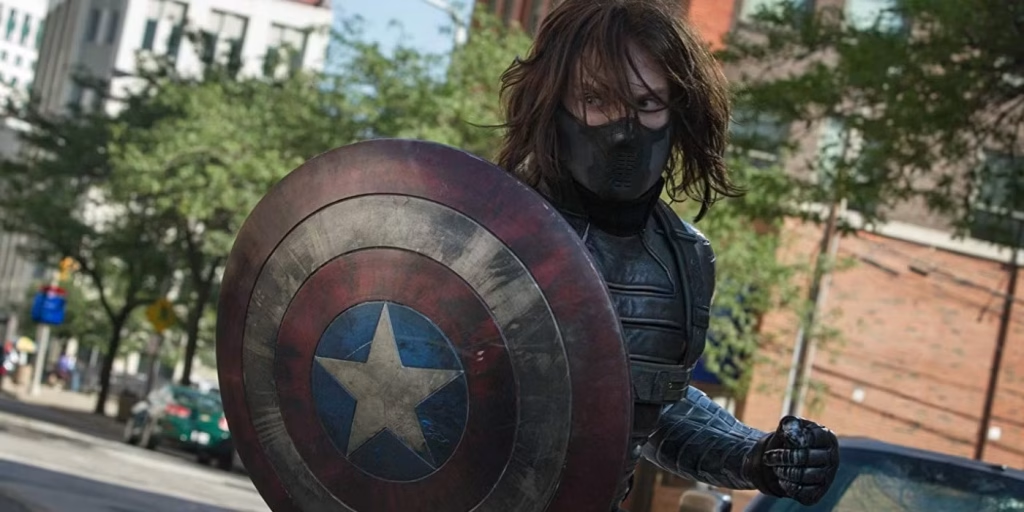
Captain America: The Winter Soldier – Grounded Heroics

No wonder Captain America: The Winter Soldier, like other Marvel blockbusters, features breathtaking visual effects and over-the-top proportions, but it stands out for something earthier: its choreography. Brought down a peg by the Russo brothers and choreographed by Chris Carnel and James Young, the movie eschews gritty realism and is less concerned with practical effects and close-quarters combat than spectacle fueled by CGI.

Image Source: Bing Image. License: All Creative Commons

From the bone-rattling elevator ambush to the gasping knife fight in the streets, every punch and kick in The Winter Soldier is done with a sense of payoff. The action is cut quickly, neat and efficient, designed to depict Steve Rogers’ muscle, athleticism, and combat brain, never at the expense of plausibility.

Image Source: Bing Image. License: All Creative Commons

What renders the choreography here so effective is its lucidity. The camera pauses just long enough for the audience to be able to admire the athleticism and fluidity of every scene, so even the most disorganized parts appear to make sense and have a strong impact.

Image Source: Bing Image. License: All Creative Commons

Why Modern Fight Scenes Matter More Than Ever

So, what makes the greatest fight scenes in modern times? It’s not merely the technical expertise or the showmanship—it’s the storytelling. Filmmakers such as Gareth Evans, Chad Stahelski, and the Russo brothers are all aware that action does not need to intrude into the story. It is the story.

Image Source: Bing Image. License: All Creative Commons

The greatest fight choreography says something about the character, ratchets up tension, and inspires emotion. Whether it’s Rama’s desperate struggle to survive, Wick’s poetic revenge, or Captain America’s gritty sense of right and wrong, the action never takes a backseat. It’s as revealing as a monologue—sometimes more so.

Image Source: Bing Image. License: All Creative Commons

When in the hands of great filmmakers, violence transcends into art. And in the age of over-stuffed blockbusters, that kind of choreography is the difference between forgettable action and unforgettable.