

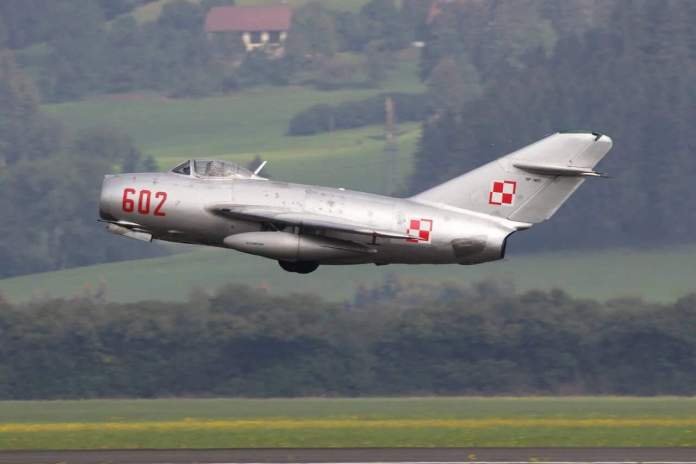
Imagine a location or area where the Cold War animosity had escalated beyond control and had changed to a physical conflict, where the noise of jet engines could be heard and pilots were taking action at a speed of almost 700 miles per hour in a matter of seconds.

Such a spot is MiG Alley, the sky’s most notorious line over the Yalu River in Korea, where the battle between MiG-15 and F-86 Sabre has intertwined with the conflicts in the air. Don’t think of the Hollywood depiction of dogfights—what was going on was intense, unpolished, and life-or-death struggles.

MiG Alley was not just a nickname—it was a warning sign. MiG-15s, built in the Soviet Union, flew by pilots who were Russians in disguise, ready to lie in wait for UN troops. The pilots sported North Korean or Chinese uniforms, mime insignia, and even attempted to communicate in the local languages over the radio—though when tensions ran high, Russian crept through again.

The MiG-15 was revolutionary. Designed by Artem Mikoyan and Mikhail Gurevich, it went to war first as a swept-wing fighter and was able to outperform the American jets in dive, climb, and acceleration of all kinds. It was powered by a reverse-engineered Rolls-Royce Nene engine and carried a heavyweight punch with one 37mm gun and two 23mm guns—sufficient to knock a B-29 Superfortress out of the sky with one pass. Its appearance in November 1950 shook UN air forces to their foundations, making propeller-driven Mustangs and bombers exposed as never before.

America replied with the F-86 Sabre, a jet designed to take on the MiG. It had swept wings, a General Electric J47 turbojet, six .50-caliber machine guns, and a radar-ranging gunsight that made high-speed shooting a matter of precision, not luck.

The ensuing dogfights were unlike any during World War II—violent, short, and on the brink of the sound barrier. MiGs got up to superior altitudes and increased their speed more effectively, while Sabres were tailored to more aggressive control at lower altitudes and to winning by dive-and-glide tactics.

The aviators adjusted their tactics by utilizing clouds, sunlight, and even gunfire from the enemy’s ground as protection.

To defy an intensely firing barrage of his comrades’ anti-aircraft guns, Soviet ace Sergei Kramarenko dived through it only to escape his chasing Sabres, thus proving the war had never been more dangerous.

The competition was personal as well as mechanical. Soviet pilots Nikolai Sutyagin and Yevgeny Pepelyaev notched dozens of kills, and U.S. aces James Jabara and Joseph McConnell turned into legends. Many instances in history were not disclosed for a long time.

An example is Royce Williams being in a “dogfight” against seven MiGs that was only unveiled fifty years later. It was common practice to keep these skirmishes secret due to the high tension between the parties, as they suspected that such a revelation would escalate the conflict further.

MiG Alley was not just an area of conflict – it was a test of one’s aerial combat skills. The methods of war had changed so quickly that the pilots had to learn by themselves that going up, attacking by surprise, and cooperating were of utmost importance. The Americans managed to turn to their advantage the mixture of technology and readiness, among which it is worth mentioning antigravity suits and radar gunsights. The Soviets were taking their top pilots in and out of Korea on rotation; thus, practically, they were running the war as their own training center to polish their skills.

The learning from MiG Alley are still applicable today. Actually, every aspect of air combat nowadays, starting from the design of a fighter jet and ending with the training of a pilot, is largely dependent on the training that was accomplished in those Korean skies. The legends of aviators vanishing, secret burial grounds, and planes turning into myths are the inheritance of the Cold War era, which was a lot more personal, fought at supersonic speed, and the victor was not known.