


Some films don’t just tell a story; they make you question everything you thought you knew. From twisting narratives to alternate realities, these movies challenge perception, identity, and even the nature of truth itself. Whether you’re drawn to psychological thrillers, sci-fi mind games, or existential dilemmas, these films leave a lasting impression long after the credits roll. This list explores 15 of the most mind-bending movies ever made, each offering a unique way to warp your sense of reality. Some are psychological labyrinths, others are dreamscapes or philosophical conundrums, but all share one goal: to make you think, wonder, and question what’s really happening on screen.

15. Reminiscence (2021)
Reminiscence immerses viewers in a noir-inspired future where memories are both a refuge and a prison. Hugh Jackman stars as a private investigator who helps clients relive their pasts using cutting-edge technology, only to become obsessed with a mysterious woman. As his fixation grows, the lines between memory, desire, and reality blur.

The film’s intricate, looping narrative keeps audiences constantly questioning what is real and what exists only in longing or regret. Its ambiguous ending leaves the viewer pondering whether the protagonist has found closure or remains trapped in his own mind. Emotionally resonant and visually striking, Reminiscence may not have dominated the box office, but it remains a haunting experience for fans of cerebral cinema.

14. The Thirteenth Floor (1999)
The Thirteenth Floor delves into the concept of simulation, presenting a world where virtual realities feel indistinguishable from actual life. The story follows a computer scientist who uncovers that his reality might itself be a computer-generated illusion.

Shifting perspectives and layered realities keep viewers on edge, and the film raises questions about identity, morality, and existence. Its ambiguous ending, hinting that each reality may simply be another layer of simulation, has inspired decades of debate, making it a cult classic for those who love reality-bending narratives.

13. In the Mouth of Madness (1994)
John Carpenter’s In the Mouth of Madness explores the terrifying intersection of fiction and reality. An insurance investigator searching for a missing horror novelist discovers that the author’s terrifying creations are bleeding into the real world.

The film constantly destabilizes perception, with characters and audiences questioning sanity and reality itself. Carpenter’s psychological horror creates an unnerving sense of complicity, making viewers feel as if they, too, are caught in the unraveling story. Its influence on meta-horror and modern psychological thrillers remains profound.

12. Coherence (2013)
Coherence is proof that a film doesn’t need a blockbuster budget to bend minds. During a dinner party on the night a comet passes overhead, a series of increasingly bizarre events traps the guests in a web of parallel universes.

The film’s intimate setting and naturalistic dialogue make the surreal events even more unsettling. As realities fracture and paranoia grows, viewers are forced to piece together what’s actually happening, giving the movie immense rewatch value for those who enjoy unraveling complex plots.

11. Source Code (2011)
Jake Gyllenhaal stars in Source Code as a soldier who wakes up in another man’s body, reliving the same eight minutes repeatedly to prevent a catastrophic attack. Each loop uncovers new clues and deepens the story’s emotional stakes.

The narrative blends high-concept science fiction with deeply human themes of redemption, responsibility, and the possibility of changing fate. By combining adrenaline-fueled action with philosophical questions about identity and causality, Source Code becomes both a thrilling and thought-provoking experience.

10. Paprika (2006)
Satoshi Kon’s Paprika is a visual feast that explores the collapsing boundary between dreams and reality. A psychologist enters her patients’ dreams via experimental technology, only to discover that the dream world threatens to overwhelm the waking one.

The film’s surreal animation and kaleidoscopic visuals create a hallucinatory experience that influenced Inception and countless other dream-centric films. Paprika remains a landmark in animated storytelling, proving that the medium can tackle complex, mind-bending concepts as effectively as live-action cinema.

9. Eternal Sunshine of the Spotless Mind (2004)
This film explores love, memory, and heartbreak through a procedure that erases painful memories. As Joel and Clementine undergo the process, viewers are taken on a non-linear journey through the mind, where memories collapse, overlap, and occasionally reform.

The narrative mirrors the chaotic emotional process of forgetting someone you once loved, blending inventive visuals with profound psychological insight. Eternal Sunshine stays with viewers long after the final scene, inviting reflection on love, loss, and the fragility of memory.

8. Fight Club (1999)
Fight Club remains one of the most iconic explorations of identity and consumerist rebellion. Edward Norton’s narrator finds himself entangled with Tyler Durden, only to realize that the chaos he’s unleashed is also an internal struggle against his own fragmented self.

The twist is legendary, but the film’s philosophical underpinnings, commentary on masculinity, capitalism, and existential despair, give it enduring relevance. Controversial and exhilarating, it’s a film that keeps audiences debating long after the final punch lands.

7. Donnie Darko (2001)
Donnie Darko blends teen angst, time travel, and existential dread into a unique psychological puzzle. Jake Gyllenhaal’s Donnie navigates a world in which a demonic rabbit predicts apocalyptic events, leaving reality constantly in question.

Its ambiguity is its strength, as viewers speculate endlessly about fate, causality, and the protagonist’s role in a larger cosmic design. Haunting imagery and emotional depth have cemented its cult status, making it a must-watch for fans of enigmatic cinema.
6. The Prestige (2006)
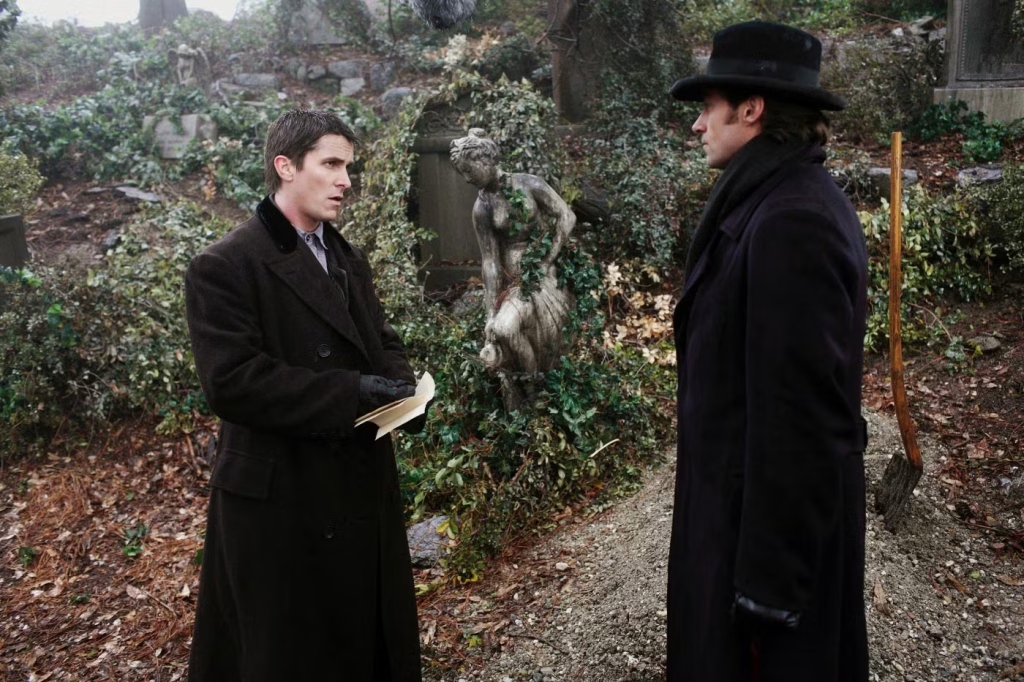
Christopher Nolan’s The Prestige explores obsession, rivalry, and the cost of deception through two competing magicians. Hugh Jackman and Christian Bale deliver compelling performances as their characters spiral into dangerous lengths to outdo one another.

The layered narrative, full of twists and moral ambiguity, rewards repeated viewings. Each time, new details emerge, revealing how far obsession can distort reality and ethics, making it a masterclass in storytelling misdirection.

5. Rashomon (1950)
Akira Kurosawa’s Rashomon examines truth and perspective by presenting multiple, contradictory accounts of the same crime. Each version reflects the storyteller’s biases, leaving the audience to grapple with the elusive nature of objective reality.

Its narrative innovation has influenced filmmaking and storytelling for decades, emphasizing subjectivity and the limitations of perception. The film remains timeless, prompting viewers to consider the difference between truth and interpretation.

4. Caché (2005)
Michael Haneke’s Caché is a tense, atmospheric meditation on guilt and surveillance. When a Parisian couple begins receiving anonymous tapes of their home, paranoia and suspicion slowly unravel their lives.

Haneke’s unflinching, long takes force audiences to examine every frame for clues, yet the film deliberately leaves the origin of the tapes ambiguous. Its influence on psychological thrillers and films dealing with observation and moral ambiguity is profound.

3. The Thing (1982)
John Carpenter’s The Thing is a masterclass in paranoia and isolation. A shape-shifting alien infiltrates a remote Antarctic research station, leaving characters and viewers unable to trust anyone.

Its chilling ending, with two survivors unsure of each other’s humanity, keeps fans theorizing decades later. The film’s combination of horror, suspense, and existential fear makes it a landmark of psychological terror.

2. Inception (2010)
Christopher Nolan’s Inception redefined the blockbuster with dreams nested within dreams. A team of thieves navigates subconscious layers to plant an idea, blurring reality and illusion at every turn.

The spinning top at the film’s conclusion remains one of cinema’s most famous ambiguous endings, sparking endless debate. Its inventive structure and philosophical questions cement Inception as a modern mind-bending classic.

1. A Serious Man (2009)
The Coen Brothers’ A Serious Man is a profound exploration of chaos and meaning in everyday life. Larry Gopnik’s life unravels as he seeks answers in a universe that offers none, leaving questions unresolved and mysteries intact.

The film mirrors life’s randomness through its narrative ambiguity, culminating in a final, enigmatic tornado. Its combination of dark humor, existential dread, and emotional honesty makes it the ultimate mind-bending experience, leaving viewers pondering long after the credits.

These 15 films prove that movies can do more than entertain; they can challenge perception, stir the imagination, and make us question the very nature of reality. Some take us into dreams, others into fractured timelines, and some simply force us to confront the limits of truth. Whether you enjoy philosophical puzzles, psychological thrills, or surreal experiences, these films remind us why cinema has the power to warp our minds and keep us thinking long after the lights come up.