


The Power universe is built on the back of complicated characters, ambiguous morality, and people who are always growing in the face of adversity. Over the years, through various series and spin-offs, the Power universe has given fans access to characters who are ruthless, fragile, intelligent, and deeply flawed, sometimes simultaneously. It is not merely the crime and the mayhem that have kept the fans engaged, but the people who find themselves in the middle of it all. The following is a list of the most interesting characters in the Power universe, which includes Power, Raising Kanan, and Power Book IV: Force.

15. Tariq St. Patrick
Tariq St. Patrick’s journey is one of the most dramatic evolutions in the Power franchise. Introduced as Ghost’s conflicted son, Tariq eventually takes center stage in Power Book II: Ghost, carving out his own path in a world he once resented. His transformation from reckless teenager to calculated strategist defines the next era of Power.

What makes Tariq so fascinating is his intelligence and adaptability. He’s constantly juggling family loyalty, survival, and ambition while learning from the mistakes of those who came before him. With future installments like Power: Legacy looming, Tariq feels less like a successor and more like a symbol of how power mutates across generations.

14. Tommy Egan
Tommy Egan is pure mayhem guided by his own twisted sense of loyalty. He’s loud, reactive, emotional, and dangerously impulsive, yet somehow, he keeps surviving situations that should have ended him long ago. Across Power and Power Book IV: Force, Tommy remains the franchise’s most unpredictable weapon, capable of equal parts destruction and devotion.

His relocation to Chicago is one of the most defining shifts in his story. Stripped of familiar allies and old power structures, Tommy is forced to rebuild from nothing. That exposure, rare for someone like him, adds unexpected layers to his brutality. Whether he’s acting as a protector, a kingmaker, or an agent of chaos, Tommy’s presence dominates every room he enters.

13. James “Ghost” St. Patrick
Ghost is the blueprint. The entire Power universe exists because of James St. Patrick’s ambition, charm, and inner conflict. He was a master strategist, constantly torn between the criminal empire he built and the legitimate life he desperately wanted. That contradiction made him fascinating and ultimately doomed.

Even in death, Ghost remains unavoidable. His influence still shapes Tommy, Tasha, and especially Tariq, whose journey feels like a continuation of his father’s mistakes and ambitions. With Power: Origins approaching, Ghost’s shadow only grows longer, reinforcing his status as the franchise’s most defining figure.

12. Kanan Stark
Kanan Stark embodies street-level ruthlessness at its rawest. Equal parts mentor and monster, he was instrumental in shaping Ghost and Tommy into who they became, leaving scars that never truly healed. His presence looms large across every chapter of the Power saga.

Raising Kanan adds crucial texture to his legacy, showing how his upbringing molded his worldview. Kanan isn’t just violent, he’s deliberate, observant, and frighteningly aware of who he is. His power lies in patience, making him one of the most dangerous forces the franchise has ever produced.

11. Claudia Flynn
Claudia Flynn turns ambition into ammunition. As a member of Chicago’s dominant crime family in Force, she constantly pushes back against the limits imposed by her father and the men around her. She refuses to be sidelined, even when the consequences are severe.

Her sharp instincts and hunger for control make her deeply unpredictable. No matter how trapped or weakened she becomes, Claudia never stops plotting her next move. That relentless drive keeps her dangerous long after others underestimate her.

10. Victor “Vic” Flynn
Vic Flynn is driven almost entirely by insecurity. Constantly chasing approval he never quite earns, he makes decisions from a place of frustration and wounded pride. That desperation pushes him toward choices that are impulsive, shortsighted, and ultimately destructive.
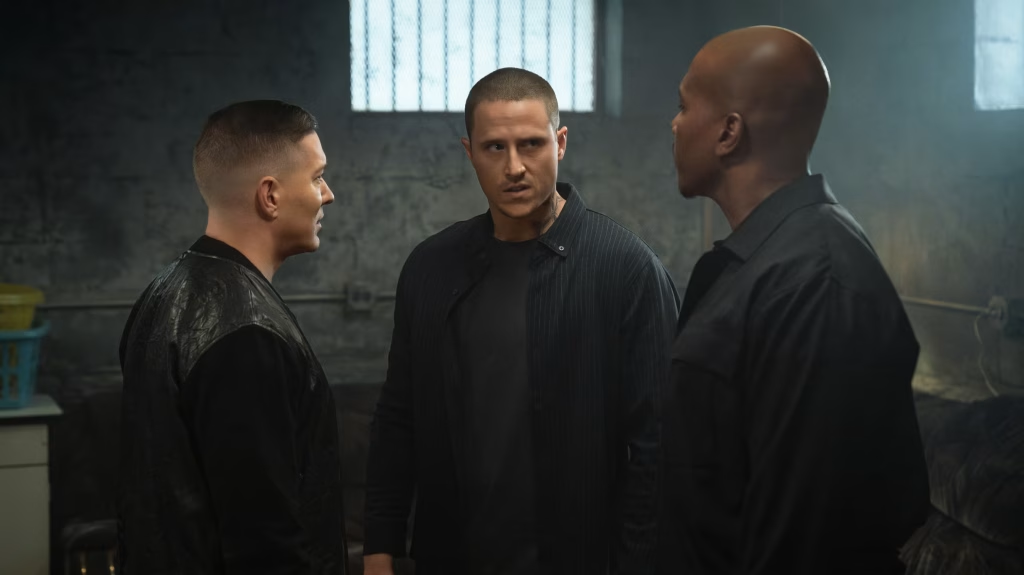
Much of Vic’s behavior is shaped by two powerful forces: his complicated love for Gloria and his deep resentment toward his father. Both emotions cloud his judgment and pull him deeper into situations he isn’t equipped to handle. Vic’s arc is tragic because it feels unavoidable. He wants power and respect, but he lacks the instinct and restraint needed to survive in that world.

9. Diamond Sampson
Diamond Sampson brings a sense of balance to Power Book IV: Force. Fresh out of prison, he approaches the streets with caution, structure, and a clear moral code that separates him from most players in the game.

His partnership with Tommy works because Diamond refuses to be a yes-man. He challenges Tommy’s impulses and forces him to think before acting. Together, they show how mutual respect and discipline can coexist with violence, though only for as long as ego and ambition allow.

8. Jenard Sampson
If Diamond represents control, Jenard represents chaos. Fueled by jealousy and a relentless hunger for authority, Jenard pursues power without ever weighing the consequences. His constant betrayals, shifting loyalties, and emotional instability make him unpredictable.

Jenard isn’t dangerous because he’s brilliant; he’s dangerous because he’s impulsive. Time and again, his inability to control himself becomes his greatest weakness, turning his ambition into self-sabotage.

7. Mireya Garcia
Mireya Garcia may be introduced as a romantic interest, but it doesn’t take long for her role to deepen. Her relationship with Tommy pulls her directly into the violent world of cartel politics and complicated family loyalties.

Caught between love and self-preservation, Mireya’s emotional depth gives her storyline real weight. She doesn’t shy away from danger, and her willingness to confront it head-on makes her one of the show’s most compelling emotional anchors.

6. Miguel Garcia
Miguel Garcia operates with cold precision. As a cartel leader, he isn’t interested in negotiation; he demands loyalty and enforces obedience without hesitation. His conflict with Tommy quickly escalates into something far larger, pushing the story into full-scale cartel warfare.

What makes Miguel especially frightening is his patience. He waits, calculates, and uses fear, leverage, and family ties as weapons. His power doesn’t come from noise or chaos; it comes from control, proving that the quietest players are often the most lethal.

5. Shanti “Showstopper” Page
Shanti Page is always playing the long game. Sharp, ambitious, and highly adaptable, she understands better than most that loyalty in the Power universe is temporary and transactional. To her, alliances are strategies, meant to be used when useful and discarded when they no longer serve a purpose.

What makes Shanti especially dangerous is how subtle she is. She doesn’t rely on brute force or intimidation; she survives by reading situations, anticipating power shifts, and adjusting before anyone else sees it coming. Her intelligence and flexibility prove that in this world, brains can be just as deadly as muscles.

4. JP Gibbs
JP Gibbs embodies the personal toll of Tommy’s violent way of life. As Tommy’s cousin, he brings family, shared history, and emotional vulnerability into a space usually ruled by destruction and survival instincts.

JP’s struggles ground the series, reminding viewers that there are real people caught in the fallout of criminal ambition. His presence adds emotional weight to the chaos, highlighting that behind every kingpin’s rise, there are loved ones quietly paying the price for that power.

3. Darnell “D-Mac” McDowell
D-Mac serves as a reflection of everything Power has been warning about since the beginning. He’s young, easily influenced, and growing up in an environment where crime isn’t just present, it’s normalized. His story highlights how the same patterns repeat from one generation to the next, often without anyone realizing it until it’s too late.

The people around him play a major role in shaping who he becomes. His connections to Tommy and JP pull him in different directions, forcing him to navigate loyalty, survival, and identity far earlier than he should have to. What makes D-Mac’s journey so devastating is how believable it feels. He isn’t making choices out of ambition or greed; he’s reacting to the world he’s been handed, and that realism makes his arc especially painful to watch.

2. Gloria
From the moment she’s introduced, Gloria is driven by one simple desire: freedom. Working as a bartender, she initially appears removed from the criminal underworld, but it doesn’t take long for her to be pulled into the Flynn family’s influence and Tommy’s increasingly dangerous life.

Unlike many characters in Power, Gloria isn’t chasing control, money, or status. She wants out. She wants a life that belongs to her, untouched by manipulation and violence. That longing for independence is what ultimately makes her story so tragic. In a universe where power often comes at a deadly cost, trying to walk away can be just as dangerous as fighting to stay on top, and Gloria pays the price for wanting something better.

1. Walter Flynn
Walter Flynn embodies a very old-school version of power, one built on fear, control, and the belief that loyalty can be forced rather than earned. As the head of Chicago’s most powerful crime family, he commands respect through sheer authority, running his operation like a patriarch who expects obedience without question. For a long time, that approach works, allowing him to dominate both his enemies and those closest to him.

But Walter’s greatest weakness is his inability to change. His constant manipulation of his children, coupled with his refusal to recognize shifting dynamics around him, slowly erodes the foundation he built. By the time he falls, the damage is already done. Even in death, Walter’s presence hangs over the city, influencing decisions, fueling rivalries, and leaving behind a legacy of control and chaos that proves just how formidable and destructive his reign truly was.

The Power universe succeeds because its characters are never static. They grow, unravel, evolve, and repeat mistakes in ways that feel brutally human. Whether driven by ambition, loyalty, fear, or love, these characters define the franchise’s emotional and narrative core.