


Cinema is a universal language, and foreign films have played a pivotal role in shaping how stories are told on screen. From groundbreaking narratives to technical innovations, filmmakers across the world have challenged conventions, expanded artistic possibilities, and inspired generations of storytellers. Whether it’s the emotional intimacy of a small drama or the spectacle of a larger-than-life epic, these films transcend borders, proving that great storytelling resonates everywhere. Here’s a countdown of 15 foreign films that changed cinema forever, each a milestone that continues to influence the way we watch, feel, and think about movies.

15. Hard Boiled (Hong Kong)
John Woo’s Hard Boiled redefined action cinema with its high-octane energy, balletic gunfights, and relentless pace. Every scene is choreographed like a dance of chaos, combining technical precision with raw emotion.

The film’s iconic style, slow-motion shootouts, daring camera movements, and tension-filled standoffs set a new standard for action films worldwide. Directors from Quentin Tarantino to the Wachowskis drew inspiration from Woo’s inventive approach. Hard Boiled also helped bring Hong Kong cinema to global audiences, proving that action could be both thrilling and artistically sophisticated. It remains a benchmark for adrenaline-fueled filmmaking.

14. Dekalog (Poland)
Krzysztof Kieslowski’s Dekalog is a ten-part exploration of modern morality, loosely based on the Ten Commandments. Each short film examines the ethical struggles of everyday people with subtlety and empathy.

Through minimalist storytelling and deep character insight, Kieslowski crafts a philosophical journey that challenges viewers to reflect on choices, consequences, and human nature. Praised by filmmakers such as Stanley Kubrick, Dekalog set a new standard for intelligent, tightly structured storytelling in cinema.

13. Russian Ark (Russia)
Alexander Sokurov’s Russian Ark is a breathtaking technical achievement, filmed entirely in a single, uninterrupted take. It guides viewers through the Hermitage Museum in St. Petersburg, blending 300 years of Russian history into a living tableau.

The immersive approach combines narration, historical figures, and museum exhibits into a seamless cinematic experience. From Peter the Great to Catherine the Great, the figures come alive in a hypnotic, ghostly parade of culture. Audiences and critics alike marveled at Sokurov’s ambition, making Russian Ark a one-of-a-kind achievement in visual storytelling.

12. Central Station (Brazil)
Walter Salles’s Central Station captures the emotional journey of a retired schoolteacher and an orphaned boy across Rio de Janeiro. The unlikely duo forms a bond that transforms both their lives, revealing the power of connection and compassion.

Fernanda Montenegro’s nuanced performance and Vinícius de Oliveira’s authentic debut bring raw humanity to the screen. Winning the Golden Globe for Best Foreign Language Film, Central Station helped propel Brazilian cinema onto the international stage and inspired a wave of Latin American filmmakers.

11. In the Mood for Love (Hong Kong)
Wong Kar-wai’s In the Mood for Love is a hypnotic meditation on longing and unspoken desire. Set in a cramped 1960s Hong Kong apartment complex, Tony Leung and Maggie Cheung’s characters move in near-silent synchrony, circling one another with delicate tension.

Christopher Doyle’s cinematography and Nat King Cole’s evocative music create a lush, romantic atmosphere. Every frame is imbued with style, mood, and emotional weight. The film’s elegance and slow-burning storytelling have influenced countless directors seeking to capture the poetry of missed connections and restrained passion.

10. Aguirre, the Wrath of God (Germany)
Werner Herzog’s Aguirre, the Wrath of God is a fever dream of obsession, following Klaus Kinski’s tyrannical conquistador in pursuit of El Dorado. Madness and greed permeate every frame, both on-screen and behind the scenes.

Herzog and Kinski’s tumultuous collaboration amplifies the film’s sense of chaos and realism, creating unforgettable tension. The final image of Kinski alone on a raft, surrounded by monkeys, remains one of cinema’s most haunting statements. Aguirre stands as a relentless exploration of human hubris and the darker corners of ambition.

9. Rashomon (Japan)
Akira Kurosawa’s Rashomon introduced the world to the concept of multiperspective storytelling. By presenting multiple conflicting accounts of the same event, the film challenged audiences to question truth and perception.
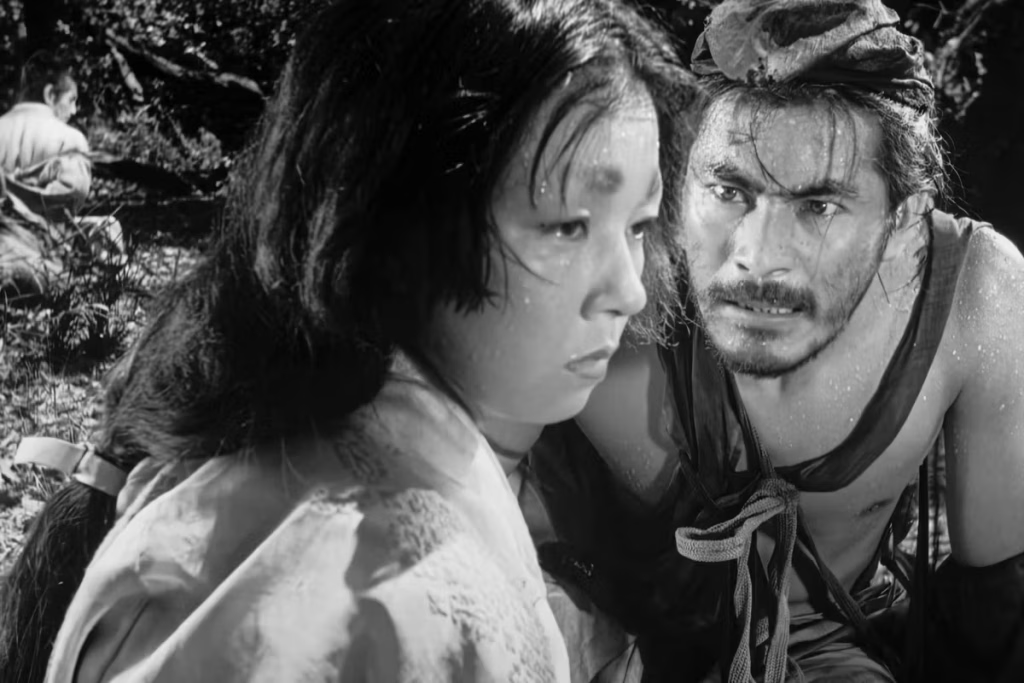
The narrative innovation influenced filmmakers worldwide, encouraging experimentation with unreliable narrators and fractured timelines. Even decades later, Rashomon’s exploration of subjective truth continues to inspire both philosophical reflection and cinematic technique.

8. La Dolce Vita (Italy)
Federico Fellini’s La Dolce Vita is a masterful critique of celebrity culture and modern decadence. Marcello Mastroianni’s gossip columnist drifts through Rome, observing and participating in the excesses of a society obsessed with fame.

The creation of the paparazzi archetype and Fellini’s satirical lens influenced popular culture far beyond cinema. La Dolce Vita reflects both society’s fascination with glamour and the melancholy of human ambition, remaining a timeless cultural mirror.

7. The Battle of Algiers (Italy/Algeria)
Gillo Pontocorvo’s The Battle of Algiers is a searing political thriller, depicting Algeria’s guerrilla uprising against French colonial forces. Its documentary-style realism riots, street fighting, and political tension feel as immediate and gripping as any blockbuster.

The film’s technical mastery has inspired generations of directors, and even military institutions have studied it for its depiction of urban warfare. A landmark in political cinema, it remains a benchmark for both realism and narrative intensity.

6. All Quiet on the Western Front (Germany)
Edward Berger’s All Quiet on the Western Front tells World War I from a German perspective, focusing on young soldiers’ harrowing experiences.

By refusing to romanticize the battlefield, the film delivers a universal portrayal of human suffering and the horrors of war. Its critical acclaim underscores cinema’s ability to convey empathy and historical truth across national boundaries.

5. Spirited Away (Japan)
Hayao Miyazaki’s Spirited Away blends Japanese folklore with universal themes of resilience, growth, and wonder. Chihiro’s journey through a magical world captivates both children and adults.

The film’s artistry, imaginative design, and emotional depth made it a global phenomenon, culminating in an Academy Award for Best Animated Feature. Spirited Away proves that animated films can be as culturally significant and influential as live-action cinema.

4. Parasite (South Korea)
Bong Joon-ho’s Parasite is a masterclass in genre-bending social commentary. Its narrative twists, dark humor, and visual storytelling dissect class inequality with precision and style.

The film’s historic Best Picture Oscar win confirmed its groundbreaking status and elevated South Korean cinema to a global stage. Parasite demonstrates that foreign-language films can speak powerfully to universal human experiences.

3. Seven Samurai (Japan)
Akira Kurosawa’s Seven Samurai is an epic tale of courage, strategy, and community, following villagers who hire samurai to defend them.

Kurosawa’s masterful pacing, dynamic action, and character depth influenced countless remakes, from The Magnificent Seven to modern action films. Its enduring legacy proves that epic storytelling transcends culture, inspiring generations of filmmakers worldwide.

2. Bicycle Thieves (Italy)
Vittorio De Sica’s Bicycle Thieves embodies the essence of Italian neorealism, portraying postwar poverty with heart-wrenching simplicity.

A father and son’s desperate search for a stolen bicycle highlights universal themes of hope, struggle, and human resilience. De Sica’s use of non-professional actors and real locations made the film a blueprint for socially conscious cinema.

1. M (Germany)
Fritz Lang’s M is a landmark psychological thriller and the first major serial-killer film. Peter Lorre’s portrayal of Hans Beckert blends terror and vulnerability, creating one of cinema’s most unforgettable villains.

The film’s expressionist visuals and moral ambiguity reflect the tensions of pre-Nazi Germany while influencing countless thrillers and horror films. M remains a cornerstone of cinematic history, demonstrating the power of narrative, performance, and visual innovation.

These 15 films remind us that cinema is a global language, capable of shaping storytelling, influencing generations, and transcending borders. From intimate dramas to epic spectacles, they prove that great filmmaking knows no nationality, only vision.