


Trains have always been a gift to filmmakers. They move forward whether the characters are ready or not, trap people together in tight spaces, and turn time itself into a source of tension. From silent-era experiments to modern genre mashups, train movies have delivered some of cinema’s most gripping stories. Here are 15 of the greatest train films that use the rails to master suspense, emotion, and unforgettable storytelling.

15. The Great Train Robbery (1903)
Everything starts here. The Great Train Robbery didn’t just popularize train-centered storytelling; it helped define how movies create suspense. This silent short may be over a hundred years old, but its energy is still impressive. By cutting back and forth between criminals robbing a train and a posse racing to stop them, the film introduced audiences to parallel editing in a way that felt thrilling and new.

That technique became a cornerstone of action and thriller filmmaking. Watching it today feels like spotting the first sparks of modern cinema. Despite its simplicity, the film proves that tension doesn’t need dialogue, just smart pacing, movement, and purpose. Its influence stretches far beyond its runtime. Nearly every intense train sequence since owes something to this pioneering classic.

14. Double Indemnity (1944)
When it comes to noir, Double Indemnity sits near the top of the mountain. Billy Wilder’s razor-sharp thriller uses a train as the key setting for a murder disguised as an accident. Barbara Stanwyck and Fred MacMurray bring a dangerous chemistry to a plot where greed and guilt ride side by side.

The train sequence isn’t decorative; it’s essential. The enclosed environment magnifies every glance and hesitation, turning the journey into a pressure cooker of moral decay. The train’s unstoppable movement mirrors the characters’ slide toward ruin. Few films use setting so deliberately. The result is one of noir’s most iconic and suspenseful moments.

13. Train to Busan (2016)
Few modern films have used a train as effectively, or as brutally, as Train to Busan. This South Korean hit drops a zombie outbreak onto a high-speed train, instantly turning every carriage into a survival test.

What makes the film stand out is how creatively it uses the train’s structure. Each car presents new dangers, emotional beats, and moral choices. Beneath the relentless action is a sharp look at class, selfishness, and sacrifice. It’s thrilling, heartbreaking, and smart, proof that genre films can deliver both adrenaline and substance.

12. Murder on the Orient Express (1974)
Elegant, icy, and meticulously constructed, Murder on the Orient Express turns a luxury train into a snowbound crime scene. With nowhere to escape, every passenger becomes a suspect, and Hercule Poirot must untangle a web of secrets.

The isolation of the train fuels the suspense. Interviews, flashbacks, and subtle clues keep the mystery tight while the lavish production design adds a layer of old-world glamour. This adaptation helped define ensemble mystery filmmaking and cemented the train as the ultimate locked-room setting.

11. The Darjeeling Limited (2007)
Wes Anderson’s The Darjeeling Limited takes a gentler approach to train storytelling. The film follows three brothers crossing India by rail, using the journey as a way to explore grief, family tension, and healing.

The train acts as a floating emotional space, part refuge, part confrontation zone. Anderson’s visual precision and offbeat humor balance moments of genuine vulnerability. It’s not about danger or speed, but about what happens when people can’t outrun their past even while moving forward.

10. Compartment No. 6 (2021)
Quiet and deeply human, Compartment No. 6 proves that intimacy can be just as gripping as action. The film centers on two strangers sharing a sleeper car on a long journey north, forced into an awkward closeness that slowly softens.
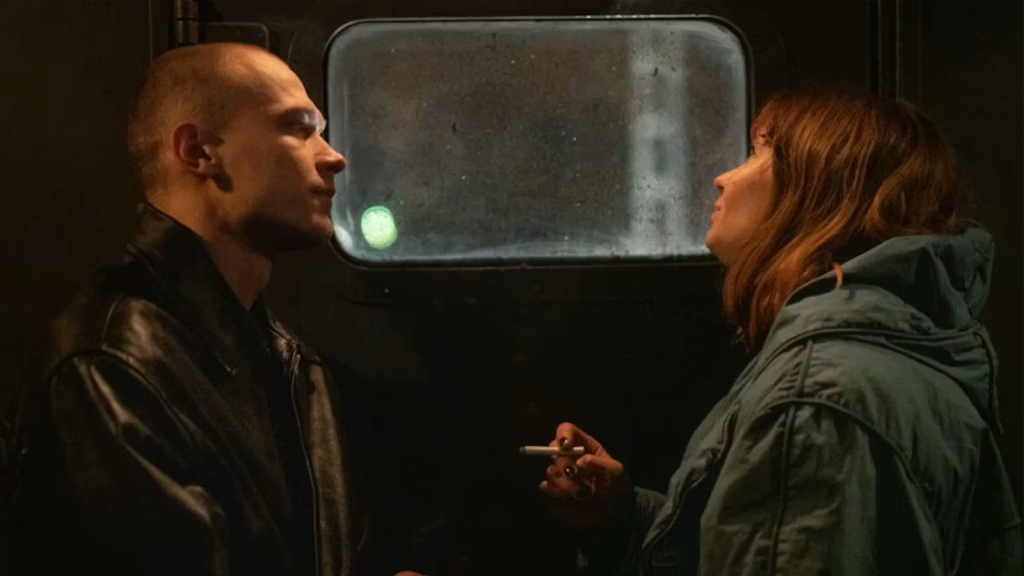
The train’s rhythm reflects their emotional shifts, while the bleak landscapes outside contrast with the warmth forming inside the compartment. Nothing feels rushed or overstated. It’s a reminder that sometimes the most powerful train stories happen in whispers, not explosions.

9. Trans-Europ-Express (1966)
This French New Wave oddity turns the train into a playground for ideas. Trans-Europ-Express follows filmmakers discussing a crime story while traveling, only for that story to begin unfolding alongside them.

The result is playful, confusing, and endlessly fascinating. The film constantly questions what’s real, what’s imagined, and who’s in control of the narrative. It’s not for everyone, but for adventurous viewers, it’s a reminder of how trains can carry stories in unexpected directions.

8. Before Sunrise (1995)
One of cinema’s most beloved romances begins with a train ride. Before Sunrise introduces two strangers who meet by chance and decide to spend a night talking, walking, and connecting.

The train is brief but crucial; it’s the spark that makes everything possible. That single decision sets off a story built entirely on conversation and emotional honesty. It’s proof that a journey doesn’t need danger to matter sometimes; it just needs the right people on board.

7. The Taking of Pelham One Two Three (1974)
This gritty subway thriller turns New York’s transit system into a battlefield. When hijackers seize a train and demand a ransom, a weary transit cop becomes the city’s best hope.

The film thrives on precision editing and sharp dialogue, cutting between criminals, officials, and trapped passengers. Every delay feels lethal. While it’s been remade, the original remains unmatched, lean, tense, and relentlessly efficient.
6. Runaway Train (1985)
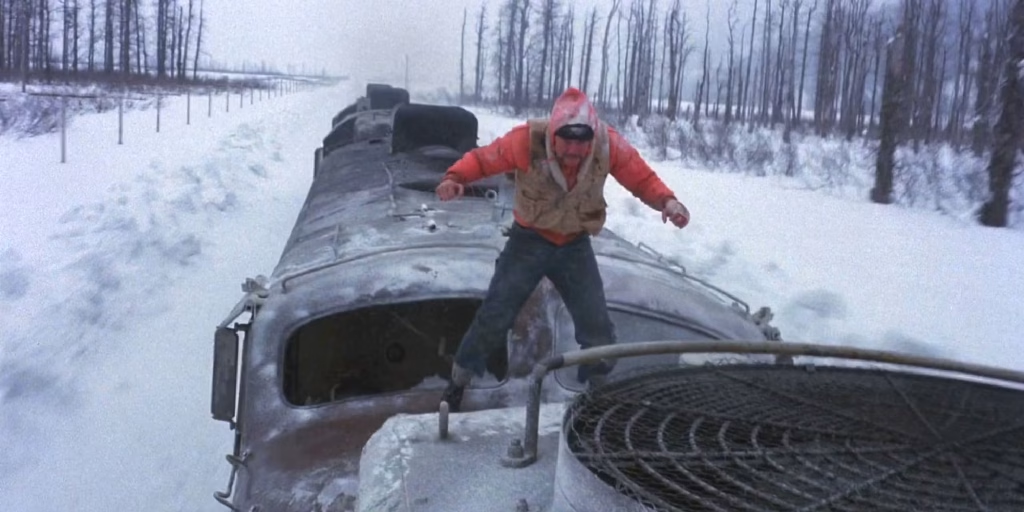
Few films capture pure momentum like Runaway Train. Two escaped prisoners find themselves aboard a locomotive with no brakes, barreling through an unforgiving landscape.

The action is intense, but the film’s real strength lies in its themes of fate, freedom, and self-destruction. Jon Voight and Eric Roberts deliver raw, desperate performances. It’s a survival thriller that feels philosophical without losing its edge.

5. Snowpiercer (2013)
In Snowpiercer, the train becomes the world. Bong Joon-ho imagines humanity’s last survivors locked into a rigid class system aboard a constantly moving engine.

Each train car represents a different layer of society, turning the forward march into a revolution. The action is brutal, inventive, and tightly choreographed. More than spectacle, the film is a sharp allegory about power, inequality, and survival.

4. Strangers on a Train (1951)
Hitchcock turns a casual meeting into a nightmare in Strangers on a Train. A conversation about “exchanging murders” becomes horrifyingly real, setting fate into motion.

The train represents inevitability. Once the idea is planted, there’s no stopping it. Hitchcock’s cross-cutting and visual precision build unbearable tension. It’s one of cinema’s great psychological thrillers, powered by chance and consequence.

3. Twentieth Century (1934)
Fast-talking and ferociously funny, Twentieth Century transforms a train into a battleground for romance and ego. John Barrymore and Carole Lombard clash nonstop as former collaborators hurtle toward New York.

The train’s nonstop movement matches the film’s breakneck pace. Every compartment becomes a stage for verbal sparring. It’s a reminder that comedy can be just as suspenseful as drama, especially when love is on the line.

2. The Lady Vanishes (1938)
Another Hitchcock triumph, The Lady Vanishes blends mystery, humor, and paranoia. When a woman disappears mid-journey, one passenger’s insistence on finding her meets constant resistance.

The train’s enclosed setting amplifies doubt and suspicion, while Hitchcock keeps the audience guessing through clever misdirection. It remains one of the finest examples of train-based mystery storytelling.

1. The General (1926)
At the top of the list is Buster Keaton’s The General, a silent-era miracle of comedy and action. Set during the Civil War, the film revolves around a stolen locomotive and Keaton’s relentless pursuit.

The stunts are astonishing, the timing flawless, and the suspense real. Keaton blends humor and danger so seamlessly that every chase feels exhilarating. Nearly a century later, The General still defines what a great train movie can be: funny, thrilling, and timeless.

Whether they’re racing toward disaster, carrying strangers into connection, or serving as pressure cookers for crime and chaos, trains have given filmmakers a perfect storytelling engine. These films prove that once a story is set on the rails, all it needs is the right direction and the courage to keep moving forward.