


Hollywood is replete with stories that transcend culture, eras, or geographical locations around the world—but the casting calls certainly don’t. For years, studios have brought stories set in specific communities and then white actresses or actors to play roles that need to be filled by actresses or actors of color, all in the interest of marketability. Despite the recent push towards more representation in the industry, there have been casting calls that have been so egregious they can be looked upon as textbook examples of things not to do. In this article, we will provide a countdown of the top 10 examples of whitewashing in the history of Hollywood.

10. Tilda Swinton as The Ancient One – Doctor Strange
What began as a positive moment for Asian representation in Marvel comics turned out to stir up another controversy instead. In the Marvel comics, the Ancient One is an Asian monk from Tibet, but in the movie, Marvel chose a Celtic version and cast Tilda Swinton. Marvel was probably trying to avoid any political controversies, and yet people condemned the film instantly for whitewashing an Asian character in a world-renowned franchise.

9. Emma Stone as Allison Ng – Aloha
The film director Cameron Crowe’s Hawaiian-set romantic comedy was heavily criticized after Emma Stone was announced to play the role of Allison Ng, a character who was initially described as being half-Chinese and half-Hawaiian. Stone later took the stage to say that she was sorry for the inconvenience, and she had understood the criticism. Originally, it could have been an opportunity to present Hawaii’s cultural wealth, but instead, the locals and Asian actors were left out, and a familiar face from Hollywood was given the role.

8. Ben Affleck as Tony Mendez – Argo
Though Argo left with an Oscar for Best Picture, it stirred animosity among the audience by casting the director-star Ben Affleck. Affleck embodied the role of Tony Mendez, a CIA agent of Mexican heritage, but the film hijacked his identity by having a white actor play the lead. A lot of people felt that it was sending them a message of hurt: that the only way Hollywood would tell a real story, if it was around an African-American subject, was by turning it into a white male protagonist instead.

7. Mickey Rooney as Mr. Yunioshi – Breakfast at Tiffany’s
The number of unaesthetic and twisted things behind the scenes that is the acting career of Mickey Rooney could hardly be limited to his depiction of Holly Golightly’s Japanese landlord, in which, upon distributing fake teeth, heavy make-up, and a loud accent, he performed as Mr. Yuniosh, a racist stereotype. Critics were raising the flag even then. Yet, it still happens to be one of the worst Hollywood satirizing rather than appreciating Asian identity examples after a long time.

6. Christian Bale as Moses — Exodus: Gods and Kings
Ridley Scott’s epic biblical drama cast Bale as Moses and Joel Edgerton as Ramses—both African and Middle Eastern in origin—while casting almost every leading role with white actors. Scott later insisted he couldn’t have made the film with “Mohammed so-and-so” starring, and people were outraged. The rationale was lame, and so was the film.
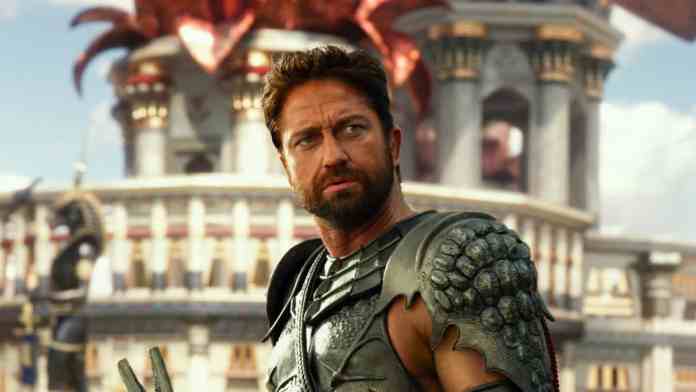
5. Gerard Butler as Set — Gods of Egypt
If Exodus was divisive, Gods of Egypt went all in. Starring Gerard Butler as the Egyptian deity Set and featuring a cast comprised nearly entirely of white actors, people cried foul from the get-go. Director Alex Proyas brushed off the criticism as small-minded, but the film bombed at the box office. It has since become the go-to example of Hollywood’s unwillingness to cast actors of color in their own narratives.

4. Matt Damon as William Garin — The Great Wall
A cross-cultural US-China co-production aimed to bridge cultures actually did the opposite. Matt Damon played the lead in The Great Wall, a film set in ancient China. While the filmmakers protested that his character was deliberately written as European, the optics were “white savior,” and it defeated the purpose of a cross-cultural production.

3. Scarlett Johansson as Major Motoko Kusanagi — Ghost in the Shell
Firstly, the announcement that Scarlett Johansson was to portray Major Motoko Kusanagi in the live-action adaptation of the famous Japanese anime was the reason for excitement among Hollywood fans, not long after the media dissemination of the news of the remake. However, uproar followed shortly after the news, precisely when Scarlett was confirmed for the part. The decision to cast a Caucasian woman for the character triggered reactions that spread from one side of the globe to the other, as the critics accused the film of getting rid of the very culture that the movie was expressing. Consequently, the film was merely a whitewashing example rather than one that honored its Japanese source material.

2. Alec Guinness as Prince Feisal — Lawrence of Arabia
During the 1960s, it was usual for white actors to wear brownface and impersonate black characters. Alec Guinness’s portrayal of Prince Feisal in Lawrence of Arabia is probably the most notorious case in point. Although the movie itself is still considered a masterpiece, the performance of Guinness acts as a reminder of the time when Hollywood was less concerned with the reality of ethnic portrayal and more with racial clichés as acceptable practice.

1. The Last Airbender — The Entire Main Cast
If one film is representative of all that is terrible about whitewashing, it’s The Last Airbender. Based on the Nickelodeon show derived from Asian and Inuit cultures, the live-action remake cast white actors in virtually every important heroic part, with actors of color cropping up as villains. It was a box office and critical flop, and a heartbreaking erasure of the very cultures whose work the original celebrated.

Whitewashing isn’t a relic of a bygone Hollywood era—it’s an intentional obstacle to equal representation. Each time a white actor is hired to play a part that should belong to a minority, it tells us that true voices and faces don’t count. These ten instances aren’t simply bad decisions; they’re lessons that contemporary filmmakers can’t afford to miss.