

Donkey Kong first made his mark in 1981, crashing into arcades as a barrel-throwing villain in a game that would go on to define Nintendo’s early success. Created by Shigeru Miyamoto, the character stood out immediately—not just as an obstacle, but as a figure with personality and humor. Players controlled Jumpman—later known as Mario—as he climbed platforms and dodged hazards to rescue Pauline. At the time, the game’s multi-level structure and storytelling elements felt fresh, setting a new benchmark for what arcade titles could be.
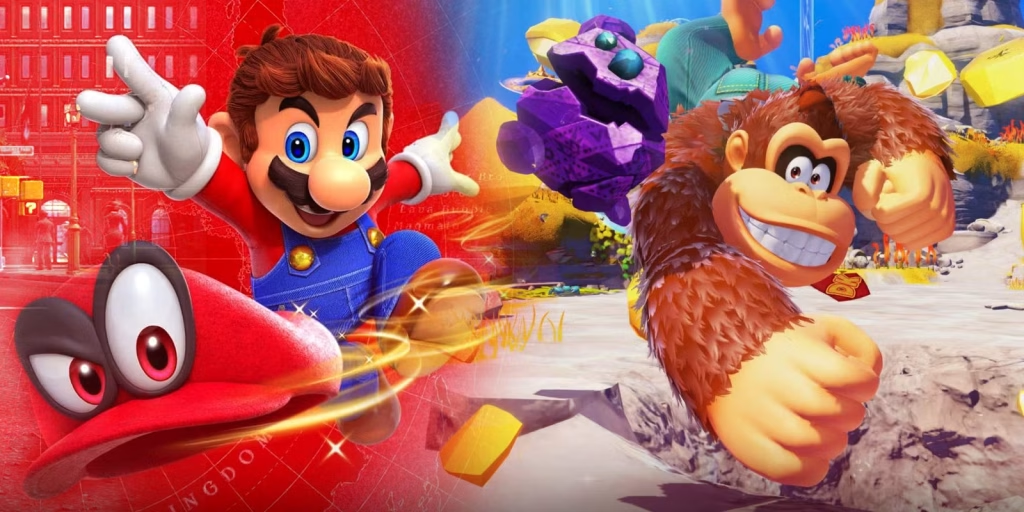
Even in his role as the antagonist, Donkey Kong brought a sense of charm that hinted at something more. Early follow-ups like Donkey Kong Jr. and Donkey Kong 3 began experimenting with that idea, most notably by reversing roles and putting Mario in a less heroic light. These early shifts suggested that characters in games didn’t have to stay fixed—they could evolve, adapt, and surprise players.
That evolution took a major leap forward in 1994 with Donkey Kong Country on the Super Nintendo Entertainment System. Developed by Rare, the game reimagined Donkey Kong as a heroic lead rather than a villain. With pre-rendered 3D visuals that pushed the hardware to its limits, the title felt like a generational leap. It also introduced fan favorites like Diddy Kong and the imposing King K. Rool, while building a rich jungle world that felt alive and immersive. The game’s success didn’t just revive the franchise—it cemented Donkey Kong as one of Nintendo’s core icons.
As the years went on, the series branched out in unexpected ways. Donkey Kong 64 brought the character into fully 3D environments, while titles like Donkey Konga and Donkey Kong Jungle Beat leaned into experimental gameplay, from rhythm mechanics to motion controls. At the same time, Donkey Kong became a regular presence in crossover hits like Mario Kart and Super Smash Bros., helping him reach audiences far beyond his own franchise.
During this period, the Kong family expanded into a colorful ensemble. Characters like Dixie Kong, Funky Kong, Cranky Kong, and Tiny Kong added personality and variety, reflecting Nintendo’s growing focus on interconnected worlds and shared universes.
In more recent years, Donkey Kong has returned to his platforming roots with titles like Donkey Kong Country Returns and Donkey Kong Country: Tropical Freeze. These games struck a balance between nostalgia and modern design, earning praise for their difficulty, polish, and creativity. Meanwhile, his continued appearances in multiplayer staples like Mario Party and Mario Kart have kept him firmly in the spotlight.
Donkey Kong’s influence goes well beyond gameplay. His adventures helped shape platforming as a genre, introduced memorable music and characters, and contributed to Nintendo’s reputation for innovation. That legacy continues today, with appearances in merchandise, television, and film—including a standout role in The Super Mario Bros. Movie, which introduced him to a new generation.
Mario himself has undergone a similar transformation. Once a supporting figure in Donkey Kong’s debut, he grew into the face of Nintendo’s global identity. That journey reached a new milestone with The Super Mario Bros. Movie, which brought the Mushroom Kingdom to theaters with a mix of nostalgia and modern storytelling. The film stayed true to the spirit of the games while opening the door to something bigger—potentially even a shared cinematic universe.
Visually, the movie impressed fans with its attention to detail and countless references. While some critics felt it leaned heavily on familiarity, audiences embraced it wholeheartedly. Performances like Jack Black’s take on Bowser stood out, and the film’s massive box office success proved that Nintendo’s characters can thrive far beyond gaming.
That expansion into real-world experiences is perhaps best seen at Super Nintendo World. Located within Universal Studios Hollywood, the attraction allows fans to step directly into the Mushroom Kingdom. From hitting question blocks to competing in interactive challenges, visitors can engage with the world of Mario in a completely new way. Attractions like the Mario Kart ride and themed dining experiences blur the line between games and reality, creating something that feels both nostalgic and cutting-edge.
What makes Donkey Kong and Mario so enduring is their ability to change with the times. Over decades, they’ve grown from simple pixelated figures into fully realized cultural icons. Their journeys mirror the evolution of gaming itself—from arcades to home consoles, from 2D sprites to cinematic worlds, and now to immersive, real-life environments.
As Nintendo continues to experiment—whether through remakes, films, or interactive attractions—the legacy of Donkey Kong and Mario remains at the heart of it all. Their staying power is a reminder that great characters, backed by creativity and innovation, can transcend generations and mediums while still capturing the joy of play.