

Animation has long been fascinated with the human mind, especially its complexities and contradictions. From classic tales of split personalities to modern explorations of trauma, the medium often portrays characters with dual identities or fractured psyches. These stories can entertain, shock, and even inspire empathy, but they also shape how audiences perceive mental health. While some series rely on clichés or exaggeration, others approach psychological struggles with nuance and care, showing that healing, coping, and personal growth are rarely straightforward. Here’s a look at some of the most compelling examples of trauma, dissociation, and duality in animation.

9. Broader Trends: Dissociative Disorders and Duality in Animation
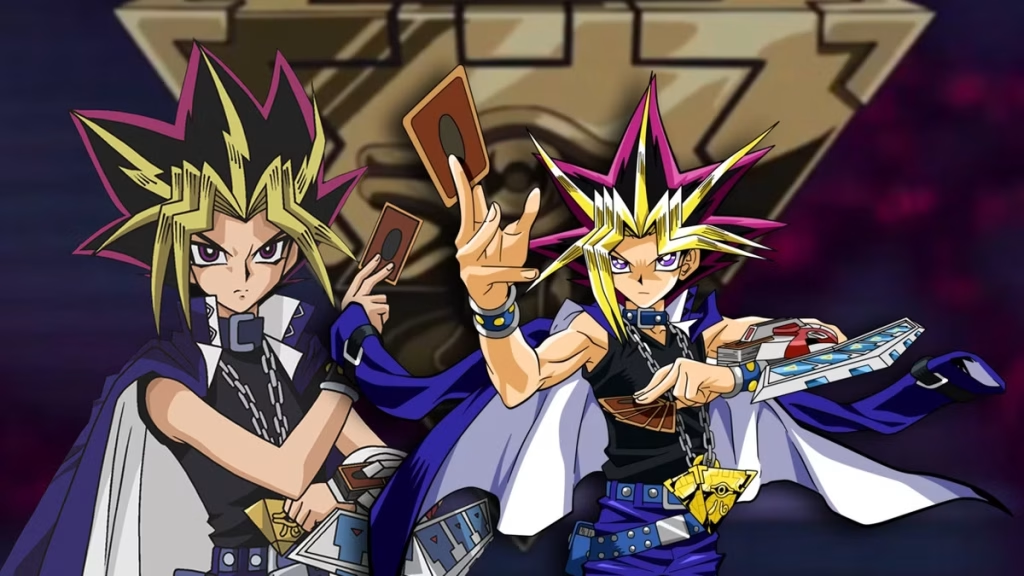
Duality has always been a recurring theme in animated storytelling. Characters often embody two selves—a mild-mannered, everyday persona and a hidden, powerful alter ego that emerges in crisis. Classic examples include Bruce Banner transforming into the Hulk or Yami Yugi taking control in Yu-Gi-Oh!. However, as Hazel Jamieson notes, these portrayals rarely reflect the real complexity of dissociative identity disorder (DID). Instead, they tend to oversimplify: characters are either “good” or “evil,” perpetuating the stereotype that people with dissociative disorders are dangerous or unstable. In reality, DID involves a rich internal world and coping mechanisms that are rarely violent. Some modern animation, though, is starting to shift the narrative. Shows like OK K.O.! Let’s Be Heroes and certain Ben 10 arcs explore internal plurality with empathy, showing that managing multiple selves is about coexistence rather than conflict. This marks a slow but promising move toward more thoughtful portrayals of mental health.

8. Jinx / Powder (Arcane: League of Legends)
Jinx, or Powder, is a striking example of trauma shaping a character’s psyche. Orphaned, neglected, and exposed to constant danger, Powder’s early experiences are devastating. A single catastrophic event—an attempt to save her sister that results in tragedy—triggers her transformation into Jinx. Arcane refuses to reduce her to a diagnosis. We see paranoia, emotional volatility, and hallucinations, but always within the context of a world that has failed her. She might display traits of PTSD, psychosis, or even antisocial behavior, but the series focuses on her lived experience rather than labeling her. Jinx embodies the messy reality of trauma: she is both victim and aggressor, child and chaos, hero and villain. Her story highlights that recovery is non-linear and that circumstances often dictate behavior as much as personal choice.

7. Asuka Langley Soryu (Neon Genesis Evangelion)
Asuka’s confident, abrasive exterior masks profound trauma. Raised by a mentally ill adoptive mother and scarred by her eventual suicide, Asuka internalizes pain that shapes every interaction. Her arrogance and aggression serve as protective armor, keeping vulnerability at bay. Evangelion uses her story to explore the enduring effects of childhood trauma on identity, relationships, and self-worth. Asuka’s struggles resonate because they are authentic: her pain is both personal and emblematic of the show’s broader meditation on human fragility and the need for connection.

6. Chise Hatori (The Ancient Magus’ Bride)
Chise’s early life is filled with rejection, abuse, and isolation. Born with a gift that sets her apart, she suffers at the hands of her own mother in a moment of despair, and later witnesses her mother’s death. The series uses Chise’s journey to explore the interplay of trauma and healing. Magic becomes a metaphor for empowerment and self-worth, as she gradually learns to value herself and trust others. Her story is an intimate portrait of overcoming inner darkness while finding hope and connection.

5. Emilia (Re:Zero)
Emilia’s past is marked by tragedy: the death of her surrogate mother at the hands of the Witch’s Cult leaves her traumatized and her powers unstable. The aftermath traps her in a magical stasis, forcing her to confront centuries of grief upon awakening. Her journey is a careful study of how trauma immobilizes and shapes us. Emilia’s resilience emerges not from forgetting the past but from learning to live alongside it. Her story underscores that healing is arduous, layered, and deeply personal.

4. Kyouka (Bungo Stray Dogs)
Kyouka’s childhood trauma involves being forced into an assassination and witnessing the death of her parents through her own inherited powers. Despite this, she finds redemption and a new sense of purpose with the Armed Detective Agency. Her arc demonstrates that trauma can catalyze growth. The series explores guilt, responsibility, and the transformative power of supportive relationships, showing that even those burdened by past horrors can reclaim agency over their lives.

3. Mikasa Ackerman (Attack on Titan)
Mikasa’s formative years are defined by extreme loss and violence: the murder of her parents, abduction, and repeated exposure to death and destruction. These experiences mold her into an elite fighter but also leave deep emotional scars. The series uses her story to highlight the duality of strength and vulnerability, exploring how trauma can harden, isolate, and simultaneously forge unbreakable loyalty. Mikasa’s journey is a meditation on survival and the cost of protecting those we love.

2. Nina Fortner / Anna (Monster)
Nina’s life is shaped by cruel experiments, dissociative amnesia, and the manipulations of her twin brother, Johan. Her trauma is relentless, a constant series of memory shocks and identity crises. Monster portrays Nina’s struggle as one of piecing together a fractured self and seeking justice in a world that offers little solace. Her story is a haunting reminder of the mind’s resilience and the lengths it goes to protect itself from unbearable pain.

1. Yuno Gasai (Future Diary)
Yuno Gasai’s abusive upbringing drives the transformation from neglected child to obsessive, violent protector. Locked, starved, and humiliated, her trauma warps her perception of love and survival. Her descent into extreme behavior underscores the thin line between victim and perpetrator. Yuno is a chilling example of how prolonged abuse can distort attachment, morality, and identity, forcing viewers to confront the dark consequences of trauma left unaddressed.

These characters illustrate the many ways trauma, abuse, and dissociation shape identity in animation. While some portrayals rely on sensationalism, others provide profound insights into resilience, growth, and the complexity of the human mind. Through these stories, audiences are reminded that psychological struggles are not black-and-white—they are deeply human, often painful, but also capable of inspiring empathy and understanding. Animation, in this sense, continues to be a powerful medium for exploring the shadowed corners of the psyche.