


Season 3 of The White Lotus continues the show’s tradition of blending dark humor, social satire, and intricate character work, all set against the stunning backdrop of Koh Samui. This season dives deep into the lives of its guests and staff, revealing the hidden tensions, desires, and secrets that simmer beneath the resort’s polished surface. From privileged families grappling with wealth and identity to staff members navigating moral dilemmas, every character plays a vital role in the season’s intricate narrative. Below, we rank the key players of Season 3, exploring their journeys, wardrobes, and the subtle details that make them unforgettable. Each entry highlights how clothing, accessories, and interactions illuminate personality traits, providing insight into the human behaviors that drive the series’ drama.
12. Valentin
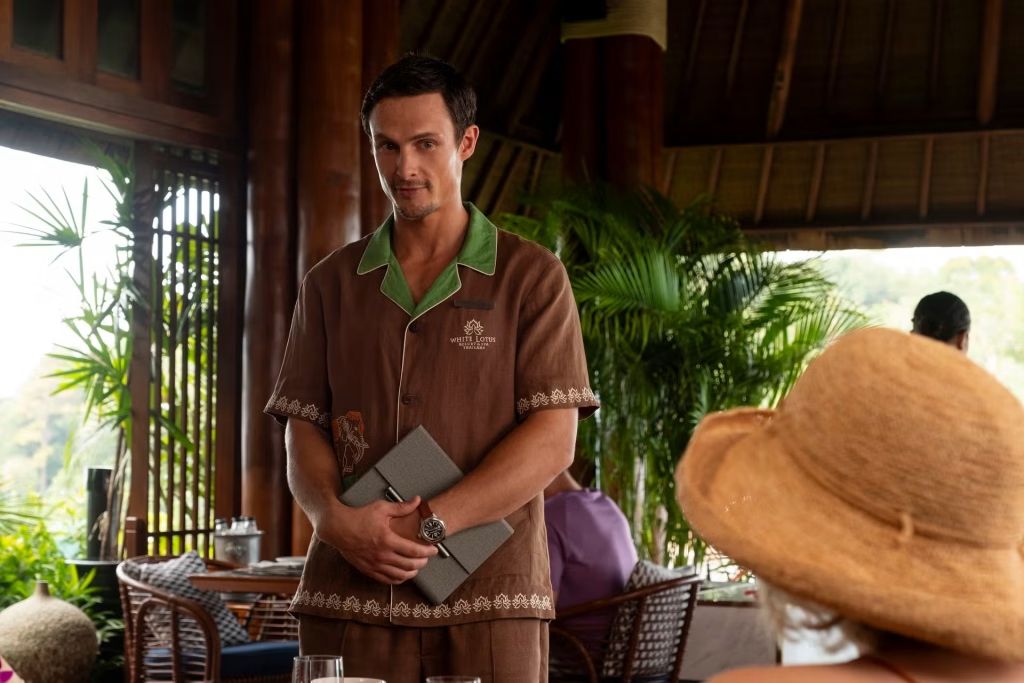
Valentin enters the White Lotus under the guise of a mysterious Russian “health coach,” projecting calmness and expertise in wellness. But as the story unfolds, it becomes clear that he has far more complex motives than simply guiding guests toward relaxation. He is eventually revealed as a central figure in the hotel’s jewelry heist, part of a cunning trio orchestrating chaos from behind the scenes.

His wardrobe mirrors this duality. While he maintains the appearance of a standard resort employee, subtle details like his Vostok Amphibian watch nod to his Russian heritage and hint at his hidden agenda. These small touches reinforce the idea that Valentin is always calculating, blending seamlessly into the environment while keeping viewers guessing.

Valentin’s interactions with the guests, particularly Jaclyn, reveal a character who thrives in ambiguity. He is charming yet dangerous, a figure who embodies the season’s themes of deception and blurred morality. His presence is both a source of intrigue and tension, leaving a lasting impression as one of the season’s most enigmatic figures.

11. Sritala
Sritala, the owner of the Koh Samui White Lotus, is the ultimate portrait of opulence. She is unapologetically extravagant, her wardrobe a glittering display of diamonds, emeralds, and statement pieces, including a David Webb monkey brooch and a $380,000 Jacob & Co. Fleurs de Jardin watch shaped like a butterfly pollinating flowers. Each piece is a declaration of her wealth and status, signaling that she is firmly at the top of the social hierarchy.

Beyond the surface, her taste for ostentation reflects a deeper fascination with power and control. Recurring animal motifs in her jewelry suggest primal instincts at play, hinting that beneath her polished exterior lies a cunning awareness of the dynamics around her. Sritala uses her aesthetic as armor, both projecting dominance and subtly influencing the people around her.

Interactions with staff and guests alike reveal a woman confident in her authority, yet slightly removed from the chaos she oversees. She is a living symbol of the resort’s lavish excess, reminding everyone that even in a place built for leisure, money and power dictate behavior and influence outcomes.

10. Saxon Ratliff
Saxon Ratliff, the eldest of the Ratliff siblings, embodies hyper-masculinity and inherited privilege. From the moment he arrives at the resort, his persona screams wealth and entitlement, exemplified by his $23,000 Hublot Big Bang Unico Black Magic watch. However, as the season progresses, Saxon subtly shifts toward a more understated style, swapping it for a Rolex Milgauss, a visual hint that there may be more complexity to his character than just brash confidence.

While Saxon’s humor and behavior often cross boundaries, revealing misogynistic tendencies and a love for provocation, the narrative allows glimpses of introspection. His engagement with astrology through Chelsea’s books and moments of personal reflection suggests a young man wrestling with identity, trying to reconcile familial expectations with his inner self.

Saxon’s arc serves as a microcosm of the Ratliff family’s unraveling. He oscillates between cringe-worthy arrogance and vulnerable authenticity, making him a character who simultaneously frustrates and fascinates viewers. His journey is one of subtle transformation within a family teetering on the edge of collapse.

9. Lochlan Ratliff
Lochlan, the youngest Ratliff, is the sibling most adrift in the family’s turbulent sea of privilege and dysfunction. His journey swings between extremes, from intimate encounters with Chloe to a taboo exploration with Saxon, even contemplating monastic life alongside his sister Piper. These experiences form a chaotic path of self-discovery, highlighting his search for purpose and identity.

His wardrobe mirrors this inner turmoil. The playful “Talk to Me About a Reality Check” tee, the alligator-printed Tombolo shirt, and his glow-in-the-dark Omega x Swatch Saturn watch are visual markers of both his naivete and the life lessons he is forced to navigate. Each choice tells a story of uncertainty, experimentation, and personal growth.

Lochlan’s arc combines dark comedy and tragedy. His explorations of intimacy, spirituality, and familial bonds underscore the season’s fascination with privilege, authenticity, and the consequences of both reckless and thoughtful decisions. Through him, viewers witness the awkward and sometimes painful process of growing up in a chaotic world.

8. Piper Ratliff
Piper Ratliff’s storyline is fueled by curiosity and a desire for enlightenment. Intending to interview a monk for her thesis, she arrives at the White Lotus seeking something beyond materialism, a glimpse into spirituality and self-understanding. Her idealism, however, is repeatedly challenged by the realities of resort life and her family’s distractions.

Her journey is marked by tension between aspiration and comfort. Piper’s rejection of her monastic ambitions, due to something as trivial yet telling as the food not being organic enough, speaks volumes about the limits of privilege and idealism when faced with inconvenience. It’s a sharp, satirical commentary on the gap between intention and action.

Relationships, particularly with her mother, Victoria, further shape her arc. Victoria’s disdain for Piper’s pursuits and her own preoccupations with status amplify the generational and moral conflicts within the family. Piper’s story explores the difficult reconciliation of personal values, familial expectations, and the compromises that come with growing up in an affluent environment.

7. Timothy Ratliff
Timothy Ratliff, the family patriarch, faces an unraveling, both internal and external. Beneath his genteel Southern manner lies a mounting financial crisis, with embezzlement charges threatening to destroy his carefully curated world. Maintaining control while facing these pressures becomes a central tension of his arc.

His wardrobe choices, particularly his gold Rolex Day Date-40 that matches Victoria’s, symbolize the intertwined fates of the couple, reflecting both shared history and the cracks in their relationship. Timothy’s struggle is often masked by humor or charm, yet moments like the attempted murder-suicide underscore the darkness lurking beneath his polished exterior.

Portrayed with a mix of pathos and privilege, Timothy’s journey is a commentary on the fragility of the American dream. His character illustrates how wealth, status, and family can be both a source of identity and a crucible of pressure, leading to profound consequences for himself and those around him.

6. Victoria Ratliff
Victoria Ratliff, brought vividly to life by Parker Posey, is both loathsome and magnetic. Her mix of materialism, naïveté, and outspoken commentary makes her impossible to ignore. She is a “woman-child” from a privileged background, and her behavior reflects both the indulgences and insecurities of someone unaccustomed to accountability.

Her wardrobe is an intricate language of status and personality, featuring high-end labels like Rachel Comey, Lanvin, Stella McCartney, a $37,000 Rolex, and a $285,000 David Webb necklace. These pieces operate as both armor and assertion, reinforcing her identity while highlighting her detachment from ordinary concerns.
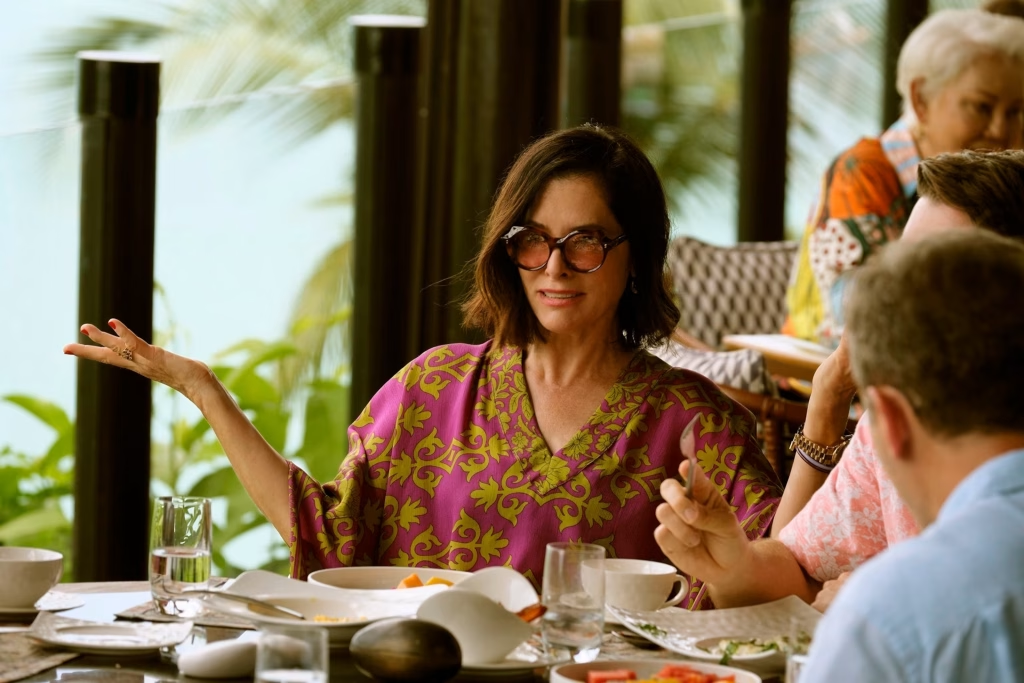
Victoria’s social interactions, influenced by substance use and sharp privilege, produce some of the season’s most memorable moments. From viral breakfast snubs to awkward attempts at control, she embodies the absurdities of wealth and entitlement while also captivating viewers with her unapologetic presence.

5. Chelsea
Chelsea, portrayed by Aimee Lou Wood, quickly becomes a fan favorite through her combination of charm, optimism, and vulnerability. Her free-spirited, bohemian style signals her individuality, but her journey is fraught with life-threatening challenges that test her resilience.

Her signature necklace, a diamond-studded dog tag engraved with “Stay Gold,” serves as a symbolic anchor, evoking innocence, fragility, and the transient nature of happiness. Chelsea’s fate, threatened by both human malice and natural dangers, underscores the precariousness of purity in a world dominated by wealth and chaos.

Her relationship with Rick amplifies her story’s emotional weight. Chelsea’s youthful optimism and energy contrast sharply with Rick’s haunted past, creating a poignant dynamic that enhances the tragedy of her arc. Her presence brings warmth, hope, and ultimately a sense of loss that resonates long after the season concludes.

4. Rick
Rick, Chelsea’s older and troubled partner, is a complex figure defined by both vengeance and restraint. Haunted by past trauma, he arrives at the resort prepared for confrontation, wielding both a gun and a thirst for justice, yet his internal struggle governs his actions more than impulsive anger.

His understated fashion choices, vintage Hawaiian shirts, and simple jewelry serve as a visual metaphor for his attempt to maintain calm in the midst of chaos. Rick’s restraint is notable when he confronts his father’s killer, choosing to step away rather than exact violence, subverting expectations.

Despite his self-control, Rick inadvertently catalyzes Chelsea’s tragic death, showing that even those who strive for morality can have unintended consequences. His arc examines age, trauma, and the moral ambiguities that define human relationships, adding layers to the season’s exploration of cause and effect.

3. Kate, Jaclyn, and Laurie
The trio of Kate, Jaclyn, and Laurie offers a nuanced exploration of female friendship and social navigation. Their dynamics revolve around shifting alliances, with humor, gossip, and rivalry shaping their interactions. Each woman’s wardrobe reflects her character: Jaclyn’s bold designer looks demand attention, Kate’s conservative floral sundresses hint at her Texas roots, and Laurie’s practical resort wear signals her status as an outsider.

Throughout the season, their relationships evolve in response to the absurdities of the resort. Moments of vulnerability and confrontation deepen their connection, revealing the complexities of lifelong bonds tested under pressure. The show uses these interactions to dissect themes of loyalty, envy, and self-awareness.

Laurie’s closing reflections on friendship provide a resonant insight into the season’s underlying human truths. The trio’s journey elevates them beyond comic relief, showing how social hierarchies and personal histories intersect in ways both entertaining and profound.

2. Belinda
Belinda, returning from Season 1 and portrayed by Natasha Rothwell, emerges as a stabilizing force in the resort’s whirlwind. Her role as a spa entrepreneur highlights themes of hope, agency, and visibility, offering a contrast to the excesses and moral ambiguities surrounding her.

This season, Belinda’s story gains depth, emphasizing representation and the importance of shared experience. Her silent, meaningful connections with other Black guests reflect both her empathy and her perspective on spaces traditionally dominated by privilege.

Her quiet presence and thoughtful choices make Belinda a moral touchstone within the narrative. Through her, viewers see the possibility of integrity, resilience, and warmth in a world often defined by chaos, entitlement, and deception.

1. Gaitok
Gaitok, the resort’s security guard, is the embodiment of the season’s moral core. Torn between his Buddhist principles and the violent demands of his position, he confronts the complexities of duty, morality, and masculinity.

His arc is a meditation on choice and consequence, as he weighs leaving the job to preserve his ethics or staying to maintain social order. Each decision carries personal and symbolic weight, reflecting the tension between spiritual ideals and worldly pressures.

Gaitok’s quiet strength, empathy, and moral courage define the season’s emotional resonance. As the moral heart of Season 3, his journey leaves a lasting impression, illustrating that heroism can manifest not in grand gestures but in the disciplined, thoughtful choices we make in everyday life.

Season 3 of The White Lotus proves once again that character is king. From chaotic guests and morally ambiguous staff to quiet moral anchors, the season’s ensemble paints a vivid picture of privilege, identity, and human folly. Each character, with their distinct wardrobe, personality, and narrative arc, contributes to a tapestry of intrigue, comedy, and tragedy, solidifying the series as a sharp, compelling meditation on wealth, desire, and the human condition.