


Historical dramas often live or die by how well they balance truth and storytelling. While some productions sacrifice accuracy for spectacle, others go the extra mile to respect real events, real people, and the complex circumstances that shaped them. When done right, historical accuracy doesn’t limit a story—it deepens it.

This ranked list highlights TV shows and films that made a serious effort to stay grounded in reality. While no dramatization is flawless, these titles stand out for their research, attention to detail, and commitment to honoring history rather than rewriting it.

17. Hacksaw Ridge
Hacksaw Ridge recounts the extraordinary true story of Desmond Doss, a World War II combat medic who refused to carry a weapon but repeatedly risked his life to save others. The film doesn’t sanitize combat, instead presenting the Battle of Okinawa as chaotic, violent, and emotionally overwhelming.

Although certain moments are heightened for dramatic impact, Doss’s unwavering faith, moral convictions, and acts of heroism closely align with historical records. The film succeeds not because it’s flawless, but because it remains sincere in honoring a man whose courage stood out even in the horrors of war.

16. American Sniper
American Sniper follows the life of Chris Kyle, focusing on his multiple tours in Iraq and his struggles adjusting to life back home. Rather than presenting a traditional war spectacle, the film places heavy emphasis on the psychological toll combat takes on soldiers and their families.

Some scenes are undeniably dramatized, but the emotional core of Kyle’s experience remains authentic. The film’s portrayal of PTSD, moral conflict, and emotional isolation reflects the realities faced by many veterans, making it an important, if controversial, historical portrait.

15. Lion
Lion tells the remarkable true story of Saroo Brierley, who was separated from his family as a young child and adopted overseas. Decades later, guided by fragmented memories, he begins an emotional journey to reconnect with his past.

While the film condenses timelines for narrative flow, its central events are faithfully portrayed. Lion’s strength lies in its honesty about memory, identity, and the long-lasting effects of childhood trauma, all grounded in real experiences.

14. Philomena
Philomena explores the painful legacy of forced adoptions in Ireland through the true story of a woman searching for her lost son. The film pairs her emotional journey with investigative journalism, uncovering decades of secrecy and injustice.

Though some interactions are dramatized, the historical reality remains intact. The film’s restraint, compassion, and emotional clarity allow it to convey difficult truths without exploitation, giving weight to a story that demands to be remembered.

13. Hidden Figures
Hidden Figures brings long-overdue recognition to three Black women whose work was instrumental to NASA’s early space missions. Their mathematical brilliance helped propel America into orbit during the height of the Space Race.

While some obstacles are symbolized rather than shown exactly as they happened, the women’s achievements and challenges are rooted in documented history. The film succeeds by making complex science and social barriers accessible without diminishing their importance.

12. The King’s Speech
The King’s Speech focuses on King George VI’s struggle with a severe speech impediment during a time of rising global tension. The film humanizes leadership by showing vulnerability rather than authority.

Though certain timelines and character dynamics are adjusted, the emotional truth of George VI’s journey remains historically sound. Its attention to period detail and psychological nuance makes it both accurate and deeply personal.

11. Spotlight
Spotlight chronicles the Boston Globe’s real investigation into systemic abuse within the Catholic Church. The film avoids sensationalism, instead emphasizing persistence, accountability, and journalistic integrity.

Many scenes are based directly on real interviews, documents, and reporting methods. The film’s commitment to accuracy strengthens its impact, turning a procedural investigation into a powerful historical record.

10. The Terror
The Terror fictionalizes the doomed Franklin Expedition with supernatural elements layered on top of a real historical disaster. Beneath the horror lies meticulous research into 19th-century Arctic exploration.

Everything from naval procedures to survival challenges reflects documented reality. Even with creative liberties, the show remains grounded in the psychological and physical realities of isolation and failure.

9. John Adams
John Adams presents an unglamorous look at the founding of the United States through the eyes of its second president. Rather than heroic mythmaking, the series emphasizes uncertainty, disagreement, and political compromise.

Its attention to historical letters, speeches, and relationships lends authenticity. The series makes early American history feel lived-in, complex, and deeply human.

8. The Pacific
The Pacific portrays World War II’s Pacific Theater through the personal experiences of U.S. Marines. Drawing heavily from memoirs, it prioritizes emotional truth over battlefield spectacle.

The series captures exhaustion, fear, and moral disintegration with painful realism. Its unfiltered approach makes it one of the most accurate depictions of war’s psychological cost.

7. The Knick
The Knick transports viewers to early 1900s New York, where medical innovation collided with ignorance and desperation. The series explores surgical experimentation, addiction, and systemic inequality.

Built on extensive research, the show depicts medical practices as they truly were—often dangerous and unethical. Its historical accuracy enhances the drama rather than distracting from it.
6. Boardwalk Empire
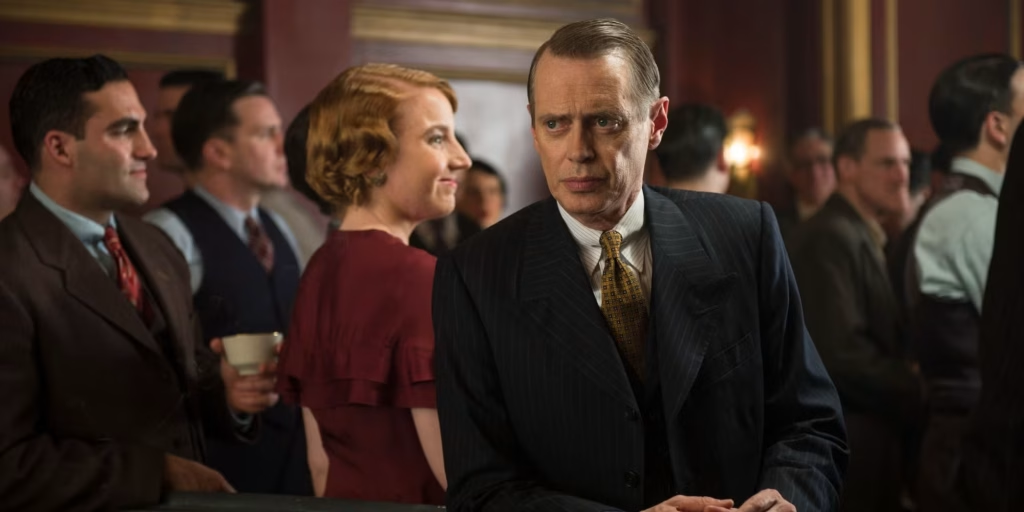
Boardwalk Empire explores the criminal and political landscape of Prohibition-era America. Real historical figures coexist with fictional characters to paint a larger portrait of corruption and ambition.

While storylines are dramatized, the cultural, economic, and political realities are carefully reconstructed. The show excels at making history feel immersive and alive.

5. Pride and Prejudice (1995)
This adaptation of Jane Austen’s novel remains a benchmark for period accuracy. Every aspect, from social etiquette to dialogue, reflects Regency-era norms.

The careful attention to costume, setting, and pacing allows the story to unfold naturally. Its faithfulness to both history and source material has earned lasting praise.

4. Rome
Rome depicts the collapse of the Roman Republic through political intrigue and personal ambition. The series refuses to romanticize ancient history, instead embracing its brutality.

Though fictional characters guide the narrative, the historical framework remains intact. Rome stands out for its willingness to portray history as chaotic and morally complex.
3. The Crown
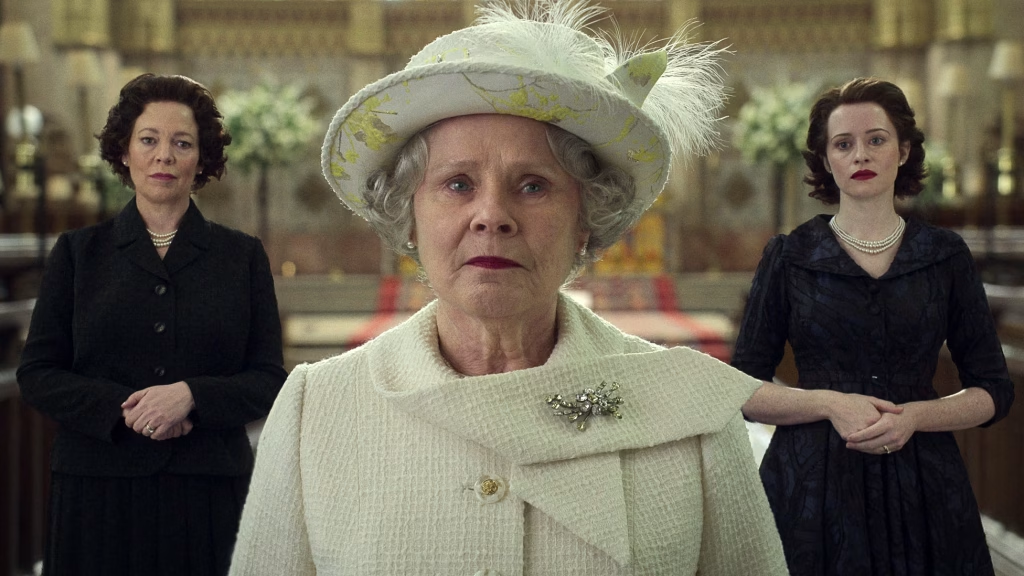
The Crown dramatizes Queen Elizabeth II’s reign with exceptional care and research. Major political moments are grounded in documented events and historical context.

While private conversations are imagined, the emotional and political realities remain credible. The series maintains a careful balance between dramatic storytelling and historical integrity.

2. Chernobyl
Chernobyl reconstructs one of the most devastating disasters in modern history with chilling precision. The series prioritizes factual detail, from reactor mechanics to political denial.

Though some characters are composites, the events themselves are depicted with honesty and restraint. The result is a historical drama where truth alone delivers the horror.

1. Band of Brothers
Band of Brothers is widely regarded as the gold standard for historical accuracy in television. Built from firsthand accounts, it follows Easy Company through Europe during World War II.

Every detail was rigorously vetted, from uniforms to battlefield strategy. The series honors real people with humility and care, making it a definitive example of history done right.

When filmmakers respect history, the stories often become richer and more impactful. Accuracy adds emotional weight, reminding viewers that these events shaped real lives, not fictional worlds. These films and series prove that truth doesn’t need embellishment to be compelling. Sometimes, history itself is more powerful than anything Hollywood could invent.