


Movie productions can be fragile ecosystems. Even talented, well-known actors can find themselves abruptly removed when chemistry falters, creative visions clash, or circumstances spiral out of control. These behind-the-scenes shakeups often change careers, and sometimes cinema history itself. Here are fifteen notable cases where actors were fired mid-production, and what happened next.

15. Kel O’Neill — There Will Be Blood
Kel O’Neill was originally cast as preacher Eli Sunday in Paul Thomas Anderson’s There Will Be Blood, opposite Daniel Day-Lewis. After several weeks of filming, however, it became clear something wasn’t clicking.
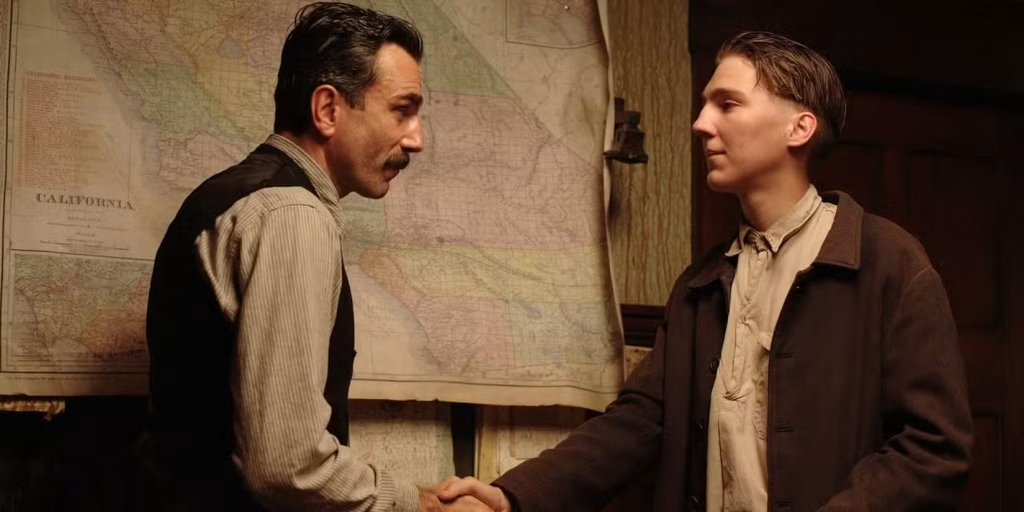
O’Neill later said he sensed the disconnect early on. Anderson decided to replace him with Paul Dano, who was already in the film as Eli’s brother. The script was reworked so Dano played identical twins, resulting in one of the film’s most unforgettable performances. O’Neill ultimately stepped away from acting and found success directing documentaries.

14. Colin Firth — Paddington
Colin Firth had fully recorded his dialogue as the voice of Paddington Bear, but once the animation came together, the filmmakers felt his voice sounded too grown-up for the character.

Firth himself acknowledged the decision with grace, noting that the bear simply wasn’t meant to sound like him. Ben Whishaw was brought in to re-record the role, and his lighter tone helped turn Paddington into a modern family-film icon.

13. James Remar — Aliens
James Remar spent nearly a month filming Aliens as Corporal Hicks before being dismissed. Officially, the explanation was “creative differences,” but Remar later admitted his firing followed a drug-related arrest during production.

Reports also described disruptive on-set behavior, including accidentally firing a prop weapon into a neighboring soundstage. Michael Biehn stepped into the role, delivering a performance that became central to the franchise.

12. Sean Young — Dick Tracy
Sean Young was cast as Tess Trueheart in Dick Tracy, but was removed after producers felt her performance wasn’t landing as intended. Young later claimed she was fired for rejecting advances from Warren Beatty, a claim he denied.

The role ultimately went to Glenne Headly, and the film moved forward successfully. The incident remains a controversial example of how personal and professional conflicts can blur on set.

11. Holly Hunter — Chicken Little
In early development, Chicken Little featured a female protagonist voiced by Holly Hunter. After recording her lines, Disney executives decided to rework the character into a boy, believing it would attract a wider audience.

Hunter was replaced by Zach Braff, and the story was reshaped entirely. While the decision reflected industry thinking at the time, later successes of female-led animated films suggest how much perspectives have shifted.

10. Connor Ratliff — Band of Brothers
Connor Ratliff lost his small role in Band of Brothers just one day before filming began. He was told executive producer Tom Hanks felt he had “dead eyes.”

Years later, Ratliff transformed the experience into the podcast Dead Eyes, exploring rejection in Hollywood. Hanks eventually appeared on the show, owning the decision and offering clarity. What began as a painful dismissal became a thoughtful conversation about art and subjectivity.

9. Dennis Hopper — The Truman Show
Dennis Hopper was originally cast as Christof, the creator of Truman’s artificial world, but struggled early on with memorization and performance consistency.

After reviewing early footage, director Peter Weir and producer Scott Rudin decided to recast the role. Ed Harris stepped in and delivered a quietly haunting performance that earned him an Oscar nomination.

8. Judy Garland — Valley of the Dolls
Judy Garland’s casting in Valley of the Dolls ended disastrously. Conflicts with director Mark Robson, combined with substance abuse struggles, made filming increasingly difficult.

Accounts from co-stars describe a tense environment that worsened Garland’s condition. She was ultimately fired, replaced by Susan Hayward, and reportedly left with her costumes in protest. The episode remains one of Hollywood’s saddest behind-the-scenes stories.

7. Eric Stoltz — Back to the Future
Eric Stoltz played Marty McFly for several weeks, but his intense, method-driven performance clashed with the film’s comedic tone.

The filmmakers quietly continued shooting while arranging to replace him with Michael J. Fox, their original choice. Fox’s arrival reshaped the movie’s energy—and helped turn it into a timeless classic.

6. Harvey Keitel — Apocalypse Now
Harvey Keitel was initially cast as Captain Willard but was let go shortly after production began in the Philippines. Director Francis Ford Coppola felt Keitel wasn’t connecting with the role under the harsh conditions.

Martin Sheen took over, delivering a performance that became legendary. Though the decision was painful, it proved pivotal to the film’s final impact.

5. Lori Petty — Demolition Man
Lori Petty was cast opposite Sylvester Stallone but exited the film after only a few days. Both sides cited creative differences, though Petty later described a personality clash between herself and Stallone.

Sandra Bullock replaced her, launching one of the actress’s earliest breakout roles. The change became a classic example of how chemistry can redefine a movie.

4. Jean-Claude Van Damme — Predator
Jean-Claude Van Damme was initially hired to play the Predator creature, but the role proved impractical. The restrictive suit and stilt-based design made movement nearly impossible.

The production ultimately redesigned the alien and recast the role with Kevin Peter Hall, whose height and presence helped create one of cinema’s most iconic monsters.

3. Lee Coleman — Friday the 13th Part VIII
Lee Coleman was cast as Sean Robertson but was dismissed after about a week. Creative concerns and an injury he sustained during off-hours complicated matters.

Scott Reeves replaced him, and the production moved on quickly. Though minor, the recasting highlighted how unforgiving tight shooting schedules can be.

2. The Voice Cast of The Good Dinosaur
Pixar’s The Good Dinosaur underwent a massive creative reset. Original director Bob Peterson was replaced, and much of the voice cast was let go as the story was reimagined.

Several major roles were recast, with Frances McDormand being the lone actor to remain. The overhaul demonstrated how dramatically animated films can change, even deep into production.

1. Samantha Morton — Her
Samantha Morton originally voiced Samantha, the AI companion in Her, and even performed scenes on set. During post-production, however, Spike Jonze realized the character needed a different emotional texture.

Scarlett Johansson re-recorded the role, infusing it with warmth and immediacy. Though difficult, the change helped define the film’s emotional core and became one of Johansson’s most acclaimed performances.

Being fired from a film doesn’t always reflect a lack of talent; often, it’s about timing, tone, or creative alignment. In several of these cases, the shakeups led to iconic performances and unforgettable movies. Behind every polished final cut lies a story of risk, revision, and sometimes, reinvention.