

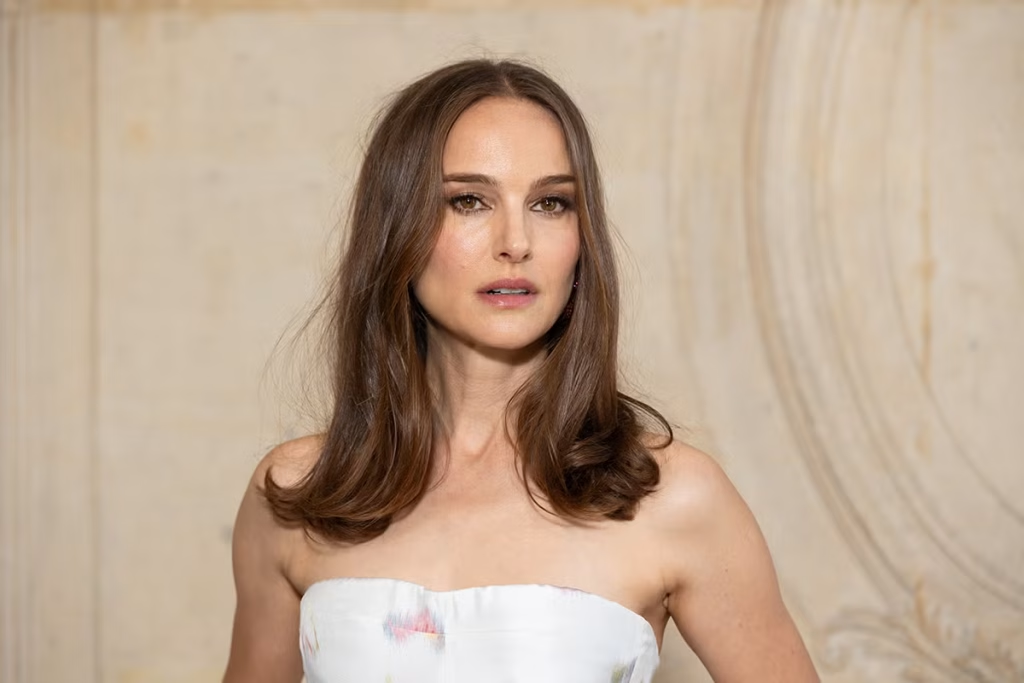
Few actors have navigated Hollywood with the versatility and fearless dedication of Natalie Portman. From her early breakout roles as a child actor to her Oscar-winning performances and daring, experimental projects, Portman has consistently challenged herself and the audience. Here’s a look at ten of her most memorable performances that not only showcased her talent but also cemented her place as one of the most influential actresses of her generation.

10. V for Vendetta
In this dystopian thriller directed by James McTeigue and produced by The Wachowskis, Portman plays Evey Hammond, an ordinary young woman swept into a revolutionary movement against a totalitarian regime. The film blends political allegory with personal awakening, giving Portman ample room to chart a powerful transformation.

Her portrayal begins with palpable fear and uncertainty, grounding the heightened world in human vulnerability. As Evey’s understanding deepens, Portman gradually shifts her performance toward defiance and resolve, making the character’s evolution feel earned rather than symbolic.

The now-infamous head-shaving sequence remains one of the most unforgettable moments of her career. It captures both physical sacrifice and emotional liberation, underscoring her willingness to commit fully to a role’s demands while anchoring the film’s sweeping ideas in intimate experience.

9. Vox Lux
In Brady Corbet’s stylized meditation on fame and trauma, Portman plays Celeste, a pop star shaped by tragedy and spectacle. Though she appears later in the film, her arrival radically shifts its energy, turning it into a volatile character study.

Portman leans into Celeste’s contradictions, arrogance, and fragility, charisma, and self-destruction. Her physicality, accent work, and commanding stage presence create a fully embodied portrait of celebrity as both armor and prison.

While the film divided critics, Portman’s performance was widely praised for its boldness. She embraces the character’s messiness without softening her edges, proving once again that she thrives in challenging, polarizing material.

8. The Other Boleyn Girl
Opposite Scarlett Johansson, Portman portrays Anne Boleyn with a blend of ambition, intelligence, and emotional volatility. The historical drama framework could easily have reduced the character to cliché, but Portman resists simplicity.

She captures Anne’s shifting motivations from romantic yearning to political calculation with layered subtlety. Each glance and tonal shift suggests a woman navigating power structures stacked against her.

By infusing Anne with vulnerability beneath the ambition, Portman elevates the film beyond courtly intrigue. Her performance reveals the human cost behind historical legend, adding emotional depth to a well-worn story.

7. Anywhere but Here
At just 18, Portman starred opposite Susan Sarandon in this mother-daughter drama. Playing Ann, a grounded teen uprooted by her mother’s impulsive decisions, Portman demonstrates maturity well beyond her years.

The film relies heavily on the chemistry between its two leads, and Portman more than holds her own. She portrays adolescent frustration and longing with authenticity, never slipping into melodrama.

This role marked a pivotal transition in her career. It signaled that she was not merely a gifted child actor but a formidable young performer capable of anchoring emotionally complex narratives.

6. Léon: The Professional
Portman’s breakout role as Mathilda introduced audiences to an extraordinary new talent. At just 12 years old, she navigated a morally complex and controversial story with remarkable poise.

Her performance balances grief, rage, and premature maturity, creating a character who is both hardened by trauma and achingly vulnerable. The emotional clarity she brings to Mathilda remains striking decades later.

Despite ongoing debate about the film’s themes, Portman’s work is widely regarded as astonishingly assured. It laid the groundwork for a career defined by emotional intelligence and fearless choices.

5. Black Swan
In Darren Aronofsky’s psychological thriller, Portman delivers perhaps her most transformative performance as Nina, a ballerina unraveling under the pressure of perfection. The role demanded intense physical preparation and psychological immersion.

She trained rigorously in ballet, embodying Nina’s discipline and fragility through precise physical control. As the character’s mental state deteriorates, Portman subtly fractures that control, letting paranoia seep into every movement.

The result earned her an Academy Award and remains a landmark in modern cinema. Her portrayal of obsession and duality is haunting, visceral, and unforgettable.

4. Closer
Directed by Mike Nichols, Closer features Portman among an ensemble that includes Julia Roberts and Jude Law. As Alice, she portrays a woman navigating manipulation, desire, and emotional vulnerability.

Portman’s performance is subtle yet commanding. She shifts effortlessly between innocence and sharp self-awareness, ensuring Alice never feels passive or one-dimensional.

Her work earned her first Academy Award nomination and confirmed her ability to tackle adult, emotionally charged material with sophistication and restraint.

3. May December
In Todd Haynes’ layered drama, Portman plays Elizabeth Berry, an actress researching a controversial real-life figure. The film explores how performance itself is constructed, borrowed, and manipulated.

Portman approaches the role with self-conscious precision, allowing viewers to see Elizabeth studying and subtly mimicking her subject. The result is a performance within a performance.

This meta-quality underscores Portman’s fascination with craft. She dissects the art of acting while fully committing to the character, creating a richly cerebral portrayal.

2. Jackie
In Jackie, Portman portrays Jacqueline Kennedy Onassis during the days following President Kennedy’s assassination. Rather than offering simple imitation, she focuses on emotional truth.

Her voice work and physical restraint capture Jackie’s public composure, while fleeting expressions reveal profound private grief. The tension between image and reality defines the performance.

The role earned her widespread acclaim and another Oscar nomination. It stands as one of her most controlled and devastating portrayals, blending historical reverence with intimate humanity.

1. Natalie Portman’s Legacy: Performance, Risk, and Authenticity
Across decades in Hollywood, Portman has consistently chosen roles that interrogate identity, power, and vulnerability. From child prodigy to fearless leading lady, her trajectory reflects careful artistic evolution rather than complacency.

She frequently portrays women grappling with internal and external expectations, challenging reductive archetypes. Whether in intimate dramas or psychological thrillers, her performances prioritize emotional authenticity over spectacle.

Portman’s legacy lies not just in awards or acclaim, but in her insistence on complexity. She has helped redefine what leading roles for women can look like, layered, daring, and unapologetically human.

From her astonishing debut to her most daring adult performances, Natalie Portman has built a career rooted in intelligence and courage. She embraces characters who are flawed, searching, and deeply alive, refusing to flatten them into stereotypes. In doing so, she has shaped modern cinema’s understanding of female protagonists not as symbols, but as intricate individuals. Her body of work stands as proof that risk, discipline, and authenticity remain the most powerful tools an actor can wield.